Founding Partner Program: one builder per cityMonth one free while we build, then $1,997/month plus ad spendAt least 35 qualified leads in 90 days of paid serviceOnly 3 new builds a monthYour domain, accounts and leads stay yoursApplication based: see if you qualifyFounding Partner Program: one builder per cityMonth one free while we build, then $1,997/month plus ad spendAt least 35 qualified leads in 90 days of paid serviceOnly 3 new builds a monthYour domain, accounts and leads stay yoursApplication based: see if you qualify

SFWeb Tech.
HVAC SEO

HVAC SEO for heating and cooling contractors

HVAC SEO from SF Web Tech helps established heating and cooling companies show up when homeowners in their service area search for emergency service, a system replacement or a maintenance plan. We work on your Google Business Profile, your system service pages and your local search presence, then track which searches turn into calls and booked visits. We work remotely with US home service businesses and never invent a local office for your listing or ours.

Illustration of a home with outdoor HVAC condenser units and a thermostat dial

Why SEO for HVAC companies is harder than it looks

These are the problems we see most often.

Demand swings with the weather.

A heat wave or a cold snap sends every homeowner in the metro searching at once. Companies with a complete profile, recent reviews and pages that answer the question of the moment get the calls. The rest watch the spike pass.

One page tries to rank for every system.

A single "Services" page that lists AC, furnaces, heat pumps, mini-splits, ductwork and air quality gives Google nothing specific to rank, so none of those searches lands on a page built to answer it.

Your Google Business Profile does not match the work.

The wrong primary category, a service area full of towns your trucks never reach, missing services and stale photos quietly hold the profile back in the map results.

Emergency and replacement leads get treated the same.

A no-heat call at nine at night and a planned system replacement are different buyers on different timelines. Marketing that cannot tell them apart wastes the fast one and underserves the slow one.

Nobody knows which searches produced jobs.

Calls, forms and texts land in different places, the same homeowner gets counted twice, and nobody can say whether search brought in real installs or just noise.

The HVAC search year: cooling peaks, heating peaks and the shoulder seasons

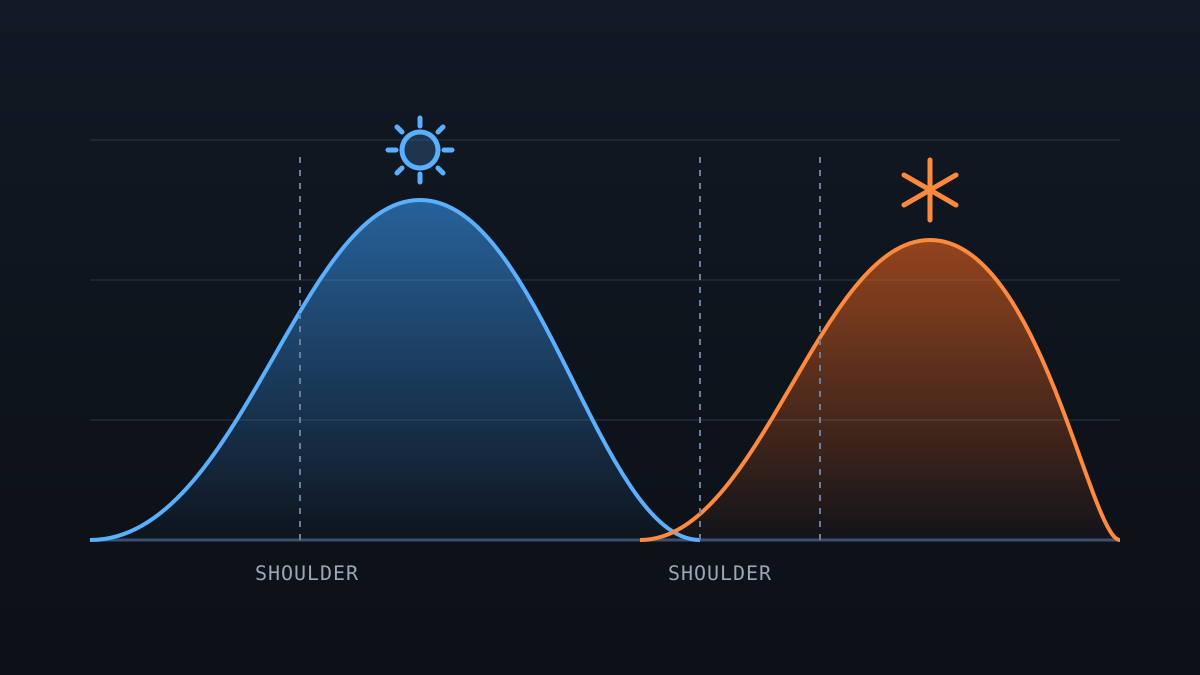
HVAC demand is seasonal in a way most trades are not, and the search volume moves with it. A plan that runs flat all year misses the two peaks and wastes the quiet months. The point of an HVAC SEO calendar is simple: build and index the content for a season before that season arrives, because there is no time to build it once the phones are ringing.

The cooling peak

When the first stretch of hot weather hits, air conditioning searches climb fast: no cold air, AC not working, emergency AC repair. This is urgent, same-day demand, and it rewards an accurate profile, recent reviews and a clear AC repair page far more than a cost guide. The companies that win it prepared in spring, before the heat.

The heating peak

When temperatures drop, the pattern repeats on the heating side: no heat, furnace not working, heat pump blowing cold. The same urgency, the same reward for being ready. Furnace and heat pump pages built and indexed in early fall are the ones earning trust when the first freeze arrives.

Diagram of a cooling demand peak and a heating demand peak across a year with shoulder seasons between

The shoulder seasons

Between the peaks sit the shoulder seasons, and they are where the planned work lives. Early spring is the window for AC tune-ups and replacement research before summer; early fall is the window for furnace tune-ups, maintenance plans and heat pump planning before winter. This is lower-urgency, higher-consideration demand, and it rewards cost explainers, system comparisons and maintenance-plan pages rather than an emergency page.

The practical rule is to build urgent service content in the off-season so it is already ranking when the weather turns, and to improve replacement and maintenance content steadily, because that planner is researching all year. Our guide to why HVAC websites get traffic but no phone calls covers how to turn that seasonal traffic into booked work.

Three ways homeowners search for HVAC

HVAC demand does not come from one kind of search. It comes from three, and they behave so differently that one message cannot serve all of them. Good HVAC SEO maps each intent to the page and the next step that fit it.

Emergency service

No heat, no cooling, a system that quit. The homeowner searches fast, reads a couple of listings and calls the first credible company that answers. There is no comparison shopping and no reading a cost guide. What wins is an accurate profile, visible reviews, an easy-to-tap phone number and a page that says plainly that you handle that repair in that area.

Replacement

A planned system replacement is a larger, slower decision. Homeowners compare equipment, read about efficiency and cost drivers, look at financing and rebates and think it over before they call. That demand runs all year and it rewards cost explainers, system comparisons, finished-job examples and clear financing and rebate pages, not an emergency page.

Three panels representing emergency service, system replacement and maintenance agreement searches

Maintenance agreements

Tune-up and maintenance-plan searches are their own intent, and they are the one that builds recurring revenue and a book of customers who call you first when something breaks. A maintenance-plan page that explains what a membership includes, when to schedule and why it matters captures a buyer most HVAC sites ignore. Our article on what marketing should cost per booked HVAC replacement explains why the lifetime value of these customers changes the math.

Where an HVAC company actually shows up on Google

A single search for an HVAC company can return three different things stacked on one screen. They are separate products with separate rules, and an HVAC SEO plan should be clear about which one it is working on.

Local Services Ads

These sit at the very top, a pay per lead product with Google screening behind the badge. They can turn on quickly and spike with a heat wave or a cold snap, but they are ads: the spend stops, the leads stop, and they are a separate decision from the organic work on this page.

The Map Pack

The map results below the ads are ranked mostly by your Google Business Profile, your reviews and how close you are to the searcher. There is a real cliff after the first few listings: the homeowner has to tap for more places to see the rest, and most do not. This is where review velocity and an accurate profile earn their keep.

Phone search result showing an ads row, a map pack with three pins and an organic results list

Organic results

Below the map sit the classic blue links, ranked by your pages, content and links. This is where system pages, cost explainers and maintenance-plan pages earn their place, and where the considered replacement buyer often spends the most time before calling.

One thing surprises a lot of HVAC owners: map results are built around the searcher, not your shop. A rank you check from your own office is not the rank a homeowner sees across town, so honest reporting looks at more than one point on the map. For the profile and map side in depth, see our local SEO for contractors overview.

How our HVAC SEO works

We start with the work you want more of, in the towns you serve, and build your organic presence around it.

Local SEO for HVAC: your Google Business Profile first

The profile is often the first thing a homeowner sees. We fix categories, services, service area, hours and photos, keep them accurate, post updates and run a review request workflow that follows Google's rules.

A service page for each system you sell

People do not search for "HVAC services." They search for AC repair, furnace replacement, heat pump installation or a specific brand. Each system you want to sell gets its own page, with the questions homeowners ask before they call and a clear next step.

Service area pages only where you really work

No page for every ZIP code. We build area pages only where you have technicians, real jobs and something specific to say. Copies with a different city name can hurt more than they help.

Illustration of an HVAC technician with a headset beside an outdoor condenser unit

Technical SEO and a site that works on a phone

Fast pages, clean indexing, correct schema and a phone number that is easy to tap, because a homeowner with no cooling is searching on their phone and will not wait for a slow site.

Measurement you can read

We set up Search Console plus call and form tracking, so you can see which pages and which seasons produced real inquiries, not just clicks.

Want to know what is holding your HVAC SEO back? Book a free strategy call and we will look at your profile, site and service area with you.

Google Business Profile categories and rules HVAC companies get wrong

Most HVAC companies are a service area business: the technician drives to the home, the homeowner does not visit a showroom. Google has guideline principles for that kind of listing, and the profile details decide a lot of your map results. Categories and review habits are where we see the most left on the table.

  • Set the right primary category. For most of these businesses the primary category is "HVAC contractor," with secondaries such as "Air conditioning contractor," "Heating contractor" and "Furnace repair service" chosen to match the work you actually do, not a long list meant to game every search.
  • Hide the address if customers do not come to you. A service area business is meant to show the towns it serves, not a street address the public never visits. A rented mailbox or virtual office is not an eligible location.
  • Do not keyword-stuff the business name. The name field is for your real business name. "City Heating and Cooling AC Repair Experts" is against the rules, even when a competitor gets away with it for a while.
  • Build review velocity, not a one-time push. A steady flow of recent reviews that name the service and the town does more for the Map Pack than a burst before a busy season. Ask after a completed job, and never offer anything in exchange, which is against Google review policy.
  • Use a number that reaches you. A tracking number is fine as long as it forwards to the business and matches how you answer, because a missed call goes to the next HVAC company on the list.
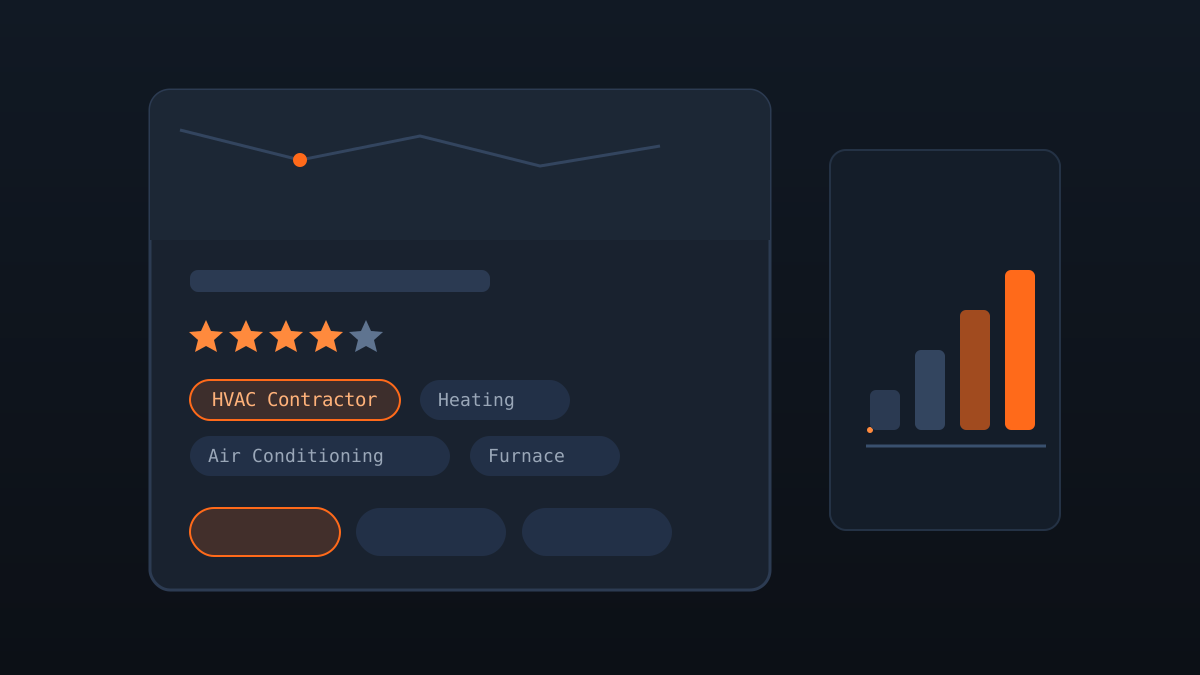
Mock Google Business Profile card with HVAC category chips, star reviews and a review trend

These are Google guideline principles, not legal advice, and they change over time. The point is simple: an accurate, actively reviewed profile is more durable than a stuffed one, and it is the one that holds up through a peak season of extra scrutiny.

A page for every system you install and service

Most HVAC websites put air conditioning, heating, heat pumps, ductwork and air quality on a single services page that ranks well for none of them. Homeowners search by the system and the problem in front of them, so each thing you actually do should earn its own page, built around how people search for it.

Map each system to its own page

We build a page for each system you install and service, and only those you offer. Each one explains who it suits, the questions to ask before buying and the next step, whether that is an emergency call or a design visit.

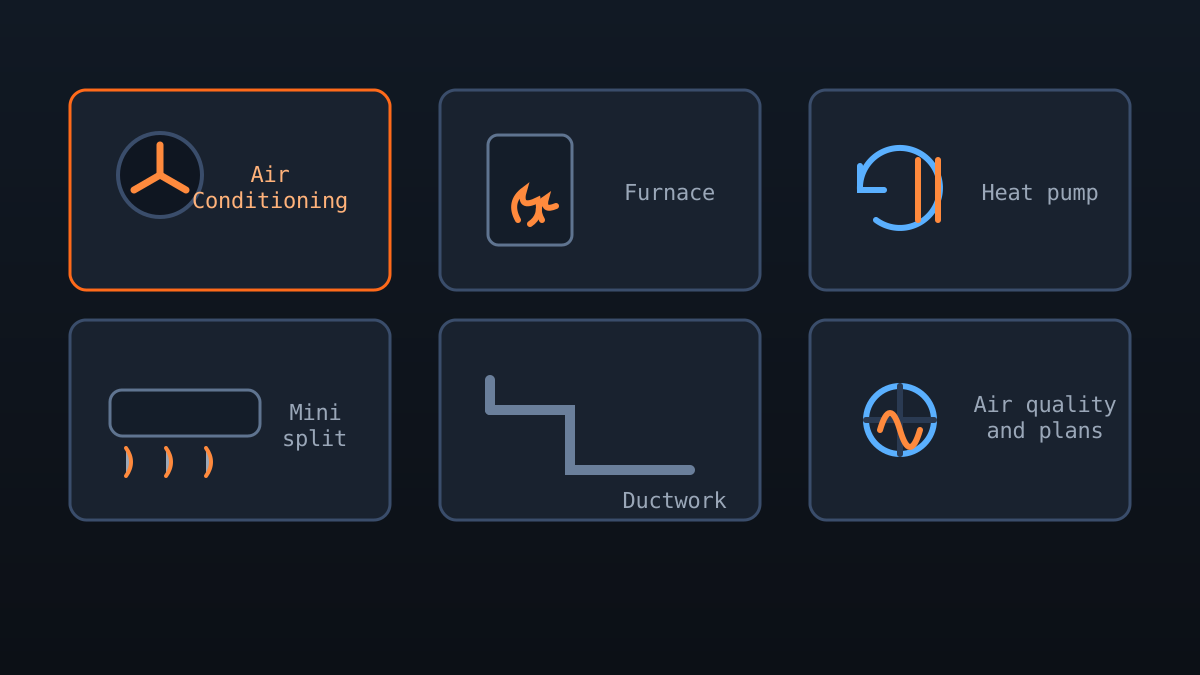
  • Air conditioning repair, replacement and installation as distinct intents, not one AC page.
  • Furnaces, including the repair-versus-replace decision that drives the heating season.
  • Heat pumps, where interest is growing with electrification, and where financing and rebates often decide the sale.
  • Ductless mini-splits for additions, older homes and rooms that never get comfortable.
  • Ductwork, duct cleaning and indoor air quality as the add-on work that lifts an average ticket.
  • Maintenance plans and tune-ups as their own page, because that search has its own intent and its own recurring value.
Grid of HVAC system tiles for air conditioning, furnace, heat pump, mini-split, ductwork and air quality

When several pages chase the same search they compete with each other and none wins. We map each system and each town intent to one primary page, so Google always has a single, clear answer to point a homeowner to. This connects to our wider website SEO work.

Financing and rebate content that reaches replacement buyers

A system replacement is one of the larger purchases a homeowner makes, so the decision often turns on cost, financing and the incentives available. Most HVAC sites say nothing about any of it, which leaves a whole class of high-intent searches uncovered. This is the clearest content gap in the trade, and it is one your competitors are mostly ignoring.

  • Financing pages that explain the options you actually offer, so a homeowner comparing a repair bill against a new system can picture a monthly path forward.
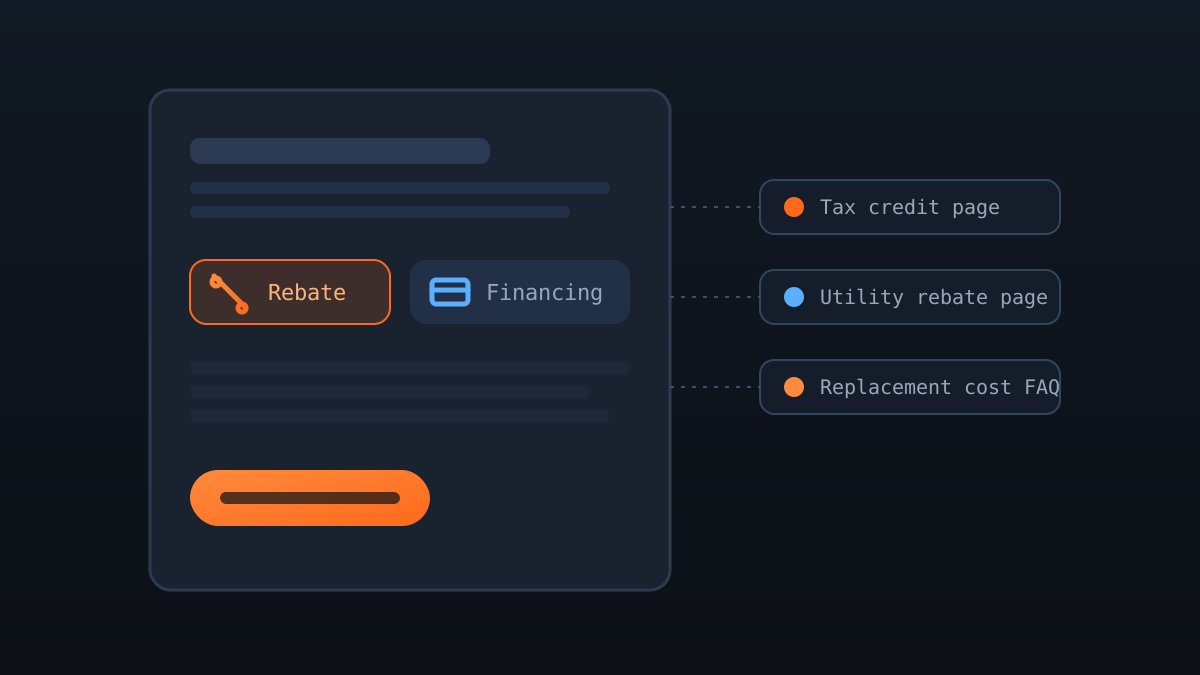
  • Rebate and tax-credit pages built around the real programs your brand, your local utility and public efficiency programs offer, each linked to its official source rather than a number we invent.
  • Cost explainers that treat price as a set of drivers, such as system type, size, efficiency and home conditions, instead of a single made-up figure.
  • Heat pump and high-efficiency pages, where incentives and financing are often what tip a hesitant buyer toward the upgrade.
Mock landing page with financing and rebate badges beside tax credit and utility rebate page tags

We only publish figures you supply and approve, and any public statistic on your pages carries a named, linked source. The goal is honest, useful pages that capture the replacement buyer who is already searching for a way to afford the work, not a wall of invented numbers.

HVAC SEO and AI search

More homeowners now ask an assistant, an AI Overview or a chat tool for the best HVAC company in their city before they ever scroll a results page. The work that earns those mentions is the same work that earns the Map Pack: a consistent profile, reviews, clear system pages and listings that all agree with each other, so an assistant can describe your business from facts it trusts.

We do not claim to rank you inside any assistant or invent an AI visibility score. We keep your entity, your pages and your reviews consistent enough to be quoted, and we treat AI answers and local search as two outputs of the same foundation rather than a separate product.

AI answers and the Map Pack are built on the same foundation: an accurate profile, real reviews and clear pages. See how we build the local side on our local SEO for contractors page.

Our HVAC SEO process

  1. 01

    Strategy call and initial audit.

    We look at your systems, service area, crew capacity, current website, Google Business Profile and any data you already have. The audit is free and you keep the recommendations.

  2. 02

    Baseline.

    We record where you stand: Search Console data, profile insights, calls and forms. Missing numbers are marked as missing, not guessed.

  3. 03

    Foundations.

    We fix the profile, the site structure, tracking and the technical issues that block everything else, ahead of your next peak season.

  4. 04

    Pages and proof every month.

    We add and improve system pages, area pages, cost and rebate content and articles on the schedule in your plan, using real project details you approve.

  5. 05

    Monthly review.

    You get a lead report and a review call. We look at qualified inquiries, where they came from and what to work on next.

What we track for HVAC companies

A ranking is not a booked job. We report two different things and never blur them: the inquiries your search presence produced, and what those inquiries turned into, with duplicates and spam removed.

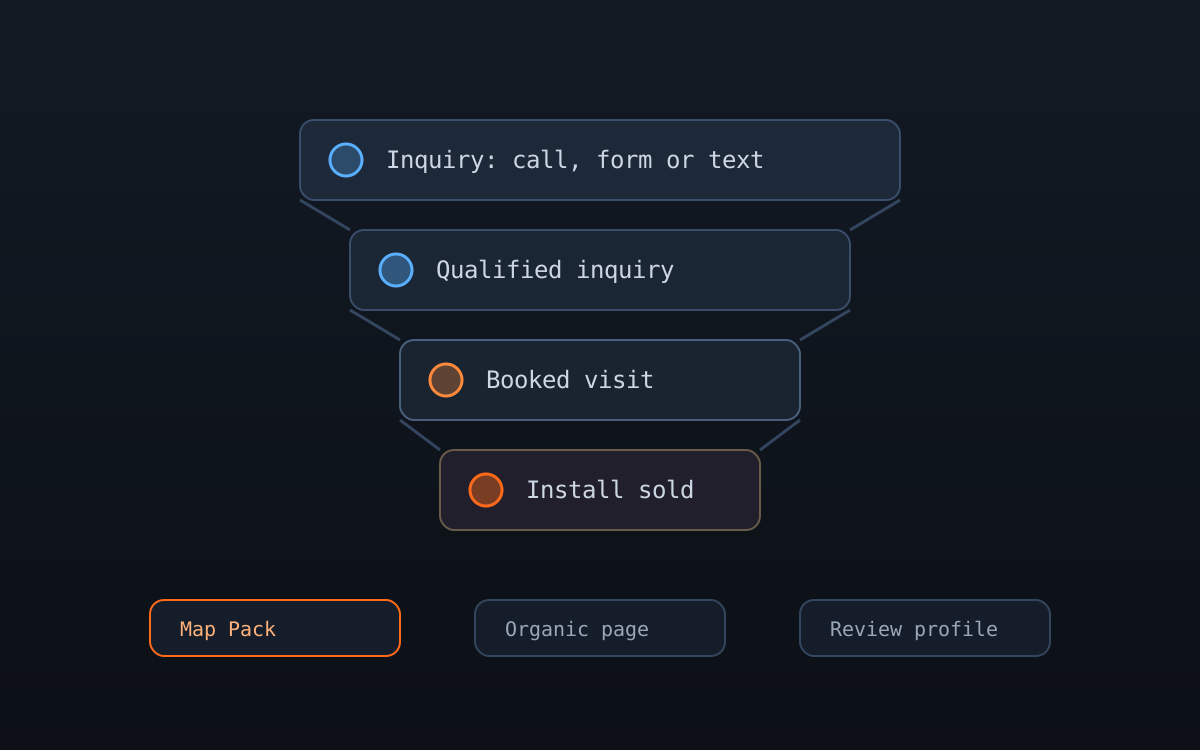
A ladder from search to installed system

We hold the work to the same stages, so you can see where the money really came from and which pages and seasons carried it.

  • Inquiry: a call, form or text that search produced.
  • Qualified inquiry: a homeowner in your area asking about a service you offer.
  • Booked visit: a qualified inquiry that becomes a service call or a design visit on the calendar.
  • Sold job: the repair, replacement or plan that actually pays for the work.

Your forms can also ask the questions your team needs, such as system type, town and whether it is an emergency, so your office spends its time on the inquiries that fit. To model the numbers for your own business, use our Lead and Revenue Calculator and our cost per booked job calculator.

A ranking is not a booked job, so we report the inquiries search produced and what they turned into.
From this page

HVAC SEO results

We keep client results private on this page. On a strategy call we walk you through verified results from comparable high ticket contractor campaigns, under a stated lead definition, so you can judge the work on real data rather than a number borrowed from a stranger.

How to choose an HVAC SEO company

Most of the searches that bring you here, such as hvac seo company and hvac seo agency, are really asking who to trust. A few questions separate a specialist from a reseller.

  • Ask for HVAC-specific examples, and whether the team understands seasonality, emergency versus replacement intent and system pages, or just swaps your name into a template.
  • Ask who owns the site, content and data if you leave, and get the answer in writing.
  • Ask how they report, and whether they measure booked jobs and qualified inquiries, not just rankings and traffic.
  • Walk away from guaranteed number-one rankings, long lock-in contracts and leads resold to several competitors at once. Nobody controls Google's results.

HVAC SEO is one trade inside our broader contractor SEO agency approach. We also run the same system for roofers, pool builders and deck builders.

What an HVAC SEO company should not promise

Be careful with any HVAC SEO company that promises first page rankings by a date. Nobody controls Google's results. We commit to a written plan, honest reporting and work focused on the systems and areas you can actually serve. SF Web Tech works remotely with US home service businesses and never invents a local office or fake address for your listing or ours.

HVAC SEO pricing

Ongoing Google Business Profile management, a custom website, call tracking and Google Ads management are all part of our one offer, the Founding Partner Program. It comes with a written guarantee of at least 35 qualified leads in your first 90 days of paid service. See what is included and how the guarantee works on our pricing page.

The Founding Partner Program is our one offer. Month one is free while we build, with no setup fee. From month two it is $1,997 a month, all in. Google Ads spend is separate, at least $1,500 a month paid to Google. The first 90 days of paid service are the commitment, then it is month to month with 30 days' notice.

Want calls while SEO builds?

Organic search takes time. If you need service and replacement calls sooner, read our guide to Google Ads for HVAC contractors and companies, which is the paid side of the same strategy. For the local map and profile side, see our local SEO for contractors overview.

Questions

HVAC SEO FAQ

What is HVAC SEO?
HVAC SEO helps a heating and cooling company appear in Google's organic and map results when local homeowners search for AC repair, a furnace or heat pump, a system replacement or a maintenance plan. It covers your Google Business Profile, system service pages, reviews, technical fixes and tracking.
How long does SEO for HVAC companies take to work?
There is no honest fixed timeline. It depends on your market, competition and current site. Because HVAC demand is seasonal, it helps to build the content for a season before that season arrives. We set a review window with you and report progress every month.
Do you guarantee first page rankings?
No. No HVAC SEO company can guarantee rankings, because Google decides what to show. We commit to a written plan, accurate reporting and a written guarantee of at least 35 qualified leads in your first 90 days of paid service, as explained on our pricing page.
What is the difference between local SEO for HVAC and regular SEO?
Local SEO for HVAC focuses on the map results and searches tied to a place, such as "AC repair near me," and leans on your Google Business Profile and reviews. Regular SEO covers your website pages and content. Most HVAC companies need both.
Do I need a separate page for each system I service?
In most cases, yes. Homeowners search by system and problem, such as AC repair, furnace replacement or heat pump installation, so a page built for each system you offer tends to rank and convert better than one services page that tries to cover everything.
Should I do HVAC SEO or Google Ads first?
It depends on how soon you need calls and on your budget. Ads can bring inquiries sooner, while SEO builds a presence you own. Many HVAC companies run both. Our Google Ads for HVAC contractors guide covers the paid side.
How do you handle the seasonal swings in HVAC demand?
We build and index cooling content before the summer peak and heating content before the winter peak, and we use the shoulder seasons for tune-up, maintenance-plan and replacement content. The aim is to already be ranking when demand arrives, not to start building once the phones are busy.
What should an HVAC SEO company actually do?
Fix and maintain your Google Business Profile with the right categories, build system and area pages that match how homeowners search, keep your name, address, phone and citations consistent, run a review workflow that follows Google's rules, handle technical SEO, and track which searches turn into booked jobs. It should never promise first page rankings by a date.
HVAC SEO

Get a clear plan for your HVAC SEO

Bring your website, your list of systems and the towns you serve. We will show you what is holding back your HVAC SEO and the smallest useful next step.

30-min strategy call·No obligation·Free
Book a free call