The right marketing cost for a pool builder is not the cheapest lead price. It is the amount the business can responsibly invest to win a suitable project after protecting direct job costs, overhead, risk, and target profit. A low-cost call from a renter pricing a small above-ground kit may have little commercial value. A more expensive inquiry from a homeowner with the yard, the budget, and a realistic path to an inground build can be far more valuable.
Work backward from signed pools. Define the projects you want, estimate their expected contribution, set a maximum acquisition allowance for one signed contract, and translate that allowance back through your own proposal, design-consult, qualification, and contact rates. This gives the owner a defensible budget tied to profitable production. It also exposes whether weak results come from traffic, qualification, design-consult capacity, sales follow-up, or the job mix itself. The same economics sit behind a paid-search plan, so pair this with Google Ads for pool builders.
Why cost per lead is the wrong starting point
Pool search demand mixes very different people and projects. The same campaign can attract homeowners pricing a full inground gunite build, shoppers comparing fiberglass packages, people wanting a spa or water feature, renovation and resurfacing inquiries, above-ground and kit buyers, do-it-yourself researchers, and job seekers. Some belong to your company, some belong to a different builder or product, and some are only early research. Counting every call and form as an equal lead makes an account look busy without showing whether it can produce suitable contracts.
Even apparently relevant prospects differ. The lot may have no access for an excavator, a steep grade, rock, or a high water table that changes the dig. The homeowner may want a build you do not offer. The caller may not own the property or have authority to approve work. The budget may fit a modest package but not the design they described. Your reporting needs to keep these distinctions instead of compressing them into one blended lead cost.
- Confirm the property is within a practical crew and excavation radius.
- Check that the yard has the access and conditions your build method can handle.
- Confirm ownership or authority to approve work.
- Distinguish a build-ready budget from a homeowner gathering early ideas.
- Raw inquiry: one unique caller or form submitter before the company confirms fit
- Contacted inquiry: a prospect the office reached and spoke with about the project
- Qualified opportunity: a yard, scope, location, authority, and budget that meet the company's written criteria
- Design consultation: a qualified prospect who completes the on-site evaluation and design conversation
- Proposal issued: a consulted opportunity that receives a defined scope and commercial offer
- Booked pool: an accepted contract the company is prepared to schedule and build
Protect design-consult capacity without asking a marketing form to size the dig.
Qualify pool inquiries before the estimateSeparate project types before setting a target
Do not force every pool service into one acquisition model. New gunite construction, fiberglass installs, vinyl liner pools, spa and water-feature add-ons, full outdoor-living builds, and renovation or resurfacing work can have different labor, material, equipment, excavation, permit, warranty, sales, and collection requirements. A blended average can hide an unprofitable service line or make a valuable project category look inefficient because its design and decision cycle takes longer.

Start with completed pools that resemble the work the campaign will promote. Use accounting records to estimate revenue and the direct costs assigned to delivery, including excavation, the shell, plumbing and equipment, decking, field labor, permits, subcontractors, sales compensation, and job-specific warranty exposure. Confirm classifications with the company's accountant. The remaining contribution still supports overhead and target profit, so management should deliberately choose how much of it can fund acquisition.

- Choose the exact pool type, property profile, customer profile, and service area the campaign will target.
- Estimate expected contract revenue and direct delivery costs from comparable completed pools.
- Protect the contribution needed for overhead, warranty obligations, risk, and target profit.
- Set the maximum total acquisition cost the company will accept for one signed contract.
- Adjust that ceiling for design-consult availability, crew backlog, cash timing, season, and service mix.
- Translate the booked-pool allowance into proposal, consultation, qualified-opportunity, and inquiry targets using observed rates.
Translate the booked-pool ceiling through your pipeline
Once management sets the ceiling for a signed pool, work backward with company data. If several proposals are normally required to produce one contract, each proposal can carry only a corresponding share of the booked-pool allowance. If only part of the consultation pool reaches proposal, the allowable cost per consultation falls again. Qualification and contact rates translate the target back to a raw inquiry. The exact values belong to your operation because geography, reputation, service mix, financing, design process, and sales discipline all affect the funnel.
Use stable stage definitions and enough time for normal decisions to mature. Keep paid search, Local Services Ads, organic search, referrals, repeat customers, and partnerships separate where practical. Record disqualification reasons rather than deleting bad-fit inquiries. Those reasons tell marketing what to change: exclude kit and DIY terms, tighten geography, clarify build methods, separate renovation from new construction, route a drainage or basement waterproofing inquiry that was never about a pool to the right trade, or set better expectations on the landing page.
Count the full acquisition cost
Media spend is only one part of acquisition. Include campaign management, landing-page work, website maintenance, content, call tracking, CRM software, photography, and the internal labor required to answer, qualify, schedule, visit, design, estimate, present, and follow up. Pool design consultations can consume substantial travel and technical sales capacity. A source that creates many unsuitable appointments can look efficient in an ad dashboard while costing the company valuable design and estimating time.
- Advertising spend only
- Every call and form counted equally
- All pool services blended together
- No cost assigned to travel, consultation, or estimating time
- Reporting stops at the first contact
- Media, management, creative, tools, and sales effort
- Qualified opportunities and consultations tracked separately
- Pool type, property profile, and geography retained
- Disqualification reasons recorded consistently
- Signed contracts connected to the original source
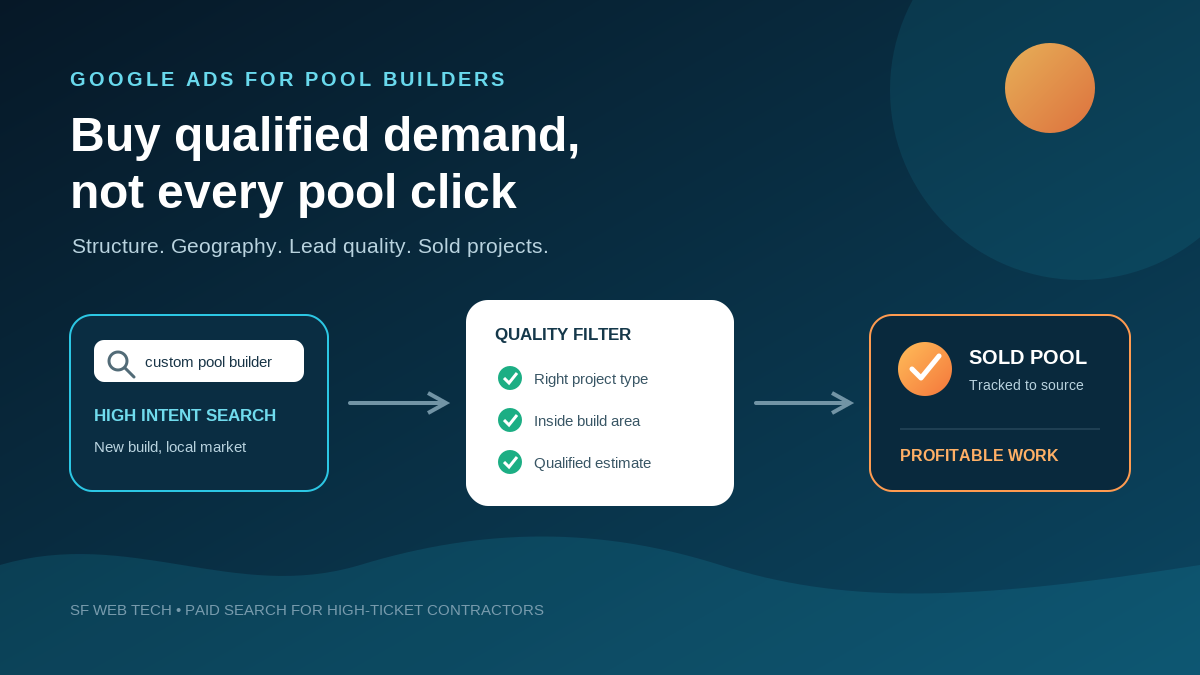
Use search terms, exclusions, build-method routing, and financing clarity to reduce wasted estimate demand.
Review the paid-search structureTrack outcomes deeper than the first form
Google Ads Help distinguishes qualified leads from converted leads. Its current guidance describes a qualified lead as a Google-generated lead that has been further qualified offline in a CRM or internal system. A converted lead is a prospect that completes a later step chosen by the business, which can include a closed sale. That structure fits pool building better than treating every initial call as the final conversion.
Google Ads Help also documents enhanced conversions for leads. The feature can use hashed first-party, user-provided data from a website together with imported offline outcomes to improve attribution to an earlier ad interaction. Implementation still has to follow Google's customer-data policies, applicable privacy and consent requirements, and the contractor's own commitments. Hashing information does not create permission to collect or upload it.
- Preserve the original source, campaign, search theme, landing page, call, and form for each unique prospect.
- Record ownership or decision authority, service area, property conditions, stated project, budget signal, and requested build.
- Use consistent definitions for contacted, qualified, consultation completed, proposal issued, and contract accepted.
- Tie repeat calls and forms to one opportunity so persistent follow-up does not inflate lead volume.
- Import only approved outcomes through a policy-compliant process with appropriate customer-data controls.
- Reconcile signed contracts with production and accounting records before judging channel profitability.
Match demand to design-consult and build capacity
A financially acceptable booked-pool cost can still create an operational failure. The company has finite capacity for answering calls, screening yards, traveling, running design consultations, preparing scopes, arranging permits and engineering input, discussing financing, scheduling excavation and crews, and supporting completed work. Before increasing spend, decide how many additional consultations the team can complete without lowering quality and which project profiles fit the current backlog.
Season and weather can change both demand and buildability. Building season, permit timelines, ground conditions, and holiday spending vary by market. These can create sudden inquiry spikes, but marketing should not promise a dig date or a firm price before anyone has seen the yard. Use timely education to explain what a design consultation evaluates, then scale campaigns only when the office and field team can keep response and appointment promises.
Review the month-to-month offer, attribution support, and what belongs outside the direct Google ad spend.
Compare the managed marketing optionsReview acquisition by cohort, not calendar snapshots
Review performance on a schedule that fits the sales cycle, but group opportunities by when they first entered the pipeline and update outcomes as they mature. A homeowner may request information, book a consultation later, compare build methods, arrange financing, and sign in different reporting periods. Keep the original source attached while later stages develop.
- Total acquisition cost by channel, campaign, pool type, and entry cohort
- Unique inquiries, contact rate, qualification rate, and documented rejection reasons
- Consultations scheduled and completed, including cancellations and no-shows
- Proposals issued, contracts accepted, and time between stages
- Expected and realized contribution from the work won
- Office, design, permitting, financing, and crew capacity
- Service areas and pool types producing the strongest operational fit
- Acquisition cost by channel, campaign, pool type, and entry cohort.
- Unique inquiries, contact and qualification rates, and rejection reasons.
- Consultations scheduled and completed, cancellations, and no-shows.
- Proposals, accepted contracts, and time between stages.
- Expected and realized contribution from won work.
- Office, design, permitting, financing, and crew capacity.
- Service areas and pool types with the strongest operational fit.
The final standard is not cheap pool leads. It is a controlled flow of suitable projects at an acquisition cost management selected from real economics. Define the target build, protect contribution, translate the booked-pool allowance through observed sales stages, connect offline outcomes to the original source, and keep demand aligned with design-consult and build capacity. That gives the owner a budget tied to signed, profitable work rather than an industry benchmark that may not fit the company. For a quick starting model, try the cost per booked job calculator.
Book a discovery call to connect project economics, campaign structure, landing pages, qualification, and lead attribution.
Map your pool builder acquisition modelSources and further reading
- Google Search: SEO Starter Guide
Crawlable links, descriptive page information and content organization. Practical trade examples are SF Web Tech recommendations.
Source checked .
- Google Ads: offline conversion imports
Connecting supported offline outcomes with advertising measurement. Lead qualification and contribution calculations are SF Web Tech operating guidance.
Source checked .
- Google Local Services Ads: getting started
Eligibility, lead handling and verification. Platform lead-billing criteria differ from a contractor's sales qualification.
Source checked .
- Google Local Services Ads: Google Verified badge
Current badging and discontinuation of the former Google Money Back Guarantee.
Source checked .