Pool builder project pages SEO is the craft of turning finished builds into honest, crawlable pages that help a planning homeowner decide whether to book a design consultation. A mega gallery of unlabeled photos rarely does that job. One substantial URL per meaningful project usually does.
This guide stays on page structure and measurement. The commercial system that wraps Google Business Profile, service pages, local coverage and ads sits on our pool builder SEO and Google Ads hub. Read that hub for the full program, then use this article when you are ready to build or rebuild the project layer.
Why project pages matter for pool builders
A custom pool is a long decision. Buyers compare shell types, features, outdoor living add ons and builders for months. They want to see work like theirs: similar lot constraints, similar style, similar communities. A project page that names the pool type, the real place and the design problem gives them a reason to trust a consultation request.
Emergency trades win on speed. Pool builders win on proof and process. Project pages support both search discovery and sales conversations without inventing rankings or lead counts.
Hub vs blog vs project URL roles
Keep the information architecture clean so each URL has one job:
- /pool-builder-seo owns service intent and head commercial terms such as pool builder SEO.
- This blog owns how to structure project pages and how to measure them.
- Each project URL documents one real build with permissioned media and accurate place detail.
- Service pages, such as gunite, vinyl, remodel, and outdoor living packages you sell, explain the offer and link down to matching projects.
- City pages exist only where you have coverage and evidence, and they link to projects completed there.
For local priorities beyond project structure, see eight local SEO priorities for pool builders. For a measurement focused reading of an example portfolio journey, see the companion pool builder SEO measurement example.
Page anatomy that converts
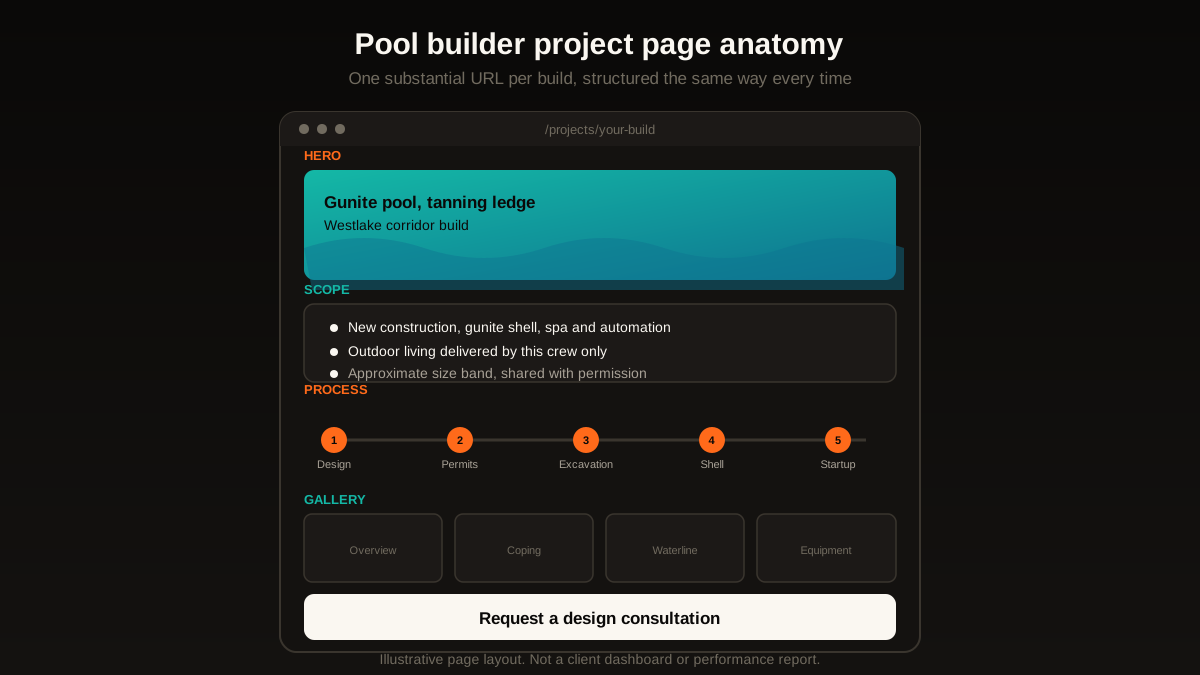
Use the same skeleton on every project so buyers can compare and your team can publish faster.
Hero: pool type and community named honestly
Open with a clear heading that states shell or style, a defining feature and the place you are allowed to publish, for example a town or corridor, not a private street if privacy requires that. The hero image should be a real overview shot of that build, not stock.
Scope block
- New construction or remodel.
- Shell type, such as gunite, fiberglass, or vinyl, when accurate.
- Major features: spa, tanning ledge, water feature, automation.
- Outdoor living attached to this job only when your company delivered it.
- Approximate size band, only if you share that publicly.
Process timeline without fake guarantees
Summarize the stages that applied here: design, engineering or permits as relevant, excavation, shell, finishes, startup. Use ranges only when they are true for this job. Never promise a universal week count for every property.
Photo set rules
- An overview of the finished pool in context.
- Detail shots that show craft, such as coping, waterline, or the equipment pad when useful.
- Before or during shots when they explain a constraint.
- Labeled file names and alt text that describe what is visible.
Buyer questions and objections
Answer what this page naturally raises: access limits, slope, privacy, HOA notes you can share, and the maintenance implications of the features shown. Link to the matching page under home service SEO for deeper offer detail on the service itself.
Clear next step
End with one action: request a design consultation or site visit. Ask qualifying questions such as lot status, timeline, pool type interest and town. If a visitor wants the wider acquisition system around these pages, point them to the pool builder SEO and Google Ads hub.
SEO structure without doorway spam
One substantial project URL beats a lightbox
Search engines and buyers need a stable URL with text, media and links. A JavaScript-only gallery that never resolves to unique HTML pages is weak for both.
Internal links that reinforce the hub
From each project, link up to the pool type or service page that matches the build, the city or corridor page only if the job was there, and two or three related projects with a similar style or feature.
Titles, meta and headings
Write a unique title and meta description for each project. Include the pool type, a feature and the real place when authorized. Keep the page heading aligned with that title. Reserve head commercial phrases for the hub, not for every project heading.
Pagination over endless scroll
On the portfolio index, paginate or filter by type, feature, style and place. Featured projects can sit at the top. Infinite scroll often hides URLs from clean crawling.
Service pages, local pages and project pages working together, not as isolated URLs.
Review the Local SEO service scopeEvidence checklist: publish vs keep private
Not every detail from a finished build belongs on a public page. Sort what you have before you write the project.
- Overview and detail photos
- Shell type and features
- Town or corridor
- Design challenge summary
- Materials named at a public level
- A short authorized quote
- Exact street address
- Client full name and contract price
- Engineering drawings and permit numbers that identify the owner
- Unfinished disputes
- Stock photography standing in for your work
- Invented testimonials, ranking claims or lead volume claims
City names such as Phoenix, Tampa or Orlando are fine as illustrations when the job was there. They do not mean a builder completed those pools unless that is separately true and approved.
Tracking consultations, not vanity views
Define success for pool builder project pages SEO as movement toward design consultations and sold designs, not page views alone.
- Tag consultation forms and calls that land from project URLs.
- Record which project or pool type the buyer referenced.
- Separate spam, vendors and out of area inquiries.
- Review Search Console queries that mention features and places you document.
- Compare project assisted consultations to other sources in the CRM.
Do not invent case study numbers. When you need a measurement focused narrative tied to an example portfolio, use the measurement example rather than a fabricated before and after chart.
An illustrative portfolio journey showing how to track project pages against inquiries.
Read the measurement exampleCommon mistakes
- Stock only galleries that look polished and prove nothing.
- One scrolling page with no unique project URLs.
- City farms that swap a town name into identical copy.
- Missing scope, so a buyer cannot tell gunite from vinyl or new from remodel.
- No CTA, or a CTA that asks for more information without a consultation path.
- Ranking promises on the project page itself.
- Orphan projects with no links from service or city pages.
- Outdoor living photos from a landscaper partner presented as if your crew built them when they did not.
When to get help
If you already have strong builds but weak pages, start with the anatomy above and ship five complete project URLs before you touch more city pages. If you need the full local and content system around those pages, including Google Business Profile, service structure and measurement, use the pool builder SEO and Google Ads hub and book a free strategy call.
Website SEO work more broadly sits under home service SEO. Packages that include ongoing content and local pages start at Lead and Local Growth, 2,000 dollars a month, or Local Authority, 3,500 dollars a month, with advertising separate starting at 50 dollars a day. Lead Launch, at 1,500 dollars a month, is paid acquisition without an ongoing SEO program. See pricing.
Lead Launch, Lead and Local Growth, and Local Authority, with advertising priced separately.
Compare current packagesFrequently asked questions
Is a project page better than a gallery?
A gallery helps browsing. A project page gives search engines and buyers a complete story on one URL. Most pool companies need both: an index plus individual pages for the builds that represent the work you want more of.
How many project pages should we publish first?
Start with your strongest permissioned builds across the pool types you sell. Quality beats a race to fifty thin pages. Add more as crews finish jobs and releases arrive.
Can we name cities we want to enter later?
Only name places on a project page when the job was there or the client authorized that place detail. Ambition towns belong in a future plan with real coverage, not on a project URL.
Does a project page replace Google Business Profile?
No. Google Business Profile handles local pack signals, reviews and profile activity. Project pages handle deep proof on your site. They support each other; neither replaces the other.
Should every photo become its own page?
No. Group media for one build on one project URL. Separate pages for every angle create thin duplicates.
Where does outdoor living fit?
Mention decks, kitchens or fire features on the project page when your company delivered them on that job. If a partner built them, say so or leave them out. Do not reframe the site as a landscaping lead magnet.
Structure the project layer and connect it to consultations, no obligation to hire us.
Book a free strategy callSources and further reading
- Google Search: SEO Starter Guide
Unique, crawlable page URLs, descriptive titles and headings, and internal link structure. Practical trade examples are SF Web Tech recommendations.
Source checked .
- Google Search: creating helpful content
People-first, original content over templated or padded pages, with no preferred word count. Does not substantiate a client result.
Source checked .
- Google Maps: prohibited and restricted content
Rules against fake engagement, misleading photos and incentivized or fabricated reviews, used here for the publish versus never publish guidance.
Source checked .