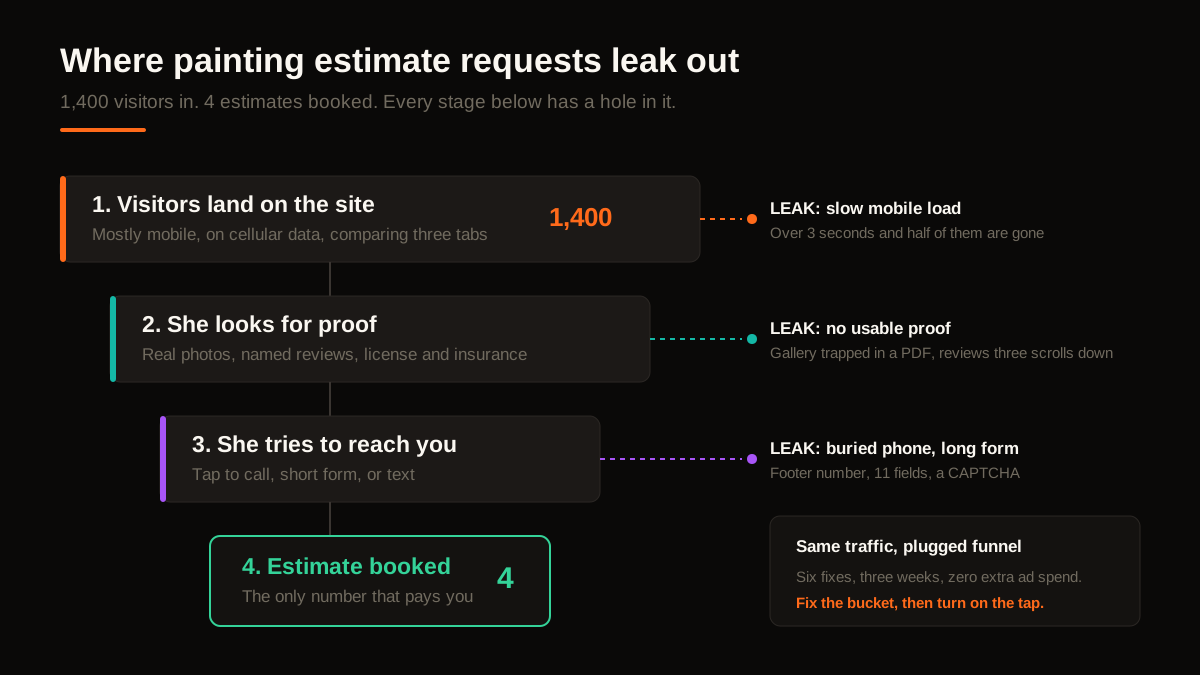
Start with the painting company’s actual analytics and inquiry records. Compare sessions, calls, forms, qualified estimates, proposals and paid projects for the same period. A high session count or a visible search position does not establish that the website caused or prevented an estimate request.
Traffic volume alone does not explain weak estimate inquiries. Reconcile visits with calls, forms, qualified opportunities, estimates, and sold work, then investigate message fit, proof, usability, speed, and tracking before buying additional traffic.
Acquisition and on-site experience influence different stages of the path to an estimate. Measure them together, then choose the traffic, message, proof, usability, or follow-up change supported by the evidence.
Test whether visitors can see relevant painting work, understand the estimate process and contact the business on mobile. No general design survey establishes this contractor’s credibility or conversion rate.
Understand the visitor’s decision stage
Some visitors arrive with a defined painting project, while others are still comparing scope, timing, colors, or providers. Use search queries, landing pages, inquiry notes, and customer interviews to understand the mix.
Visitors may compare several providers on a phone or desktop. Make relevant work, process, service coverage, and contact options easy to evaluate, then measure how those paths contribute to qualified estimates.
Review each element for a clear purpose in the estimate journey. Test whether a slider, stock image or other asset adds useful information, delays the primary content, or obscures the next step on representative mobile devices.
The five conversion killers on painting contractor websites
Common review areas include service clarity, project evidence, mobile contact paths, form friction and follow-up. Treat these as hypotheses. Use recordings, analytics and lead records where permission and data quality allow, then change one measurable part at a time.
Keep the phone and estimate route easy to find, make project images usable on mobile, and ask only for information needed at the first step. A free-estimate CTA should be used only when that is the real offer. Review form completion and qualified inquiries before attributing a result to one design element.
Notice that not one of these is about how pretty the site is. Painters spend a fortune on design and almost nothing on the four inches of screen where the decision actually happens.
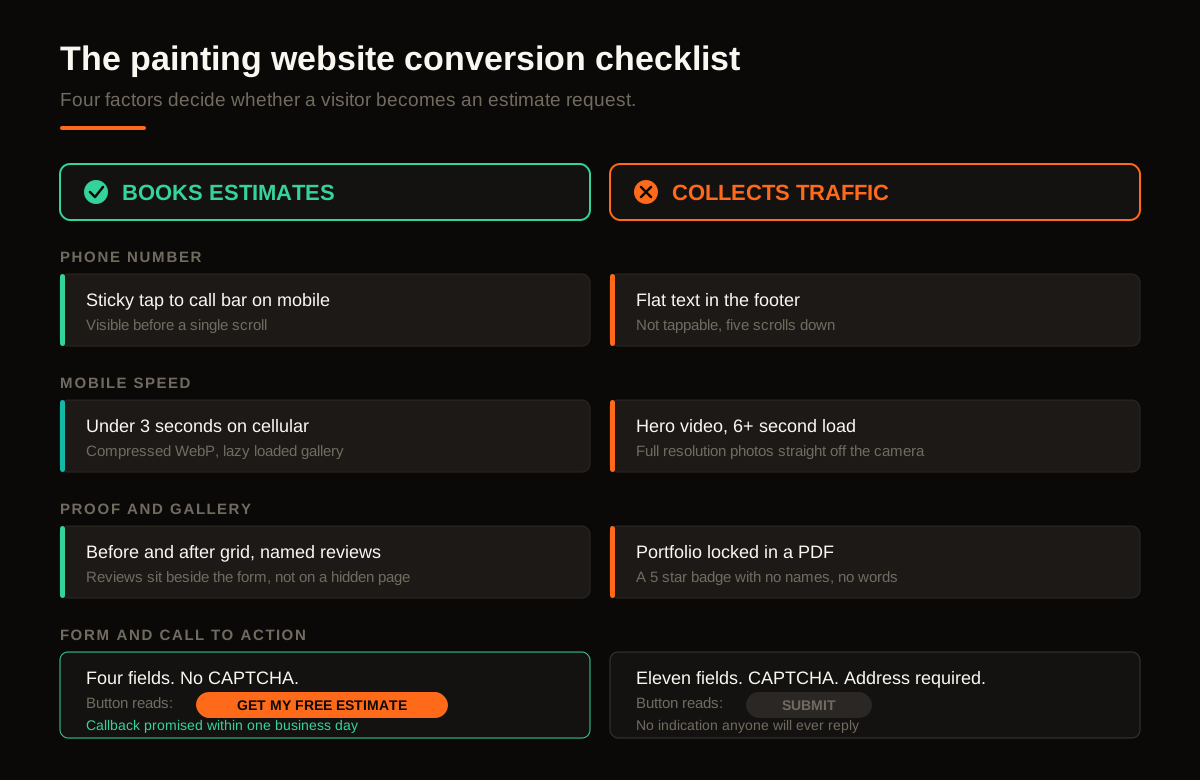
High converting versus low converting: a side by side
- Tap-to-call number visible where the business can staff it
- Permissioned before-and-after photos compressed for the page
- Form fields matched to routing and qualification needs
- Authentic reviews shown with appropriate permission and context
- Specific estimate request label that matches the service
- Current license, insurance and warranty details where supported
- Observed mobile performance checked with field and lab data
- Response expectation the company can actually meet
- Phone number difficult to find or use on mobile
- Portfolio hidden behind a slow or inaccessible interaction
- Form fields with no routing or qualification purpose
- Badge graphic without verifiable supporting context
- Generic next step that does not explain what happens
- Trust information absent, stale or unsupported
- Large media delaying useful content
- No accurate response expectation or ownership
Two painting websites can present the same services very differently. A brochure-style page may leave project fit, proof, availability, and the next step unclear. Compare qualified calls and estimate requests after improving those elements rather than assuming design alone caused the result.
Conversion-aware design with clear estimate paths, supported proof and measurable lead stages.
See how we build painting websitesThe four things that actually convert a painting visitor
Strip a high performing painting contractor website down and you find the same four load bearing walls every time. Everything else is decoration.
Make current credentials, actual service scope and genuine project evidence easy to find. Offer contact options the office can support and keep mobile pages usable. Use authentic customer feedback with permission; one placement does not always outperform another.
“Decorative effects do not substitute for clear proof and an usable inquiry path. Show relevant painting work, explain the estimate process, and make phone and form options easy to find on representative devices.”
Fixing the estimate request itself
An estimate request can fail when it asks for information the office does not need or leaves the customer unsure about the next step. Review the actual intake and follow-up workflow before changing the form.
Each required field adds effort, but the right field set depends on routing and estimate needs. Collect only the information required for a useful first response, explain why sensitive details are needed, and compare completion and qualification outcomes after a change.
A generic Submit label gives little context. Explain the actual next step, responsible team, supported response window, possible fee, and whether an on-site visit is required. Test comprehension and completed inquiries rather than assuming one wording change controls conversion.
- Ask only for the contact and project details the team needs for the stated next step.
- Use a button label that accurately describes the action, such as Request an Estimate, when that is what the business provides.
- State the real fee, obligation, staffed hours, and supportable response window near the form.
- Use permissioned customer feedback near the form only when it is relevant and represented accurately.
- Offer a secure photo upload only when the team can receive, protect, review, and delete the files appropriately. Keep it optional unless the service genuinely requires an image.
- Offer text messaging only with the required consent, disclosures, opt-out handling, staffing, and record retention.
- Keep appropriate anti-spam and abuse controls. Test accessible CAPTCHA, managed challenge, honeypot, and rate-limit options without weakening security to chase completions.
- Make the confirmation page restate the actual next step and provide a working contact route for urgent corrections.
Optional photos can improve inquiry routing
A homeowner may be able to photograph peeling paint, staining, or a damaged surface before an on-site visit. Explain which images help the team route the request, how uploads are protected, and which conclusions still require inspection. A photo can add context but does not establish the final scope or price.
Here is what changes when you add an optional photo field to your estimate form. First, the visitor who uploads a photo has emotionally committed. She has stopped shopping and started showing you the job. Second, you can quote tighter. A photo of water damage on a ceiling tells you whether this is a repaint or a drywall replacement before you drive across town. Third, you beat the competitor who called back blind because your first conversation is already specific.
A photo can provide context about room type, approximate size, visible surface condition, and whether the request appears to be a refresh or repair. It cannot establish exact measurements, trim quantities, hidden prep, or a final price. If the company offers a preliminary range, state its actual response window and explain that an on-site review may be required before final pricing.
Mobile speed is a conversion feature, not an IT chore
Painting websites are the slowest sites in home services, and the reason is almost sympathetic: you are proud of your work, so you upload the full resolution photos straight off the camera. Thirty of them. On the homepage.
A visitor on a slower mobile connection may abandon a page before large media finishes loading. Test representative devices and network conditions, then prioritize the content and contact path needed for the first useful view.
Check actual mobile performance and optimize large images or scripts that make pages difficult to use. Measure the effect rather than presenting a historic cross-industry speed statistic as the percentage of painting leads being lost.
- Resize and encode photos for their rendered use while preserving needed detail
- Lazy load suitable offscreen media and verify galleries remain accessible and discoverable
- Evaluate hero video against performance, accessibility, and measured contribution before keeping or removing it
- Audit plugins, trackers, chat widgets, and fonts for business value, privacy, and performance cost
- Test representative phones, browsers, connection speeds, and inquiry paths
We will review the mobile journey, form delivery, and measurement setup, then prioritize testable corrections. 30 minutes, no pitch deck.
Get a free conversion teardown of your painting websiteShow verifiable proof beside clear service information
Generic adjectives give a prospect little information to verify. Pair service claims with current credentials, permissioned project evidence, accurate scope, genuine reviews, and a clear next step. The useful mix depends on the project, market, visitor, and evidence the company can support.
Evidence should be genuine, current, permissioned, and scoped to what it demonstrates. Review whether visitors can understand it and whether qualified inquiries improve before treating a proof element as commercially useful.
When visibility is present but suitable inquiries are low, review proof placement alongside traffic intent, page speed, service clarity, calls to action and form completion. Do not diagnose a single cause without evidence from the actual path.
Connect visibility, useful proof, accepted inquiries, qualification, and booked outcomes.
How local SEO and conversion work togetherA measured review sequence
Prioritize the smallest change supported by the evidence, such as clarifying the primary action, shortening an unused form field, or moving relevant project proof. Record the baseline and verify the result before deciding whether a broader redesign is justified.
- Week 1: Audit mobile phone and estimate links, confirm the offer language, and test every destination.
- Week 1: Measure mobile performance, optimize the largest images or video assets, and compare the same routes before and after.
- Week 2: Match required form fields to the intake workflow, retain appropriate abuse controls, and test delivery plus accessibility.
- Week 2: Place permissioned, accurately represented customer feedback where it helps evaluate the relevant service.
- Week 3: Make authorized project examples usable on mobile and label the actual service, scope, and context.
- Week 3: Publish license, insurance, and warranty details only when current, applicable, and supported by the business records.
- Week 4: Add text messaging or photo upload only when consent, disclosure, staffing, security, and retention requirements are satisfied.
- Week 4: Measure calls and forms with appropriate consent, then reconcile them with accepted inquiries, estimates, won work, and paid work.
How to know it worked
Track sessions, website calls, submitted estimate requests, qualified estimates, proposals, and paid projects as distinct stages. Choose a review interval that produces enough observations for a decision, annotate material site or follow-up changes, and avoid attributing a change in inquiries to the website without supporting evidence.
Do not apply a generic conversion benchmark as a pass or fail rule. Define what counts as an accepted and qualified inquiry, exclude staff and spam traffic where possible, and compare the site with its own prior periods and traffic mix. A conversion rate can move because the audience changed even when the page did not.
Conversion work and traffic quality should be assessed together. An illustrative doubling of conversions at unchanged cost and quality improves acquisition efficiency, but real visitor mix can change. Diagnose the actual limitation before choosing the next investment.
The Ohio painter fixed six things off this list in about three weeks. Same 1,400 sessions the following month. Nineteen estimate requests. He did not need a better website. He needed his existing website to stop apologizing for itself.
Conversion cannot fix a site nobody finds.
Still not ranking in the first place? Start hereNot impressions. Not sessions. Booked estimates.
Work with a contractor marketing team that measures booked jobsSources and further reading
- Google Search: SEO Starter Guide
Crawlable links, descriptive page information and content organization. Practical trade examples are SF Web Tech recommendations.
Source checked .
- Google Search: creating helpful content
People-first writing, useful original information and the absence of a preferred word count. Does not substantiate a client result.
Source checked .
- Google Maps: prohibited and restricted content
Rules against fake engagement, incentives and selectively soliciting positive reviews.
Source checked .