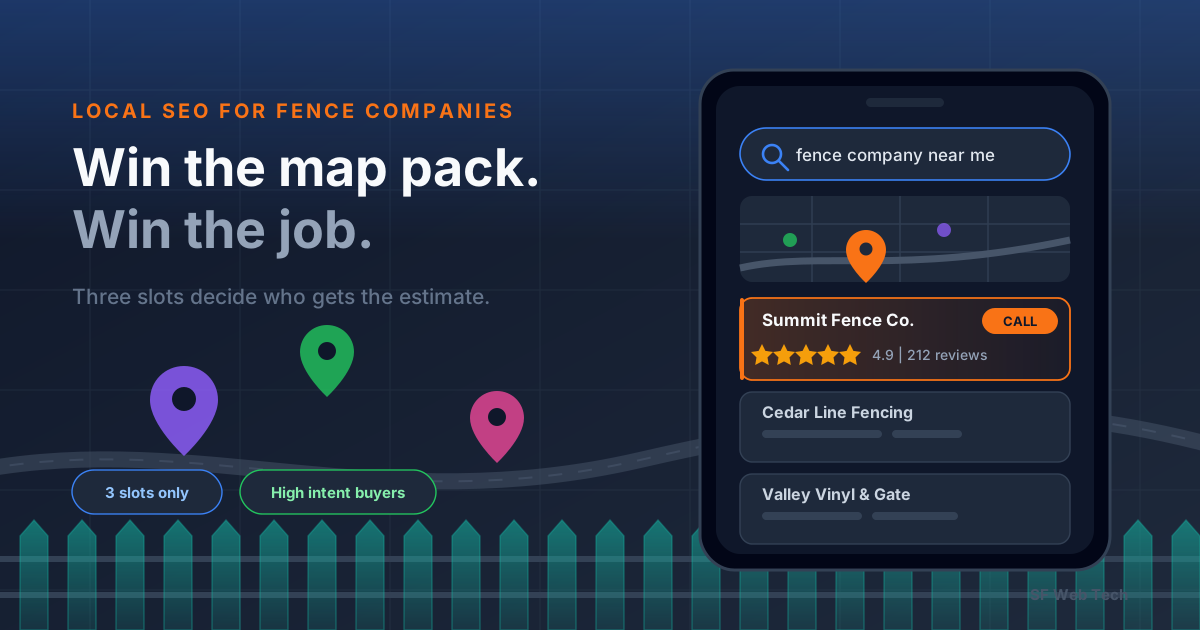
It is Saturday morning after a wind storm rolled through the county. A homeowner walks out back and finds three cedar panels flat on the grass and a gate hanging off one hinge. She does not open a laptop. She does not research fence materials. She does not read anybody's about page. She pulls out her phone and types four words: fence company near me.
Three businesses appear in a box with a map above them. She taps the first, glances at the rating, swipes through two photos of a finished vinyl fence, and hits call. Somebody answers on the second ring and books her for Tuesday. You were the eighth organic result. As far as she is concerned, you do not exist.
The local results panel can be an important discovery and contact path for a fence contractor. Review it alongside standard organic results, referrals, paid traffic and direct visits. Keep each source separate through qualification and booked-work reporting.
Make the local profile accurate and useful
Local map results and organic pages can both help customers find a fence contractor. Review the actual searches and locations relevant to the business rather than applying a study’s click share as a universal rule.
A nearby search may represent research, an urgent repair or a planned installation. Match the service information and contact process to those needs without assuming every visitor will hire within a week.
Measure local visibility, relevant visits and qualified inquiries separately. Broad consumer-search statistics do not establish this fencing company’s likely lead volume.
Fencing differs from other trades: there is no incumbent. A homeowner has a plumber on speed dial. Almost nobody has a fence guy. Fence work is high ticket and happens once every fifteen to twenty years, so the buyer starts from zero and Google decides who makes the shortlist.
What a fence buyer actually types into Google
Compare the language used in actual queries, calls and estimate requests with the terminology on the site. Create or deepen a material or service page when intent, scope, proof and customer questions differ; avoid assuming a fixed number of search families or pages.
- Urgency and repair: document supported emergency or repair services, staffed response, search terms, accepted inquiries, and current competition before prioritizing a page.
- Material: use actual query and lead evidence to decide whether vinyl, cedar, aluminum, chain-link, or other supported materials deserve distinct information.
- Service: explain supported gate repair, removal, haul-away, or modification work without assuming that a smaller request becomes a replacement.
- Research: publish current, supportable guidance about pricing variables, material comparisons, maintenance, and lifespan, then measure qualified use.
- Local intent: compare current organic and map results by query and location without treating one phrase as exclusive to a result type.
Material-specific pages can help when wood, vinyl, aluminum and chain-link work have different questions, price drivers, photos and qualification rules. Combine them when the information would repeat. Google does not publish a rule that one page per material must rank better.
Accurate profile information, useful service pages, internal links, and qualified-inquiry measurement.
See How Our Local SEO WorksThe five pillars of fence company local SEO
No secret here. Five things, done consistently, separate the fence companies in the box from the ones buying shared leads.
Keep the profile accurate, use genuine project evidence, explain actual service coverage and make contact reliable. Build separate pages when they answer distinct questions. Invite honest reviews consistently, and use currently supported profile features rather than assuming every historic Q&A tool remains available.
Pillar one: treat your Google Business Profile as the real homepage
A Business Profile may be one part of a fence buyer's evaluation. Current third-party aggregate interaction research does not forecast one contractor's calls or jobs. Use the profile's available performance data, website analytics, and qualified lead records to understand the local path.
Set your primary category to Fence contractor. Do not get clever. Add secondary categories only where you genuinely do the work. Fill the services list with the language buyers use: vinyl fence installation, cedar privacy fence, chain link repair, gate installation. Each is a relevance signal, and relevance is what competitors leave half empty.
Add permissioned photos from real fence projects when they help customers evaluate materials, installation, terrain, and finished appearance. Choose a capture and publishing process the crew can maintain, keep location details accurate, and use manufacturer media when the rights and context permit it.
Pillar two: build a review engine, not a review habit
Reviews help customers evaluate experience, but a difference in review count does not determine which contractor gets a call. Use genuine feedback with permission and keep the review request neutral.
Invite eligible customers to describe their experience in their own words after real work. Do not ask for a particular rating, place name, material phrase or positive-only response. Use a direct review link for convenience, and respect the platform’s current review policies.
Pillar three: pages that match what people search
Create distinct material or service pages when search intent, scope, proof and customer questions genuinely differ. Use permissioned project photos, supported pricing variables, and accurate guidance about concerns such as vinyl performance in cold weather or cedar movement. Measure qualified estimates rather than promising that one answer wins the job.
A city page should exist only when it adds distinct coverage, process, project or local-authority information that the company can verify. Do not invent permit, HOA, soil or weather details, and do not reuse one project across several towns. Judge the page by usefulness and qualified inquiries rather than assuming local detail guarantees ranking.
Pillar four: citations and the dealer locator nobody thinks about
Citations are boring and they still matter. Your name, address, and phone need to be identical across Google, Bing Places, Apple Business Connect, Yelp, Angi, Houzz, and every fencing directory that will have you. Inconsistency is less a penalty than a confidence problem.
The one contractors miss universally: manufacturer and supplier dealer locators. If you install a specific vinyl or ornamental aluminum brand, that manufacturer has a find a dealer page. High-authority, hyper-relevant citations sitting there free.
Pillar five: measure the response process
Set a response process the office can sustain and measure time to first contact and qualification outcomes. Historic cross-industry response multipliers should not be presented as a prediction for fence leads.
Picture your crew. It is 10:40 on a Wednesday, everyone is setting posts, and the form fill sits in an inbox nobody opens until dinner. By then she has called the next two listings. You did not lose on price. You lost on latency.
- Profile information left stale after services or coverage change
- One page combining unrelated materials without useful detail
- Customer feedback ignored or displayed without a response process
- Conflicting identity or contact information across important profiles
- Forms reviewed too late for the company’s stated follow-up process
- Dependence on shared marketplace contacts without source ownership
- Accurate primary category, services, coverage, and permissioned job media
- Distinct material or service pages where customer intent and evidence differ
- A consistent policy for inviting and responding to authentic feedback
- Matching business identity and contact information across eligible profiles
- Phone and form routing aligned with staffed response expectations
- Owned website, tracking, contact paths, and lead-stage records
“Fence buyers may compare visible proof, responsiveness, service fit, materials, and installation details. Present those factors clearly and measure which inquiries become suitable estimates.”
Use quieter operating periods to prepare accurate service content and inquiry handling. Seasonal demand varies by market. Starting later does not automatically put a company a full season behind or determine its future rankings.
SF Web Tech focuses on US home-service businesses. We begin with the contractor's actual services, coverage, operations, evidence, and lead definitions.
Review SEO and measurement with SF Web TechFour mistakes that make local information less useful
- Setting a service area radius that covers half the state. A profile claiming 60 miles signals that you are relevant to nowhere in particular. Claim the towns you genuinely serve and win those.
- Using a virtual office or a mailbox address. Google is aggressive about suspending profiles it decides are not real locations, and fence contractors get caught constantly. If you run from home, hide the address and set a service area.
- Chasing backlinks before fixing the profile. A contractor with an unfinished profile does not need guest posts. He needs a primary category, forty photos, and thirty reviews. Sequence matters.
- Treating repair searches as beneath you. Emergency fence repair and gate repair convert fast, cost almost nothing to rank for, and turn into full replacement quotes more often than contractors expect.
What this is actually worth
Angi puts the national average fence installation around 3,200 dollars, with a wide spread from small repairs into five figures for long runs of ornamental aluminum. Residential work dominates the fencing industry by a wide margin, which is exactly the segment that searches locally.
Illustrative planning only: if four additional qualified estimates were attributed to a source and one became a paid project, compare that project’s contribution with the full acquisition cost. Replace every input with reconciled records; a map position does not guarantee estimates or profit.
Transparent monthly retainers. No setup fees, no long contracts, no leads resold to your competition.
See Our PricingYour first 30 days
You do not need an agency to start. You need a few weeks of unglamorous work, in this order.
- Confirm profile eligibility, ownership, real-world name, primary category, services, hours and service area against current business facts.
- Review relevant controlled and reputable third-party profiles. Correct material identity or contact errors without chasing a fixed directory count.
- Use one neutral review-request process for all eligible customers. Keep participation optional, avoid incentives or requested wording, and respond factually.
- Set a supportable call and form response process, disclose hours and route each inquiry to a monitored owner.
- Create material pages only when they contain distinct scope, evidence, options and customer guidance.
- Create a city page only when genuine coverage and distinct local information justify it. Do not publish towns on a fixed monthly schedule.
A homeowner facing a damaged fence may compare nearby providers, recent project evidence, service fit, availability, and the clarity of the contact path. Keep those facts accurate, make the next step easy to find, and measure whether inquiries become qualified opportunities.
Bring the profile, website and recent lead records for a scoped review of accuracy and measurement gaps.
Book a Free Strategy CallSources and further reading
- Google Search: SEO Starter Guide
Crawlable links, descriptive page information and content organization. Practical trade examples are SF Web Tech recommendations.
Source checked .
- Google Business Profile: local ranking guidance
Google’s broad relevance, distance and prominence guidance. No exact ranking weights or guaranteed service-area coverage are stated.
Source checked .
- Google Maps: prohibited and restricted content
Rules against fake engagement, incentives and selectively soliciting positive reviews.
Source checked .