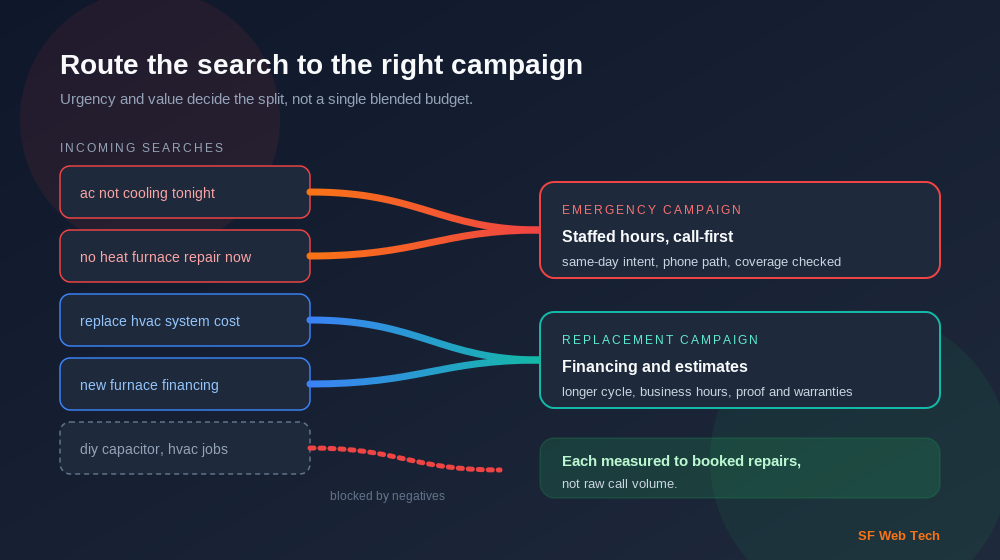
HVAC advertising often serves two very different buyers at once: the homeowner with no heat on the coldest night or no cool in a heat wave who needs someone today, and the owner planning a full system replacement over the coming weeks. Those requests differ in timing, value, qualification, staffing, and landing-page needs. Keep the search terms and the downstream outcomes visible before deciding whether they belong in one campaign or several.
Combining emergency repair and planned replacement in one budget, keyword list, and message can hide real differences in cost and lead quality. A same-day no-cool call and a scheduled furnace replacement do not compete for the same attention or close on the same timeline. Separate the segments, preserve the search terms, and compare qualified and booked outcomes before changing spend.
Review blended-campaign economics
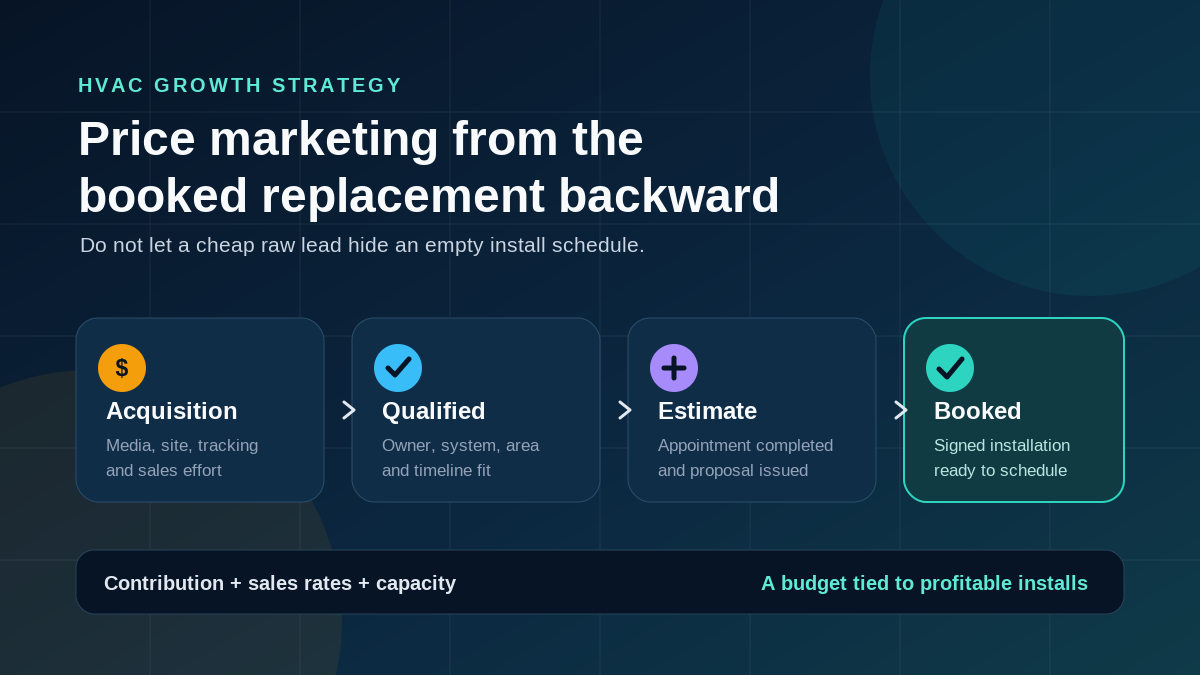
Emergency repair, normal repair, and replacement can involve different service scope, job value, response capacity, and sales timing. Use the company's actual records rather than fixed repair or replacement prices when deciding how to organize the account. A no-heat call that needs a technician within hours is a different economic event from a planned equipment change.
Review whether conversion goals and search terms reflect the work the business wants. A mixed campaign does not automatically optimize for the urgent, high-value repair, and a cost-related query can still come from a suitable customer. Use actual qualification evidence before excluding it, and avoid treating raw call volume as if every call were a booked job.
Why emergency repair and replacement economics need separate review
An HVAC account may advertise emergency repair, planned replacement, and installation work with different values, qualification rules, response capacity, and buying timelines. Use the operator's records to decide whether those differences justify separate campaigns or budgets, rather than assuming the urgent call and the planned project can share one plan.
Repair and replacement values vary by equipment, scope, and site conditions. Use the operator's actual contribution and close-rate data when choosing acquisition limits. Do not publish an unsupported repair price, a guaranteed response time, or a flat diagnostic fee the field cannot consistently meet.
A shared budget can obscure those differences when one service consumes spend the other needs. Compare search terms, staffed response times, qualified opportunities, estimates, and sold work by service before splitting the account, changing bids, or making assumptions about which season or hour owns emergency demand.
- Emergency repair has a budget and schedule that match staffed response capacity
- Replacement ads use accurate offer and approved financing language
- Local Services Ads are evaluated only where the business is eligible
- Negative keywords follow observed irrelevant search terms
- Reporting separates qualified repair and replacement outcomes
- Repair and replacement share a budget without capacity controls
- Search terms mix service, parts, do-it-yourself, and employment intent
- One generic ad and page cover materially different requests
- Calls and forms are counted without qualification results
- Spend cannot be reconciled with estimates and sold work by service
The broader HVAC Google Ads framework for seasonal budgets, branded search, and measurement.
See the general HVAC ads strategySplit into emergency, replacement, and branded
Use separate campaigns when service scope, budget control, landing pages, response coverage, or measurement genuinely differ. Keep a simpler structure when volume and data quality do not support reliable segmentation, because thin segments learn slowly and spend erratically.
Separate urgent repair from planned replacement when budget and tracking justify it. Advertise only the hours the office and crews can truly respond, and lead the emergency ads with the call. Treat Local Services Ads as another option to evaluate; its lead-billing rules do not guarantee a suitable inquiry.
Evaluate branded search separately. A brand campaign may help measure and control paid visibility for company-name queries, but its value depends on organic coverage, auction activity, budget, and incrementality. Treat it as a measured account decision rather than default insurance.
Evaluate Local Services Ads for eligible emergency demand
Check whether Local Services Ads is available and suitable for the business before allocating budget. Google now uses the Google Verified badge for eligible verified profiles. The badge is not a replacement for accurate scope, honest pricing, and reliable response when a homeowner has no heat.
Google's current LSA badge guidance should be used instead of the retired guarantee reimbursement promise. Review current billing and credit rules, and compare qualified opportunities with Search using the same definition rather than assuming the channels produce the same quality.
Review the current platform rules for reporting invalid or unsuitable leads, then keep the call, message, and outcome evidence needed for an eligible dispute. Credits depend on the provider's policy and review. Track billed leads, accepted opportunities, booked repairs, completed work, credits, and paid outcomes separately so the effective acquisition cost reflects the account record.
Keep required verification and business details current and respond reliably, which matters most during a cold snap or heat wave when volume spikes. Google warns that regularly failing to respond can affect LSA ranking; do not convert that into a known penalty for every missed call.
A measurement-led framework for campaign scope, search terms, qualification, and sold-work feedback.
See the home services ads playbookBuild negative keywords from verified mismatch
Build negative keywords from actual search terms, service boundaries, job value, and the company's diagnostic and repair scope. A shared list can reduce repeated work, while campaign-specific exceptions may preserve useful intent. Record additions and review the effect on qualified calls, booked repairs, completed jobs, and any missed query themes.
- Parts and DIY: hvac capacitor, furnace igniter, condenser fan motor, thermostat wiring diagram
- Job seekers: hvac technician jobs, apprentice salary, hiring, careers
- Bargain and rental: free, cheap, used furnace, portable ac rental, window unit
- Research only: how to fix ac not cooling, reset furnace, diy refrigerant recharge
- Wrong product: car ac, rv air conditioner, hvac school, duct cleaning only
- Warranty and supplier: home warranty hvac, manufacturer recall, parts distributor
- Parts and DIY
- Job seekers
- Bargain and rental
- Research only
- Wrong product
- Warranty and supplier
Review search terms according to spend, query volume, match types, launch risk, and staffing. Confirm intent before adding a negative, because a superficially irrelevant phrase can still represent a suitable emergency repair. Record exclusions and compare qualified calls, booked repairs, completed jobs, and contribution after each material change.
“Campaign structure should follow supported services, search-term evidence, staffed response capacity, and booked repairs. Segmentation is a testable account choice rather than a diagnosis on its own.”
Bid strategy and ad scheduling for emergency calls
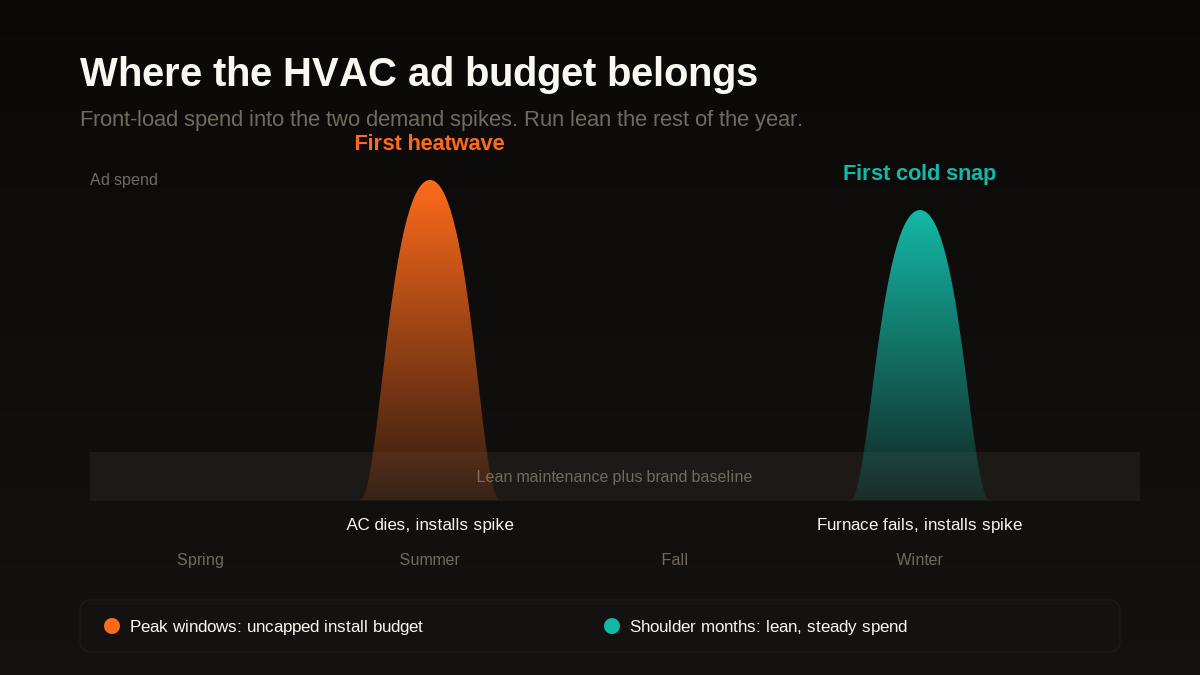
Use search-term, hour-of-day, call, qualification, and staffing records to identify when suitable emergency demand appears and when the office can respond. Schedule ads around supported coverage and economics. Do not assume competitors pause overnight or that any single period owns no-heat and no-cool demand without checking the account.
Advertise within staffed availability, use supported ad formats and call assets, and test call and form tracking. Select bidding according to current requirements and reliable data. Confirm geographic coverage and review actual inquiry locations so an urgent call does not come from outside the service area.
Match the landing page to the emergency offer
A slow or generic destination can create friction, but the effect must be measured in the actual account. For an emergency page, make the supported service, operating area, current availability, and the phone path clear, then compare page behavior and qualified outcomes.
Test mobile usability and inquiry routing, since most emergency searches happen on a phone. Set a response target the office can actually staff and measure the result. Generic page-speed or lead-response studies do not forecast this HVAC account's conversion rate.
- Make the supported service and operating area clear.
- Show license, credentials, and current availability.
- Make the click-to-call path obvious above the fold.
- Test mobile usability and inquiry routing.
- Set a response target the office can staff and measure the result.
Match the destination to the advertised service and the next step the business can support. An emergency page may emphasize current hours, coverage, and phone routing; a replacement page may explain equipment options, evidence, warranties, financing, and the estimate process. Test each path rather than assuming one layout wins the job.
What to do this week
Start with the smallest reviewable changes: confirm supported services and staffed hours, inspect search terms and negatives, verify conversion routing, evaluate LSA where eligible, and use a focused emergency page when service and evidence justify it. Expand or split only after qualified outcomes support the decision.
- Separate emergency repair and planned replacement only when volume, economics, and response capacity justify the split.
- Build negative-keyword groups from observed irrelevant search terms and review exclusions before applying them.
- Track calls only with appropriate number ownership, disclosure, consent, and outcome reconciliation.
- Evaluate Local Services Ads where eligible and dispute charges only under the platform's current valid-credit rules.
- Use a focused emergency page when the company can accurately support the service, hours, coverage, and response path.
Review account structure, search terms, landing pages, lead quality, and measurement gaps.
Audit your HVAC advertisingMake the urgent repair call easy to start and measure on mobile.
Improve the HVAC inquiry path30 minutes to review search terms, lead quality, and measurement gaps
Book a call with SF Web TechSources and further reading
- Google Search: SEO Starter Guide
Crawlable links, descriptive page information and content organization. Practical trade examples are SF Web Tech recommendations.
Source checked .
- Google Ads: keyword matching options
How keyword match types relate to search intent; account strategy and examples are editorial recommendations.
Source checked .
- Google Ads: negative keywords
Negative keyword behavior and exclusions. The suggested service exclusions require account-specific review.
Source checked .
- Google Ads: advanced location options
Presence and interest settings and the limits of geographic targeting accuracy.
Source checked .
- Google Ads: average daily budgets
Platform budget and spending mechanics, not a trade-specific CPC or lead-cost forecast.
Source checked .
- Google Local Services Ads: getting started
Eligibility, lead handling and verification. Platform lead-billing criteria differ from a contractor's sales qualification.
Source checked .
- Google Local Services Ads: Google Verified badge
Current badging and discontinuation of the former Google Money Back Guarantee.
Source checked .