A blended HVAC campaign can place emergency no-cool calls, full system replacements, tune-ups and maintenance-plan signups under the same target. That makes it almost impossible to tell which spend is renting you one-time jobs and which spend is building the recurring book that makes an HVAC business valuable. The recurring agreement is the asset. A campaign that cannot see it will quietly starve it.
HVAC has two different buyers hiding inside one keyword list. One is the urgent customer: no heat on the coldest night, a system down in a heat wave, a replacement quote needed this week. That person calls whoever answers first. The other is the planner: a homeowner who wants a maintenance agreement and, once they sign, stays for years. Same account, very different value, and if you bid on them identically you overpay for the cheap work and underbid for the valuable work.
Why one blended HVAC campaign starves the recurring book
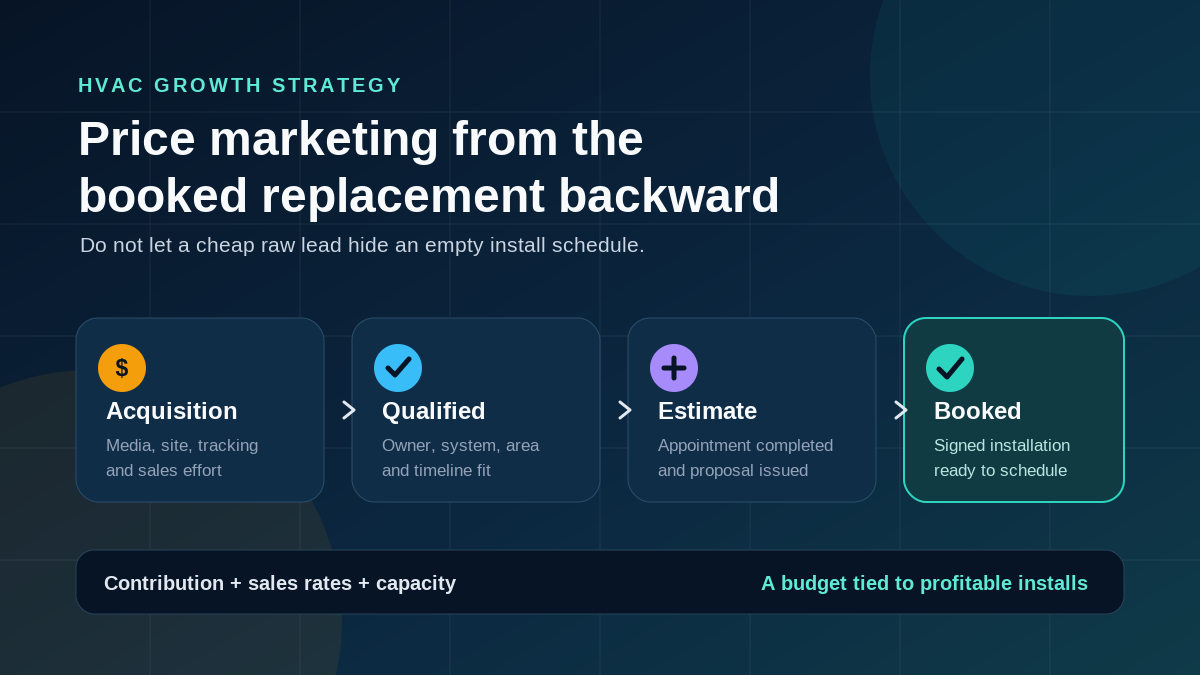
One-time repair and replacement work and recurring maintenance agreements have different revenue, fulfillment, retention and acquisition economics. A tune-up or a membership signup is worth very little on the first visit but can produce years of service revenue, priority renewals and replacement pull-through. If your reporting rewards whatever is cheapest per lead, the recurring work always looks like the loser, because its value does not land on day one.
Preserve the service type and the customer outcome in your data, then calculate what you can afford to pay for each from observed contribution rather than a single transactional average. Value a maintenance agreement from your own billing, renewal and service-cost records, not from an assumed multi-year relationship. That evidence is what lets you bid more for a plan member than for a one-time repair without guessing.
Two engines: urgent repair versus maintenance-plan intent
The two-engine setup is an option to test, not a universal rule, but for most established HVAC companies it makes the tradeoff visible for the first time. Compare Local Services Ads, where eligible, and Search using qualified inquiries, signed agreements and contribution. Choose the initial channel and territory from eligibility, capacity and budget, and keep new maintenance-plan inquiries separate from one-time repair requests so you can judge each honestly.
Local Services Ads and Search have different controls and billing rules, and neither is automatically the fastest or cheapest route to the work you want. Use the current platform process for charges, and compare outcomes with consistent qualification criteria rather than assuming the channel that produces the most leads is producing the most members.
Engine 1: Local Services Ads and Search for the repair and replacement calls
This is where your high-urgency, high-cost demand belongs. Emergency no-cool and no-heat clicks and replacement searches are competitive and expensive because the intent is immediate and the ticket is large. Paying per lead through Local Services Ads, where eligible, takes some of the sting out of that, and a verified profile does part of the trust-building for you. Check current Local Services Ads eligibility and verification rather than relying on an old badge description.
Keep the messaging accurate and avoid manufactured panic. Customers need to understand availability, the assessment step and the scope before anyone commits. Set an inquiry response process the office can sustain, because the urgent buyer books the first company that answers. Google's guidance notes that regularly failing to respond can affect ad ranking, but one missed call should not be described as a known penalty.
Engine 1 is graded on cost per booked repair or replacement, not on the raw lead count. That keeps the urgent side honest and stops it from borrowing budget that should be funding the recurring book. Review Local Services Ads charges using the current platform process, and remember that a lead the platform considers billable is not automatically one your sales process would qualify.
Eligible channel setup, tracking and ongoing optimization within the agreed package.
See how we run Local Services Ads for contractorsEngine 2: Geo-fenced Search for maintenance-plan memberships
Engine 2 is the one most HVAC accounts never build. It is a dedicated, evergreen Search campaign aimed at homeowners looking for a maintenance plan, a tune-up or a service agreement, geo-fenced to the routes you already run so a new member slots into an existing drive. Because lifetime value is doing the paying here, you can raise the acquisition ceiling on purpose, as long as the number is backed by your own renewal and contribution records.
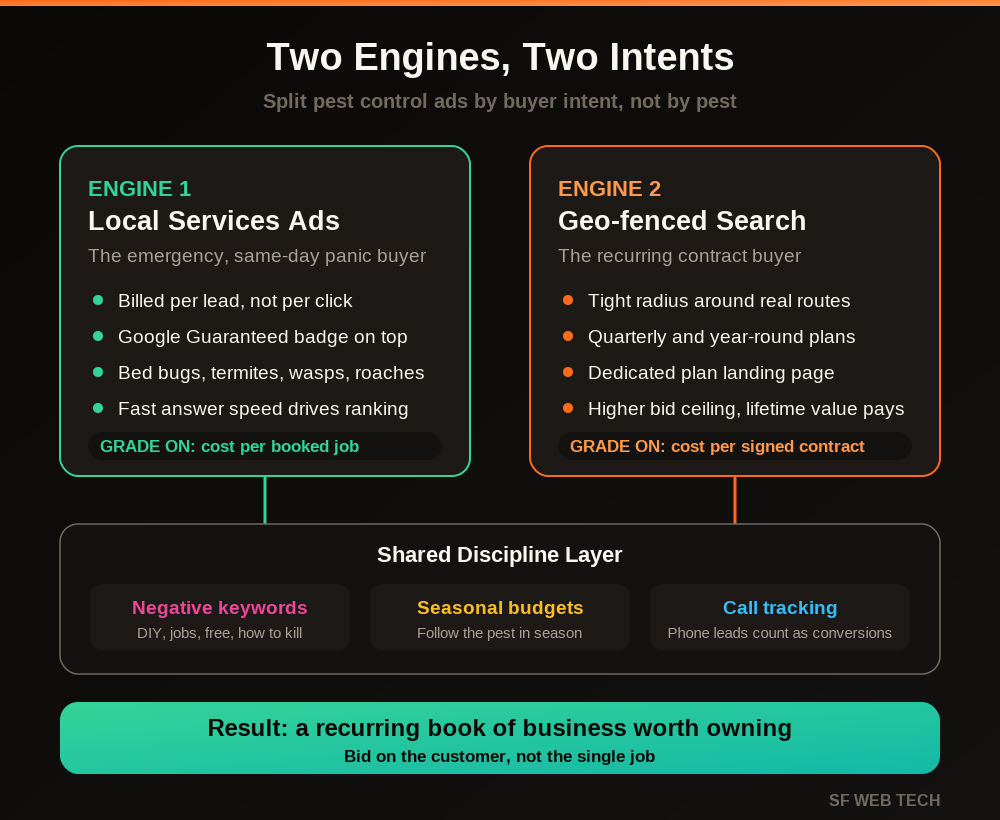
- Build around recurring-intent keywords: hvac maintenance plan, ac tune-up, heating and cooling service agreement, annual furnace service.
- Draw the geo-fence around routes you already run so a new agreement fits an existing drive.
- Send clicks to a dedicated membership landing page about the plan and its value, not your generic homepage.
- Track signed agreements as the conversion, not raw form fills, so bidding optimizes toward real members.
- Raise the acquisition ceiling on purpose, because lifetime value, not the price of one tune-up, is paying.
The membership landing page that earns a signup
Sending maintenance-plan traffic to your homepage wastes the whole point of Engine 2. A homeowner comparing agreements needs a page that explains exactly what the plan includes, how it is priced, and how to cancel, with a single clear call to action and genuine reviews nearby. The clearer and more honest that page is, the more it does your qualifying for you, because a serious planner self-selects and a tire-kicker filters out.
Keep the plan details accurate and substantiated: the number of visits, what each visit covers, any priority-service or repair-discount terms, and the real price. Do not imply guarantees you cannot support. The page is where the agreement is actually won or lost, so it deserves as much attention as the campaign that feeds it.
The lifetime-value math that changes your bids
Value a maintenance agreement from the company's observed billing, renewal, cancellation, service-cost and gross-margin records. Take the contribution a typical member produces over the time they actually stay, and that figure, not the price of a single tune-up, is the ceiling you bid against in Engine 2. The limit should follow realized customer value and move as paid-customer evidence accumulates, not a borrowed benchmark you read online, including ours.
“Evaluate maintenance-agreement acquisition separately from one-time repair acquisition. A plan may produce value over years, but renewals, service costs, cancellations and collected revenue must be measured rather than assumed.”
This is why Engine 2 can afford a higher cost per lead than Engine 1 and still be the more profitable spend. The urgent repair pays once. The agreement pays across renewals and often opens the door to the eventual replacement. Just make sure the higher ceiling is earned by your own retention data, because a plan with weak renewals cannot carry the acquisition cost of a plan with strong ones.
How HVAC landing pages turn paid clicks into qualified, booked inquiries.
Make the membership page convertNegative keywords and shoulder-season budgets
The fastest way to pollute Engine 2 is to let one-time and DIY intent leak into it. A maintenance-plan campaign should exclude the queries that signal a single repair, a parts purchase or a job search, so your cost per signed agreement describes real membership demand. Build the negative list before you scale, then review the search-terms report on a regular cadence.
- One-time repair intent you want in Engine 1 instead: ac repair near me, furnace not working, emergency hvac.
- DIY and parts: how to clean a condenser, capacitor replacement, hvac filter size, diy tune-up.
- Jobs and training: hvac jobs, technician salary, epa certification, hvac school.
- Free and price-only shoppers hunting a giveaway rather than an agreement.
- Wrong services and commercial queries outside the residential plan you sell.
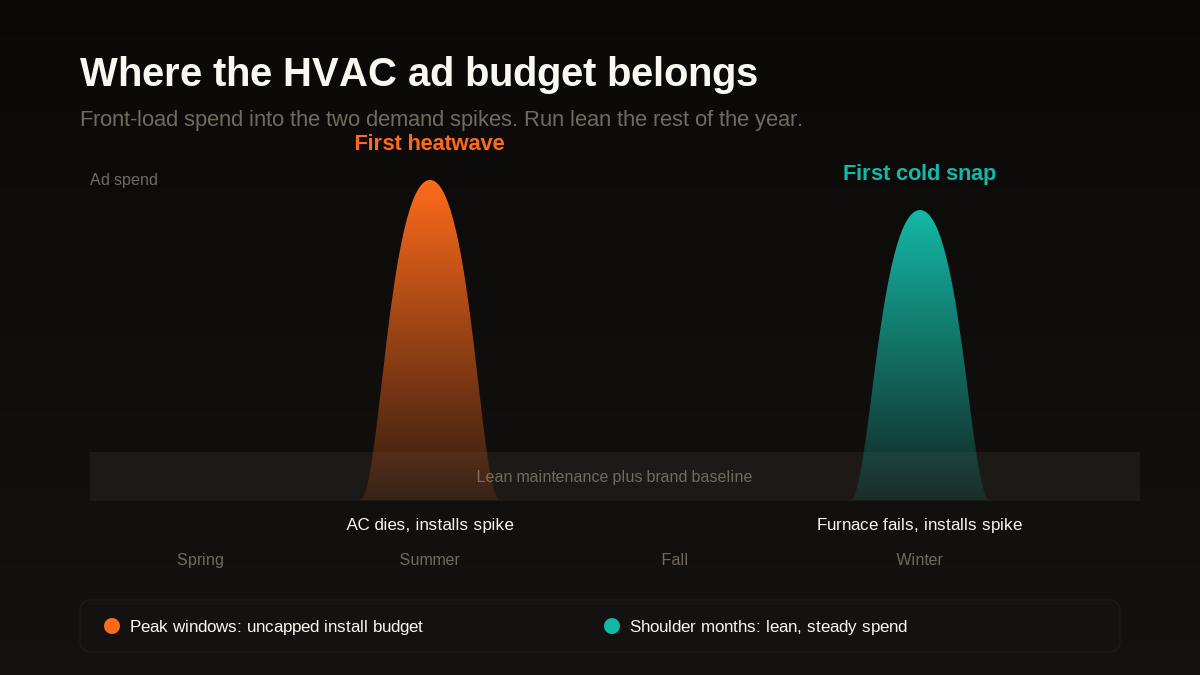
Budget timing matters too, but it should follow your own demand, not a borrowed seasonal template. Many HVAC companies find the shoulder seasons before peak heating and cooling are a natural window to promote maintenance agreements, when homeowners are thinking about readiness rather than a crisis. Shift spend when your qualified-inquiry and capacity data support it, not just because the calendar turned.
- Signed agreements, counted distinctly from one-time jobs the north-star metric for Engine 2
- Collected revenue and service cost per member so contribution, not price, sets the bid ceiling
- Renewal and cancellation rates over time a weak renewal rate caps what you can pay to acquire
- Cost per booked repair for Engine 1, kept on its own line so the urgent side never borrows the recurring budget
Track signed agreements, not form fills
You cannot optimize two engines while you are staring at one blended number. Separate the reporting the way you separated the campaigns, and grade each engine against its own job: Engine 1 on cost per booked repair or replacement, Engine 2 on cost per signed agreement measured against lifetime value. Where supported, import the signed-agreement outcome back into the account so bidding learns from real members rather than raw form fills.
Renewal and retention is where the money is
Acquisition is only the start of a maintenance plan's value. The acquisition cost you can afford in Engine 2 rests entirely on how long members stay and renew, so the retention work is part of the marketing math, not a separate department. A pre-expiration reminder sequence, reliable service, and an easy renewal path protect the lifetime value that justified the higher bid in the first place. Advertise harder only when the renewals hold.
Where to start this week
You do not have to rebuild everything at once. Split the account into the two engines, move the urgent repair and replacement demand into Engine 1, wrap a tight geo-fence around a maintenance-plan Search campaign pointed at a dedicated membership page, and set conversion tracking so each engine is graded on its own goal. Do that, and within a couple of billing cycles you will finally see which spend rents you one-time jobs and which spend is building a recurring book worth owning.
We split your account into the two engines and grade each one on the right number.
Get an HVAC Google Ads plan built around recurring revenueHow to structure HVAC campaigns by service line, budget and season.
Read the full HVAC Google Ads playbookTransparent monthly management for home service businesses.
See pricing for managed Google AdsSources and further reading
- Google Search: SEO Starter Guide
Crawlable links, descriptive page information and content organization. Practical trade examples are SF Web Tech recommendations.
Source checked .
- Google Ads: keyword matching options
How keyword match types relate to search intent; account strategy and examples are editorial recommendations.
Source checked .
- Google Ads: negative keywords
Negative keyword behavior and exclusions. The suggested maintenance-plan exclusions require account-specific review.
Source checked .
- Google Ads: advanced location options
Presence and interest settings and the limits of geographic targeting accuracy.
Source checked .
- Google Ads: average daily budgets
Platform budget and spending mechanics, not a trade-specific CPC or lead-cost forecast.
Source checked .
- Google Local Services Ads: getting started
Eligibility, lead handling and verification. Platform lead-billing criteria differ from a contractor's sales qualification.
Source checked .
- Google Local Services Ads: Google Verified badge
Current badging and discontinuation of the former Google Money Back Guarantee.
Source checked .