Consider a custom home builder running paid search: the owner watches cost per click and tries to push it down, but the search-term report is full of tract listings, prefab and modular shoppers, floor-plan software, and how-to-build researchers. Those clicks rarely turn into a signed design-build contract. Before touching bids, separate the work the business actually sells, a bespoke home on the client's lot, from the related searches it cannot or will not fulfill.
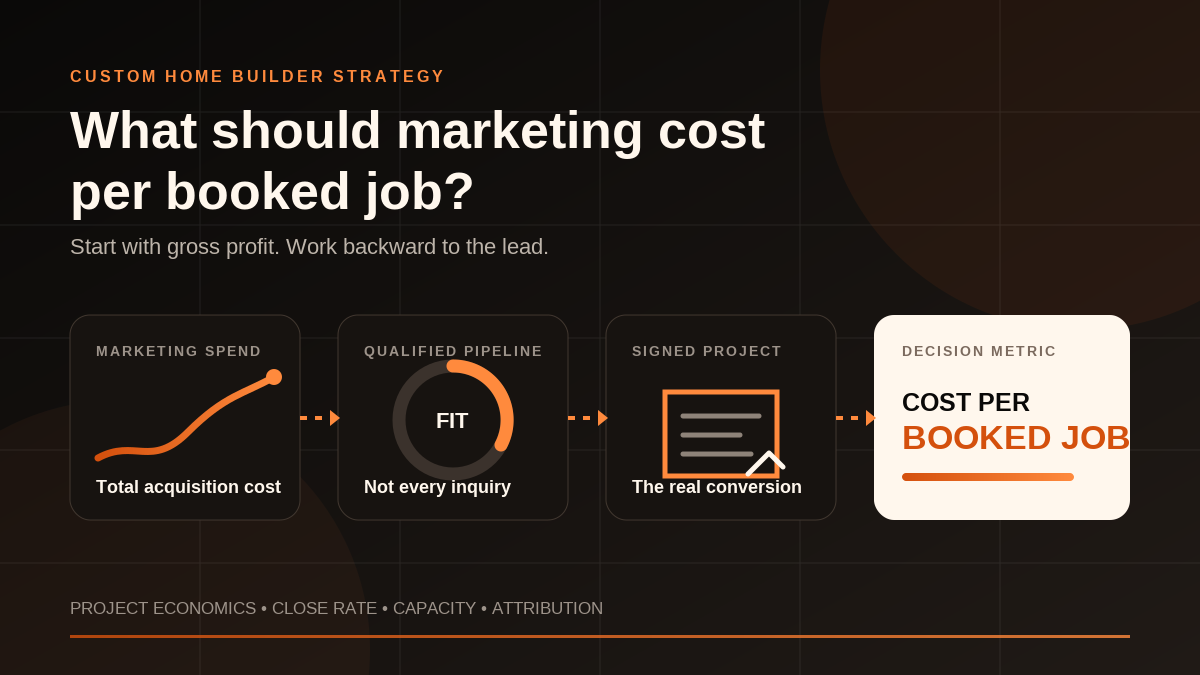
Cost per click does not establish customer-acquisition efficiency on a high-ticket, long-cycle build. Review search terms, qualification, consultation requests, booked design meetings, signed contracts, and the full acquisition cost. A cheap click can still be the wrong buyer, and that has to be measured in the account and the sales record, not assumed from the click price alone.
Your clicks cost more because the category and the sales cycle are long
Custom home builder click costs vary by market, land availability, price tier, query mix, and competition. Use the account's own search-term, cost, qualification, and signed-contract data to separate viable design-build intent from requests the business does not serve, then adjust bids and exclusions from that evidence rather than from a borrowed benchmark.
There is no universal custom-build CPC or minimum profitable budget. Estimate the gross profit a typical project contributes, the share of qualified inquiries that reach a consultation and then a contract, and the media spend the business can support across a buying cycle that often runs months. Use the account's real search terms and closed contracts to test those assumptions instead of starting from a number someone else published.

Every click on a high-intent build term is expensive, so use search terms, negative keywords and qualified-inquiry data to cut traffic that will never convert. A broad term such as home builder mixes new-construction buyers, remodel shoppers, real estate listings, product and informational intent. Inspect the actual account before deciding how to contain it, because one word is doing the work of several very different searches.
The intent trap that drains custom builder accounts
The phrase home builder does double duty in Google. One person types it because they own a lot and want an architect-led, one-of-a-kind home. The next person types it because they want the cheapest production floor plan in a new subdivision, or a modular unit, or a kit they can assemble themselves. Same words, very different budgets and timelines. If your ads answer all of them, you pay for all of them, and most leave the moment they see a bespoke design-build process and price.
In most custom builder accounts we review, a meaningful share of spend goes to searches that live on the wrong side of that line: production and tract shoppers, prefab and mobile-home seekers, floor-plan software, do-it-yourself build guides, rentals, and job hunters. That spend is not a rounding error. It is the difference between an account that fills the calendar with qualified consultations and one the owner is ready to switch off.
- custom home builder near me
- build on your own lot builder
- luxury home builder [metro]
- architectural design build firm
- estate home construction cost
- modular and prefab homes
- cheap house plans / floor plan software
- mobile homes for sale
- how to build a house yourself
- home builder jobs / salary
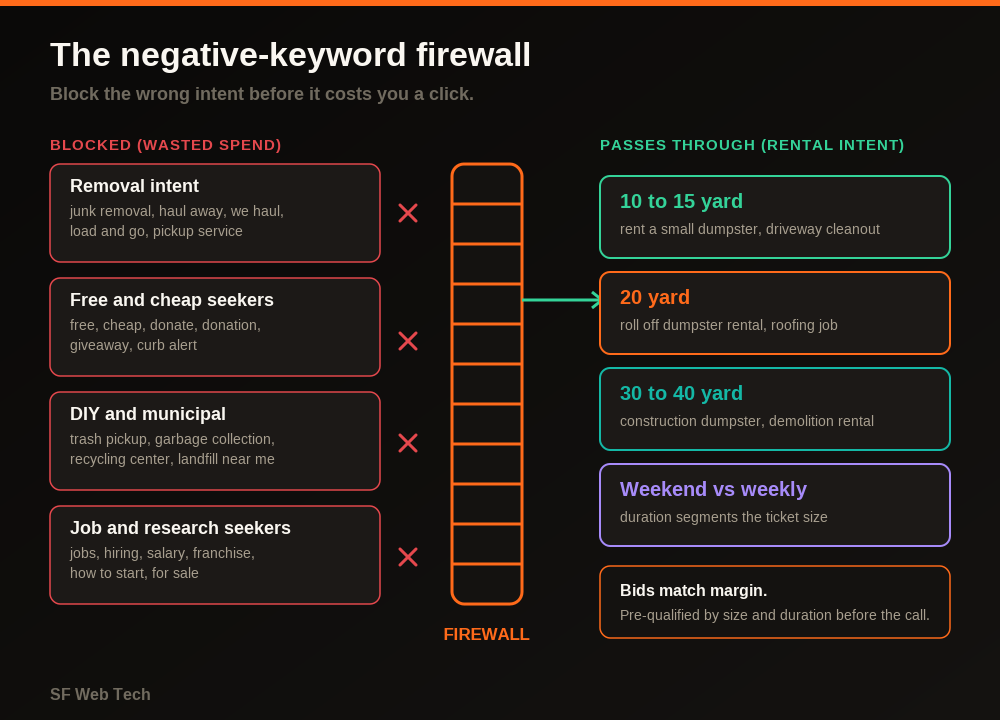
Build your negatives firewall and qualifying words
A negative-keyword system is more than a short list in campaign settings. Maintain shared exclusions where they fit, inspect search terms at an interval supported by spend and query volume, document why terms are kept or excluded, and compare each change with qualified outcomes. On the positive side, qualifying words in the keywords and copy, custom, architectural, luxury, estate, build on your lot, discourage starter-home and bargain clicks before they cost you. Pair the firewall with the organic foundation in our custom home builder SEO approach so paid and owned search reinforce each other.
- Production and prefab: tract homes, spec homes, production builder, modular, prefab, manufactured, mobile home, kit home.
- Bargain and DIY: cheap, affordable, budget, free house plans, floor plan software, how to build a house.
- Wrong product: real estate for sale, homes for sale, apartments, rentals, tiny home on wheels.
- Research and listings: new construction near me for a browser, Zillow, builder reviews only, salary.
- Job and supplier seekers: builder jobs, hiring, careers, subcontractor wanted, materials supplier.
Firewall build, project-type structure, and weekly search-term cleanup, done for you.
See how we manage Google AdsStructure campaigns by project type and stage, not one blob
Once the wrong buyers are filtered out, the next job is sorting the right ones by what they want to build and how close they are to deciding. A build-on-your-lot inquiry, a hillside estate, and a whole-home scope in an established neighborhood are not the same client, and they should not share one ad group with one ad and one budget. Split them so your message, your landing page, and your bids match the project and the price tier.
This structure does some of the pre-qualifying for you. Before anyone books a consultation, the searcher has already told you roughly what they want to build and where they are in the decision. Your bids can lean into the project types the business wants more of, and your copy can stop trying to speak to a lot owner, a tract shopper, and a DIY researcher in the same breath.
“Bidding on the word builder with no negative list and no qualifying words is paying to advertise the production and prefab competitors a custom client was never going to hire.”
Your real problem is consult-to-contract, not click price
Campaign structure cannot explain the full sales outcome on a long custom-build cycle. Review live answer rate, follow-up speed, consultation show rate, proposal quality, qualification, and signed contracts alongside paid clicks. Repair a verified response or follow-up gap before you increase spend, because a bespoke build is often lost in the weeks between the first call and the design agreement, not at the auction.
Use company data to calculate cost per qualified consultation and per signed contract, then model how different qualification and close-rate assumptions change the result. Treat the model as a scenario until reconciled contracts, deposits, and gross profit support it. Import offline conversions so bidding learns from booked consultations and closed builds, not from raw form fills. Compare conversion improvements with bid changes rather than assuming one lever is larger.
We will pull your search terms report live and show you where the build budget is leaking.
Book a strategy callYour 30-day rebuild
You do not need to blow up the account. Run these steps in order and give each one about a week to gather data before you judge it.
- Week 1: Export the last stretch of search terms. Highlight every tract, prefab, DIY, listing, and job query. Build one shared negative list and apply it everywhere.
- Week 2: Split ad groups by project type and stage. Write ad copy and a matching landing section for each, and add qualifying words such as custom, architectural, and estate.
- Week 3: Move your strongest build terms to phrase and exact match. Cut or lower bids on the loose broad-match terms that survived the firewall.
- Week 4: Track cost per qualified consultation and per signed contract, not cost per click. Fix your speed to lead and intake script so more qualified buyers reach a design meeting.
Separate project type, stage, location, and price tier where the economics or sales path differ. Use current scope and search-term evidence, then track qualified consultations, proposals, signed contracts, and gross profit. Click cost is still part of the economics and should be judged with the downstream stages, not on its own.
Website architecture, project proof, and inquiry tracking built to support paid search.
See the custom home builder playbookSources and further reading
- Google Search: SEO Starter Guide
Crawlable links, descriptive page information and content organization. Practical trade examples are SF Web Tech recommendations.
Source checked .
- Google Ads: keyword matching options
How keyword match types relate to search intent; account strategy and examples are editorial recommendations.
Source checked .
- Google Ads: negative keywords
Negative keyword behavior and exclusions. The suggested service exclusions require account-specific review.
Source checked .
- Google Ads: advanced location options
Presence and interest settings and the limits of geographic targeting accuracy.
Source checked .
- Google Ads: average daily budgets
Platform budget and spending mechanics, not a trade-specific CPC or lead-cost forecast.
Source checked .