Custom home builder local SEO usually comes down to one architecture question: do you need a city or county page, a community or neighborhood page, or neither for a given search. They are different jobs. A custom builder normally needs city or county pages where they actually build, and a community page only when that named place has its own buyer question and its own proof. Copying a production builder's 'a page for every subdivision' playbook is how thin doorway pages get made.
This guide is for custom and design-build teams, including remodelers who also build new homes on a client's lot or their own lots. If you sell inventory, floor plans, and quick-move-in homes inside named communities, your model is different and this article is not a floor-plan SEO guide. For the full service program, see the custom home builder SEO hub. This post is the decision piece that sits underneath it.
Who this is for, and who should use a different model
A custom or design-build firm sells a process: a home designed and built for one client, often on the client's lot or on a few lots you control. Buyers search by where they want to live and by the kind of builder they want, not by a model-home name. A production or semi-custom builder sells inventory inside subdivisions, with floor plans and move-in-ready homes. That business genuinely benefits from community pages for each active neighborhood. If that is you, this decision table still helps, but your default page count is higher and your content is about plans and availability.
The rest of this article assumes the custom case. The goal is a small number of pages that each earn their place, linked in a clear, browseable structure, not a sprawl of near-duplicate location pages built to chase a list of city names.
The decision: which page does this search deserve
Start from the search and the proof you can show, not from a spreadsheet of towns. Each row below is a buyer intent, the page it may deserve, and the case where you should not publish a separate page at all.
What belongs on a custom-builder city or county page
A city or county page is strong when it carries facts that belong to that jurisdiction and could not be copied onto the next town over. Build it from what you actually know:
- The type of homes you build there: estate homes, infill on tight urban lots, build-on-your-lot in outlying areas, or whole-home additions.
- The permit or planning desk by name, and how to find the official rules. Link the city or county's own page and date when you read it, rather than quoting a number you did not verify.
- Finished projects in that place, linked to their project pages, with photos taken there.
- Lot, soil, slope, or HOA patterns you have genuinely dealt with in that area.
- A clear next step: a consultation request for someone planning to build there.
This is the method Licheo's service-area guidance gets right: source the city's own document and date it, show finished work in that place, and name a real contact. Borrow the method, not any specific ordinance figure or review-time claim from another market. If you cite a rule, open that city or state page yourself and link it.
What belongs on a community or neighborhood page
For a custom builder, a community page is not a production inventory page. You are not listing floor plans and quick-move-in homes. You are answering a buyer who has already chosen a place and wants to know whether you build the kind of home they want there. Publish one only when you can write the following honestly:
- Why you build in that community: the homes, lots, or design styles that fit it.
- Lot or design constraints that differ from the rest of the city: setbacks, architectural review, lot sizes, or site conditions you have worked with.
- Approved or completed projects in that community, with real photos and a link to the project page.
- How a buyer there starts a conversation with you.

The doorway and scaled-content line you must not cross
Google's search spam policies describe two failure modes that location pages fall into. Doorway abuse, in Google's words, is 'when sites or pages are created to rank for specific, similar search queries' that 'lead users to intermediate pages that aren't as useful as the final destination', including 'multiple domain names or pages targeted at specific regions or cities that funnel users to one page'. Scaled content abuse is 'when many pages are generated for the primary purpose of manipulating search rankings and not helping users'. Google states that sites violating these policies 'may rank lower in results or not appear in results at all'.
- Pages a reader would actually click through: territory, then real city and community pages
- Each page has distinct facts, projects, and photos
- Location pages link to the project pages that prove them
- You can defend every page to a buyer, not just a crawler
- Twenty pages that swap only the city name
- The same paragraphs with a find-and-replace place name
- No projects, no photos, no permit-desk detail
- Pages closer to a search result than a real answer
The safe rule for a custom builder is simple: publish where you can prove something, keep the structure browseable, and read Google's current policy before you scale pages. See the Google Search spam policies for the exact wording and examples.
How this sits with your Google Business Profile
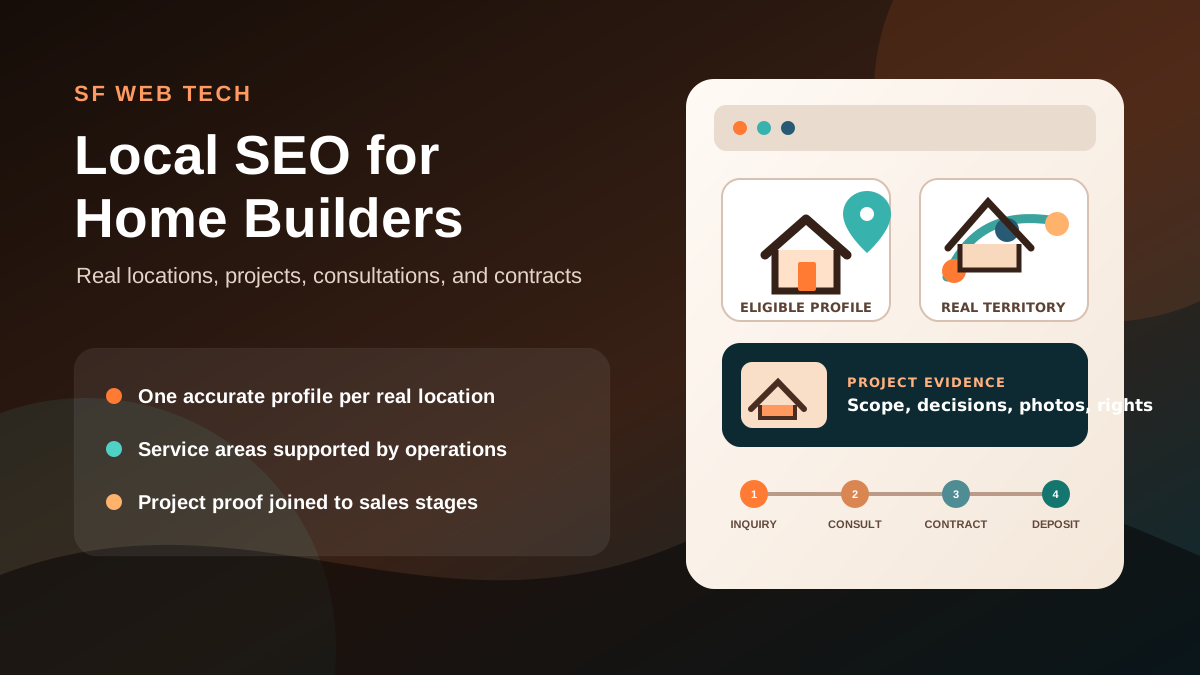
Website geography pages are not extra Google Maps listings. A custom builder who is a service-area business building on the client's lot generally has one eligible profile for a real staffed office or qualifying location, and city or community pages on your site do not create additional map listings. Confirm eligibility against Google's current business-profile guidelines rather than copying a production builder's sales-office-versus-model-home rules, which do not automatically apply to you. For the profile checklist that pairs with this architecture, read our Google Business Profile checklist for home builders.
How to measure it without inventing a trend
Judge location pages by the inquiries they produce, not by rankings alone. A homebuilder's buying cycle is long and low-volume, so the honest scorecard is consultations and qualified build inquiries from those pages, plus the Search Console queries for the place names you targeted.
For context on the current baseline, a 3 November 2026 Search Console export showed home-builder queries such as 'local seo for home builders' and 'seo for custom home builders' landing on the custom home builder hub at average positions in the mid-80s to high-90s, with no clicks recorded yet on those queries. That is a starting point, not a promise. Do not publish invented timelines or result multiples; report movement from your own Search Console and CRM over real quarters.
Where this fits in the rest of your site
City and community pages are one layer. Your project pages are the proof underneath them, and your website structure decides whether any of it can rank. For project pages and the full site architecture a custom builder needs, read what a custom home builder website needs before it can rank. For the local system and profile work, use the Google Business Profile checklist for home builders. When you want the whole program run as one plan, the custom home builder SEO hub is the service page.
See the full local, website, and content program for custom and design-build firms, with location pages that earn their place.
Custom home builder SEOThe site architecture and project-page approach that these city and community pages link into.
What a custom home builder website needs to rankThe local search service that supports your profile, reviews, and location pages for home builders.
Local SEO servicesTalk through which city or community pages you can actually prove before you publish them.
Book a free strategy callFAQ
When should a custom builder write its first city page?
When does a neighborhood deserve its own URL?
What if I have no finished project in a new city yet?
Do production-builder community-page checklists apply to me?
Next step: map your real territory and projects first, then read what a custom home builder website needs before it can rank and book a free strategy call to decide which pages to publish.
Sources and further reading
- Google Search spam policies: doorway abuse and scaled content abuse
Official definitions of doorway abuse and scaled content abuse, the city-and-region doorway example, and the stated consequence that violating sites may rank lower or not appear, quoted in the doorway and scaled-content section.
Source checked .
- Google Business Profile: guidelines for representing your business
Business-profile eligibility and representation guidance supporting the point that website geography pages are not additional Maps listings and that a service-area builder generally has one eligible profile.
Source checked .
- Google Business Profile: local ranking guidance (relevance, distance, prominence)
Google's relevance, distance, and prominence framing used in the measurement and profile sections rather than invented ranking factors.
Source checked .