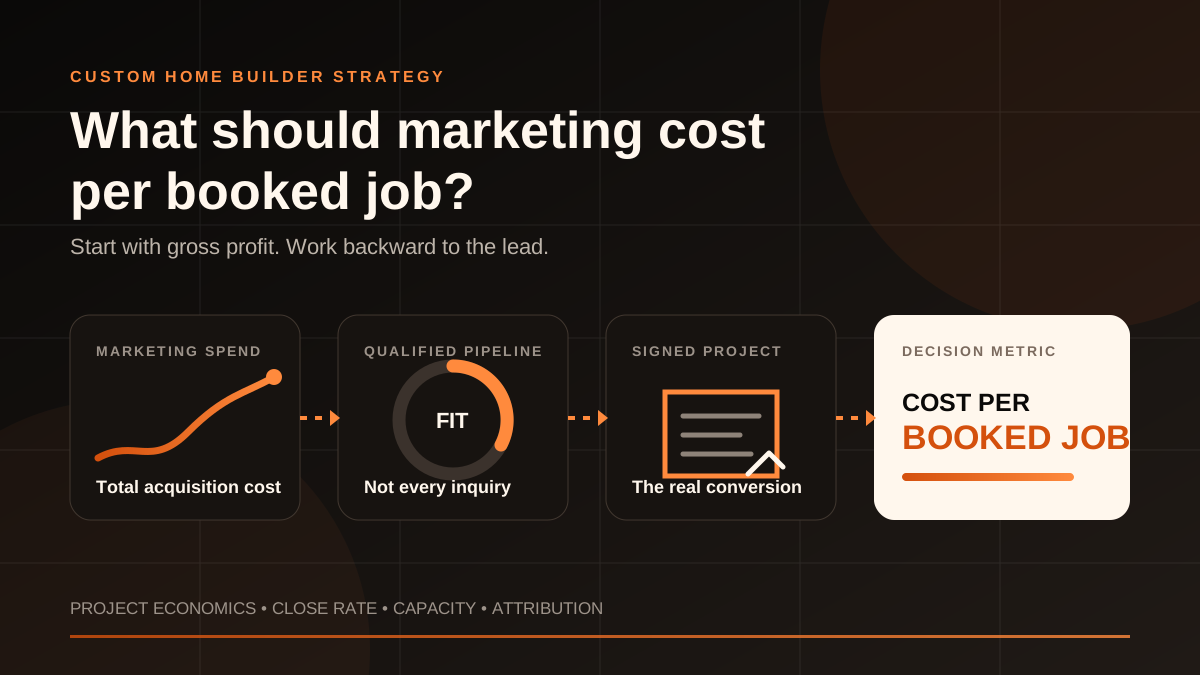
The right marketing cost for a custom home builder is not a universal price per lead. It is the most you can spend to win a signed project while protecting gross profit, keeping the right crews busy, and avoiding more opportunities than your sales team can handle. A builder that starts with an arbitrary lead benchmark will usually make one of two mistakes: underinvest in a profitable market or buy a pile of inquiries that never become viable projects.
Work backward from the economics of a completed job. Define the gross profit available before marketing, decide how much of that contribution you can responsibly invest to acquire the project, and then use your real qualification and close rates to translate that number into targets for consultations and leads. This makes marketing accountable to signed contracts, not clicks, forms, or attractive reports.
Why cost per lead is the wrong starting point
Custom home demand produces leads with radically different value. One form may come from a landowner with financing, plans, and a realistic timeline. The next may come from someone collecting inspiration with no lot and no budget. Counting those two inquiries equally makes a low cost per lead look efficient even when the campaign creates no buildable pipeline.
The sales cycle also hides weak marketing for months. A click can become a form today, a design consultation later, and a signed construction agreement much later. If reporting stops at the form, the ad platform receives credit before the business knows whether the opportunity was qualified. Google Ads explains that offline conversion imports connect an ad click or call with later offline outcomes, including a signed contract. That is the measurement model a high-ticket builder needs.
- Raw lead: a call or form with contact information, whether qualified or not
- Qualified opportunity: a prospect who fits the service area, project type, budget, land, and timeline requirements
- Sales appointment: a qualified prospect who completes the next meaningful meeting
- Proposal or preconstruction agreement: an opportunity that reaches a defined commercial milestone
- Booked job: a signed agreement that the company accepts into its production pipeline
Connect search visibility, paid campaigns, landing pages, and attribution to signed work.
See the contractor marketing systemStart with job economics, not an industry average
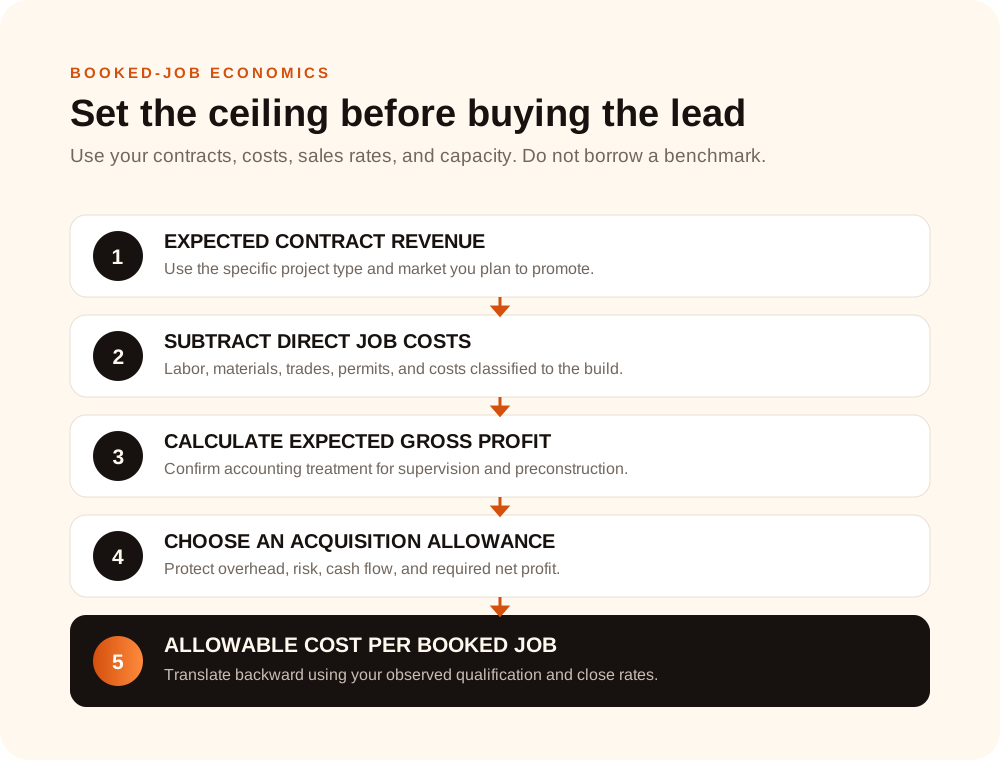
Begin with the revenue you expect from the type of project being marketed. Subtract direct job costs such as labor, materials, subcontractors, permits, and other costs your accounting method assigns directly to the build. The result is expected gross profit before marketing and overhead. Confirm the exact treatment with your accountant because builders do not all classify preconstruction, supervision, warranty reserves, and owner compensation the same way.
Next, choose an acquisition allowance from that gross profit. This is a management decision, not a public benchmark. It should reflect overhead, target net profit, risk, cash flow, backlog, and how badly the company needs the next project. A builder with a healthy backlog may set a stricter allowance and focus only on ideal-fit builds. A builder opening a new service area may accept a higher acquisition cost while the referral base and organic visibility develop.
- Expected contract revenue for the specific project type
- Direct job costs under the company's accounting method
- Expected gross profit before marketing and overhead
- Required contribution toward overhead, warranty risk, and net profit
- Maximum acquisition allowance for one signed project
- Current backlog and the number of production starts the company can actually accept
Turn the booked-job ceiling into lead targets
Once you know the maximum acceptable cost per booked job, translate it backward through the sales pipeline. Divide the acquisition allowance by the number of qualified opportunities normally required to sign one acceptable project. Then translate qualified opportunities into raw inquiries using your own qualification rate. This gives every stage a target grounded in business reality.
For example, do not assume that every builder closes the same share of consultations. Pull a meaningful period from the CRM and count only consistently defined stages. If referrals are mixed with paid search, separate them. If sales staff changed, note the change. If a campaign produced many out-of-area forms, keep those visible as disqualified leads rather than quietly removing them. The point is not to manufacture a flattering rate. It is to forecast what the next marketing dollar is likely to produce.
Count the full acquisition cost
Ad spend alone is not the acquisition cost. Include the costs required to create and convert demand: agency or employee labor, landing pages, photography, call tracking, CRM tools, listing management, content, and the sales time consumed before a contract is signed. Keep long-lived brand assets visible, but use a consistent allocation method so one month does not absorb the entire cost of a website that supports the company for years.
- Advertising spend only
- Every form counted as a success
- No allowance for sales time
- No separation by project type
- Channel credit stops at the first contact
- Media, management, technology, and content
- Qualified opportunities tracked separately
- Sales stages and disqualification reasons recorded
- Project type and service area retained
- Signed contracts tied back to original source
Review fixed SF Web Tech pricing before deciding what belongs in your acquisition budget.
Compare transparent monthly packagesBuild tracking around the signed contract
Google Ads says website conversion measurement can track actions after an ad interaction, while offline conversion imports can connect that interaction to what happens later over the phone or in the sales process. Google also warns that Primary and Secondary conversion actions must be configured correctly because bidding uses those signals. For a builder, a brochure download or button click should not carry the same optimization weight as a qualified consultation or converted lead.
Capture the original source, campaign, landing page, service area, requested project type, budget fit, land status, timeline, and sales outcome in the CRM. When an opportunity reaches a meaningful stage, send that status back to the advertising platform using an approved, privacy-conscious process. Google currently recommends enhanced conversions for leads for advertisers starting this kind of offline measurement. Follow consent requirements and do not upload information you are not authorized to use.
- Define one owner for CRM stage quality and attribution hygiene
- Record why leads are disqualified, including geography, project fit, budget, timing, and inability to contact
- Track phone calls and forms without counting duplicates as separate prospects
- Mark qualified and converted leads as distinct outcomes
- Reconcile signed contracts with accounting or production records
- Review acquisition cost by channel, project type, and market each month
Match the budget to production capacity
A profitable cost per booked job can still create an operational problem. Custom builders have finite estimating, design, permitting, supervision, and trade capacity. Before increasing spend, decide how many additional starts the company can accept, when those starts can enter production, and which project profiles make the backlog stronger. Marketing should create controlled choice, not overwhelm the team with consultations it cannot serve.
Use paid search as a demand control and SEO as a long-term visibility asset. Paid campaigns can be narrowed by geography, project language, and schedule when near-term capacity changes. Search-focused service and location pages can build durable demand around the work the company wants to own. The U.S. Census Bureau's Characteristics of New Housing program publishes national and regional tables for contract price, square footage, construction method, financing, foundations, and other housing attributes. Those tables are useful for market context, but they do not replace the builder's actual contracts, costs, and close rates.
Use each channel for the job it does best, then measure both against qualified pipeline.
Compare SEO and Google AdsReview the number every month and after every signed job
A cost-per-job target is a decision rule, not a number to set once and forget. Review it when material costs, subcontractor pricing, financing conditions, backlog, project mix, or close rate changes. Use a rolling view long enough to account for the sales cycle, and keep recent cohorts open until they have had a fair chance to progress. A campaign launched last month should not be judged as though every serious custom-home prospect signs immediately.
- How much total acquisition spend entered the period
- How many unique leads and qualified opportunities each channel created
- How many opportunities advanced to consultation, proposal, preconstruction, and contract
- Which project types and locations produced the strongest expected contribution
- Which disqualification reasons marketing can fix and which belong to sales or positioning
- Whether current pipeline exceeds, matches, or falls short of production capacity
The final standard is simple: marketing should help the company sign the right number of profitable projects at an acquisition cost the business chose deliberately. Cheap leads are irrelevant if they never become suitable builds. Expensive inquiries can be valuable if they consistently become strong contracts. Set the ceiling from gross profit, translate it through real sales rates, track the signed outcome, and adjust the budget to the work your team can deliver well.
Book a discovery call to connect your project economics, search strategy, and attribution plan.
Map your cost per booked jobSources and further reading
- Google Search: SEO Starter Guide
Crawlable links, descriptive page information and content organization. Practical trade examples are SF Web Tech recommendations.
Source checked .
- Google Ads: offline conversion imports
Connecting supported offline outcomes with advertising measurement. Lead qualification and contribution calculations are SF Web Tech operating guidance.
Source checked .

