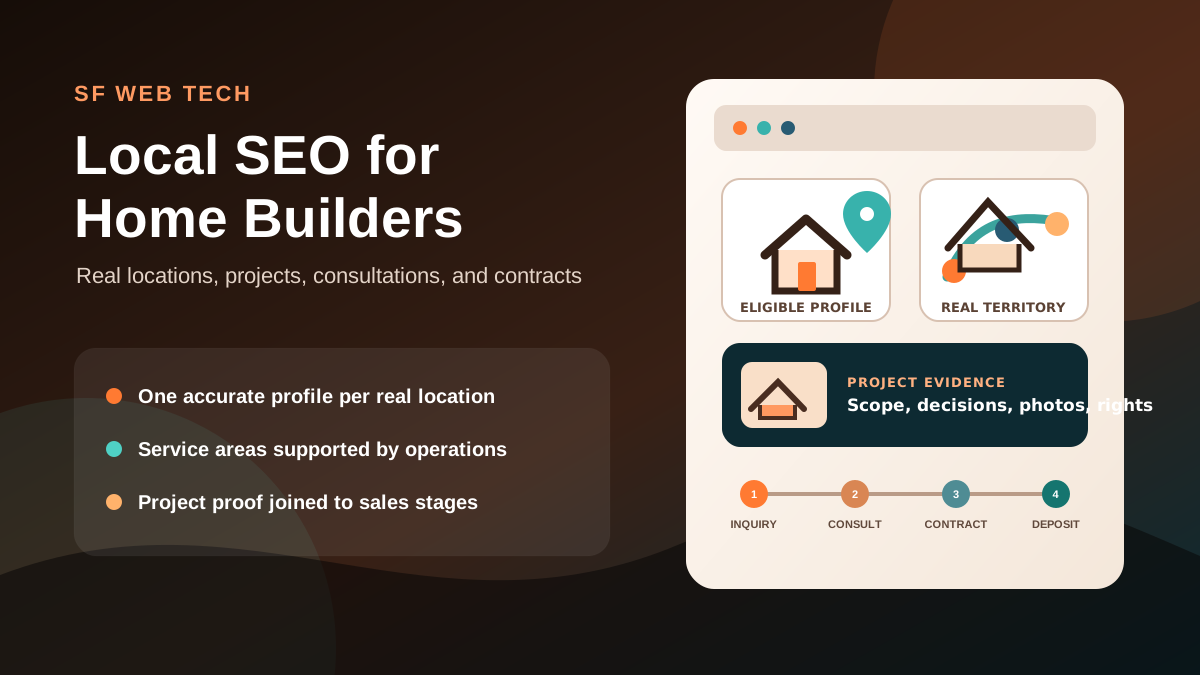
Local SEO for a home builder should help the right buyer answer three questions: does this company build the kind of home I want, does it genuinely work where I plan to build, and is its process a fit for my project? A profile full of categories and a batch of city pages cannot answer those questions alone. The useful system connects accurate business information, actual build territory, permissioned project evidence, and a website that explains the path from first conversation to a signed agreement.
Start with the operating model. A custom builder, production builder, design-build firm, and major-additions contractor may share some search terms while serving different buyers, geographies, timelines, and project requirements. Define what the company sells and where it can deliver before changing the Google Business Profile or publishing a location page. The goal is a smaller number of suitable consultations, not the largest possible count of calls and forms.
Connect local discovery, website structure, proof, measurement, and client-owned assets.
See the full contractor SEO systemConfirm profile eligibility before optimization
Google's Business Profile guidelines allow a profile for a business with a location customers can visit or a business that travels to customers. A home builder should represent the real operating location and customer contact model. A staffed sales or leasing office can be eligible, while a model home or property offered for sale is not eligible by itself. A virtual office without staff during stated business hours does not create another valid location.
Use a storefront profile when customers can visit a clearly represented, staffed location during the listed hours. Use the correct service-area configuration when the company travels to customers and does not receive them at its address. A builder with multiple true locations and separate staff can evaluate one profile for each eligible location. Do not turn a subdivision, temporary model, mailbox, or planned market into a profile because the company wants visibility there.
- Identify the legal and public business name used consistently in the real world.
- Record each staffed customer-facing office and the hours when the team is actually available there.
- Separate eligible offices from model homes, lots, projects, temporary trailers, mailboxes, and virtual addresses.
- Choose the profile type and address visibility that match how the company serves customers.
- Keep the builder as the account owner and give the agency manager access instead of transferring ownership.
Define where the company can build well
A service area should follow supervision, subcontractor coverage, site access, permitting knowledge, sales capacity, and the builder's delivery model. It should not begin as a list of every affluent city near the office. Document the counties, communities, and project conditions the team can support, then decide whether the site needs one regional page or a small number of distinct local pages.
- Explains the project types the builder accepts there
- Uses approved nearby projects and original photography
- Names real site, design, approval, or delivery considerations
- States the consultation and territory boundary honestly
- Links to the matching service, process, and project pages
- Repeats the same copy for every place
- Implies an office or project history that does not exist
- Adds unsourced permit, neighborhood, or market claims
- Targets a city the team cannot serve consistently
- Exists only because a keyword tool listed the variation
Google says local results are mainly based on relevance, distance, and prominence. Complete business information can help Google understand relevance, but an agency cannot change the searcher's distance or buy a better local ranking. That is why the territory decision must begin with serviceability. A page may explain where the builder works; it does not move the underlying business closer to every searcher.
Make the project portfolio useful local evidence
Finished homes are the builder's strongest owned evidence when publication rights are clear. A project story can explain the broad location, home type, site constraint, design goal, delivery role, and important decisions without exposing a private address. Connect each story to the relevant project-type and service-area pages so the buyer can move from inspiration to fit.
Google's image guidance recommends relevant high-quality images near useful text, descriptive filenames, and accurate alt text. Apply that literally. Put exterior images beside the site and material explanation, interior images beside the plan or finish decision, and progress images beside the construction sequence. Credit the architect, designer, photographer, and other partners when the agreement requires it. Do not reuse a client image, plan, testimonial, award, certification, or logo without the applicable permission.
- Public project name or a privacy-safe descriptive title
- Broad location only when the client and contract allow it
- Project type and the builder's verified role
- Site or design constraint that made the work distinct
- Two or three decisions that demonstrate the team's judgment
- Approved photographs with useful captions and alt text
- Links to the relevant service, process, and territory pages
Turn project types, service areas, project stories, and buyer questions into a clear site structure.
Build the supporting website architectureKeep the Business Profile accurate and useful
Use the most accurate available category and complete the fields the business can maintain. Keep hours, phone, website, appointment path, services, description, and photos aligned with the current operation. If the builder changes office access, territory, branding, or contact routing, update the profile and connected website information together. Accuracy matters more than filling every field with marketing copy.
Reviews can help future buyers evaluate the company, but the request process must remain neutral. Ask eligible customers for honest feedback in their own words. Do not offer an incentive, ask only satisfied customers, prescribe a rating, or supply location and service phrases for them to repeat. Respond to the experience described without confirming confidential project, financial, dispute, or personal details.
Request genuine customer feedback without scripting praise or turning reviews into keyword copy.
Use a responsible review workflowEarn local references through real relationships
A builder's useful local references often come from work that already exists: a builders association membership, chamber profile, architect or designer collaboration, supplier relationship, community sponsorship, development team, or editorial project feature. Each route needs truthful eligibility, permission, and an audience reason. A list of hundreds of generic directories creates maintenance work and can introduce inconsistent business information without proving buyer value.
- Maintain core business listings where customers or search systems reasonably expect the company to appear.
- Reconcile the name, phone, website, and location model before creating another profile.
- Ask partners for a project credit or profile only when the relationship is real and they approve the wording.
- Prefer local, building-industry, supplier, design, and community references that a future client may actually use.
- Track the live URL, ownership, cost, referral visits, accepted opportunities, and maintenance responsibility for every profile.
Connect local discovery to the builder's long sales cycle
Calls, forms, chat messages, and booked meetings are interactions. They can describe one buyer and one proposed home. Give the journey one stable record, preserve each marketing touch, and link duplicate interactions instead of counting them as new opportunities. Keep the source observed by the website or provider separate from the source the prospect says influenced the decision.
The commercial stages should match the builder's process. A practical sequence may include inquiry, accepted opportunity, initial consultation, land or site review, design or preconstruction agreement, proposal, signed construction agreement, deposit, progress billing, and collected revenue. The exact stages differ by business. The rule is consistent meaning: a consultation is not a contract, a proposal is not revenue, and a signed agreement is not collected cash.
- Capture the landing page, referrer, campaign data, and provider source without overwriting them later.
- Ask how the prospect found the builder and store the answer as declared source.
- Deduplicate the journey by the business's approved identity rules while keeping the touch history.
- Record serviceability, project type, territory, land or site state, broad fit, timing, and the next action.
- Advance consultation, preconstruction, proposal, contract, deposit, and revenue from the system that owns each fact.
- Review accepted opportunities and commercial progression by landing page and source, with unattributed cases left visible.
Work backward from capacity, gross profit, close rate, and the cost of winning a signed project.
Set home builder acquisition economicsUse one evidence cycle before expanding
Begin with the eligible profile, the main project-type pages, a clear service-area explanation, a small set of approved project stories, and the complete inquiry-to-contract record. Confirm that each item is crawlable, current, and useful on a phone. Then observe which queries and pages attract suitable prospects, which inquiries are rejected, and where accepted opportunities stop moving.
Expand only when another page or profile can answer a distinct buyer problem with real evidence. A new community page may be justified when the builder has current work, useful local knowledge, and a different consultation question there. Another project-type page may be justified when the process, proof, and qualification rules differ. Do not publish one page for every query variation. Google's current AI search guidance recommends valuable non-commodity content and warns against separate pages made mainly for search variations.
Local SEO for home builders is strongest when every public fact matches the operation. Use an eligible profile, an honest build territory, approved project evidence, clear project and process pages, neutral reviews, real local relationships, and a sales record that reaches contracts and payments. That system gives buyers useful answers and gives the builder evidence for deciding what to improve next.
Review profile eligibility, service areas, project evidence, website structure, and lead-to-contract measurement.
Plan a home builder local SEO systemSources and further reading
- Google Business Profile: guidelines for representing your business
Storefront, service-area, location, address, staffing, and accurate-representation rules. Does not substantiate a ranking or lead result.
Source checked .
- Google Business Profile: eligibility and ownership guidelines
Model homes and properties for sale are ineligible by themselves; sales or leasing offices can be eligible. Owner and manager roles should reflect the real business relationship.
Source checked .
- Google Business Profile: local ranking guidance
Google's broad relevance, distance, and prominence framework and its statement that a business cannot request or pay for better local ranking.
Source checked .
- Google Maps: prohibited and restricted content
Rules against fake engagement, incentives, rating manipulation, and selectively soliciting positive reviews.
Source checked .
- Google Search: image SEO best practices
Relevant high-quality images near useful text, descriptive filenames, and accurate alt text. Practical builder examples are SF Web Tech recommendations.
Source checked .
- Google Search: creating helpful content
People-first, original, useful content with clear authorship and purpose. Does not establish rankings or traffic outcomes.
Source checked .
- Google Search: optimizing for generative AI features
Non-commodity useful content and the warning against separate pages created mainly for query variations or scaled manipulation.
Source checked .