A water damage lead can lose value while it sits in a general inbox. The caller may be standing near wet electrical equipment, dealing with contaminated floodwater, trying to reach a tenant, or asking for a service your company does not perform. A long form and a slow callback do not qualify that person. They create delay when the first job is to establish a safe, appropriate next action.
The right system uses a short digital intake, a trained human response, and clear routing rules. It identifies immediate hazards without pretending to assess them remotely, confirms whether the property and loss fit your operation, and checks whether a crew can meet the promise being made. Strong qualification does not mean rejecting more callers. It means moving dispatch-ready work faster while giving every other inquiry an honest route.
Define the calls your operation can actually serve
Start with operational truth. A residential extraction company, a large-loss commercial team, a mold remediation specialist, and a full-service fire and water restorer can appear for overlapping searches while accepting very different work. Write the fit rules before changing the website or ad campaign. Otherwise the office is forced to invent policy during a stressful call.
Separate eligibility from priority. A property outside your real response radius or a request for work you do not perform may be ineligible. A caller who needs landlord approval, a loss with no current access, or a non-urgent moisture concern may still fit but require a different route. If every obstacle becomes a bad lead, the company loses future work and marketing never learns what actually happened.
- Service area: the property is inside a territory the available team can reach and support
- Service fit: the reported event belongs to work the company is equipped, trained, licensed, and insured to evaluate where required
- Property authority: the caller owns, occupies, manages, represents, or has permission to coordinate access to the property
- Access: the caller can explain occupancy, entry, utilities, pets, security, tenants, and any known restrictions
- Response fit: the current crew, equipment, and supervision capacity can support the next step being promised
- Communication path: the team has a reachable contact and knows who must approve inspection, mitigation, or further work
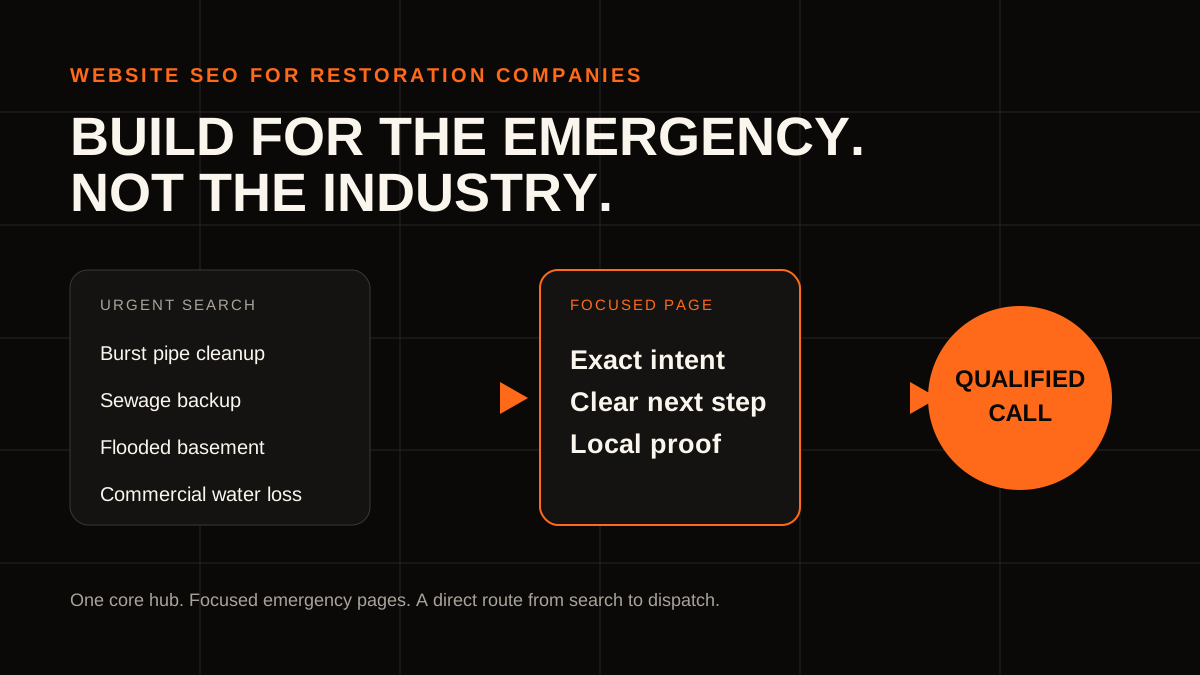
Connect burst pipes, sewage backups, flooded basements, storm losses, and commercial work to focused pages and clear dispatch paths.
Build service pages around the emergencies you acceptPut safety escalation before sales qualification
A marketing team should not tell a caller that a wet building is safe. Ready.gov warns that floodwater can contain dangerous debris or contamination and that wet electrical equipment and standing water can present an electrocution risk. The federal guidance tells people not to touch wet electrical equipment or touch it while standing in water. Your intake process should recognize reports that require an approved safety script or referral to emergency services, utilities, building management, or another qualified authority.
The script should be written with the company's safety, legal, and technical leadership. Call takers need clear triggers and boundaries, not improvised advice. They can ask what the caller observes, whether anyone may be in immediate danger, whether the water source is still active, and whether authorities or a utility have already been contacted. They should not declare the building safe, classify contamination remotely, or instruct an untrained person to enter a hazardous area.
Use a short form that prepares the first conversation
Emergency visitors do not want to complete a damage inventory before anyone answers. Put a prominent phone route first, then offer a compact form for people who cannot call. Ask only for information that changes safety escalation, coverage, preparation, or routing. Optional photos can help the team understand what the caller sees, but only when files are handled securely and reviewed by trained staff.
- Collect the property address or ZIP code and the best callback number.
- Ask whether the situation is happening now, recently discovered, or a planned assessment.
- Offer broad event choices such as supply-line leak, appliance leak, roof or storm entry, sewage backup, groundwater or floodwater, fire suppression, commercial loss, or not sure.
- Ask whether the source appears active and whether the caller has already contacted the appropriate utility, emergency authority, property manager, or plumber when needed.
- Identify residential, multifamily, commercial, institutional, or other property context.
- Ask whether the caller can authorize access or who else must be involved.
- Provide an open notes field for visible conditions, affected areas, access limits, and the reason for acting now.
- State who will respond and what the first callback will cover.
Avoid fields that ask the customer to choose a technical classification, estimate hidden moisture, confirm mold, select demolition, or predict insurance coverage. Those answers may be unreliable and can make the form feel like a test. The caller should report observations in plain language. Your team applies the approved assessment process later.

Let a trained call taker confirm the dispatch context
The first call should verify the intake and fill the gaps required for routing. Confirm the exact property, caller relationship, current occupancy, observed source, affected spaces, access restrictions, contact path, and any action already taken by utilities or authorities. Then compare the request with the company's service boundaries and current dispatch board.
Capacity is part of qualification. A campaign can create valid demand while the operation is unable to accept it. During a freeze, storm, or major building loss, the office should know which jobs can be dispatched, which require supervisor review, which can enter scheduled follow-up, and which need a referral. Marketing should never advertise an arrival time or continuous availability the current operation cannot reliably provide.
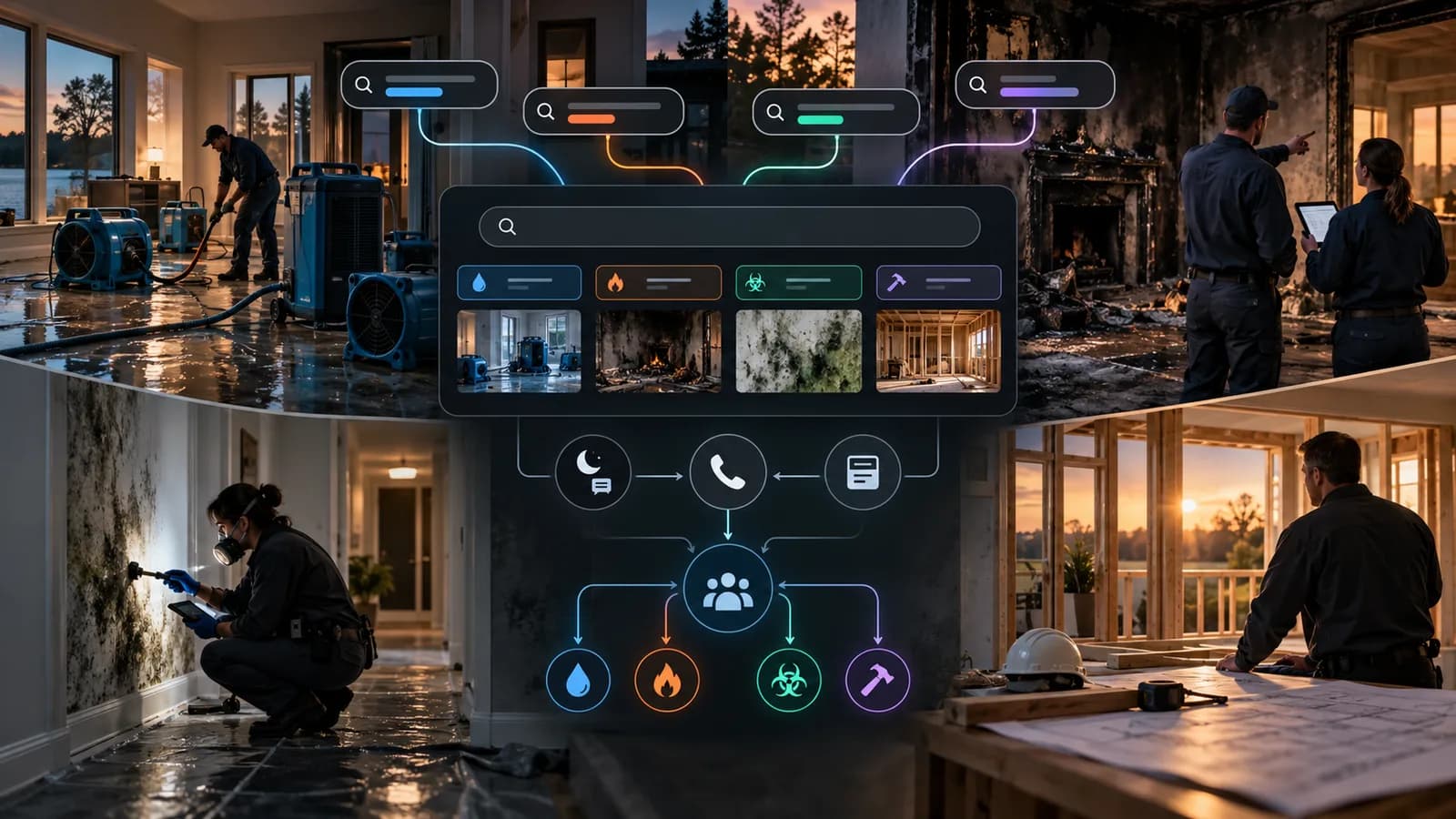
Structure campaigns around emergency intent, service lines, geography, call handling, and the work your crews can fulfill.
Align paid search with real restoration capacityCreate more useful outcomes than booked and lost
Booked and lost are too crude for restoration. A strong-fit caller may need a supervisor callback because the loss is commercial. A property manager may need authorization. A storm inquiry may be valid but outside current capacity. A request may belong to plumbing rather than mitigation. Record the next action and the reason so the office can follow through and marketing can improve.
- Every call labeled as a lead
- Missed calls mixed with answered calls
- No separation by loss or property type
- Outside-area work deleted from the report
- Dispatch stops the measurement
- Unique inquiries connected across calls and forms
- Safety escalation and service fit recorded separately
- Loss, property, geography, and authority retained
- Capacity declines and referrals assigned a reason
- Completed work tied back to the original source
- Immediate dispatch: service and capacity fit are confirmed for the approved response
- Supervisor review: scope, property type, hazard report, or size requires higher-level judgment
- Information or authorization pending: access, owner approval, location detail, or contact information is incomplete
- Scheduled assessment: the situation fits but does not require the emergency dispatch lane
- Capacity unavailable: the request fits, but the company cannot make an honest response commitment
- Partner or authority referral: another trade, utility, emergency service, or specialist is the appropriate next contact
- Outside scope or area: the property or requested service does not match written operating boundaries
- Unable to reach: the approved callback sequence ended without contact
Follow the opportunity through assessment and completed work
The source report should not end when dispatch is created. Follow accepted opportunities through arrival, assessment, authorization, mitigation, monitoring, reconstruction where offered, and completion. Keep the definitions appropriate to your business. A commercial loss with a longer approval path should not be judged on the same timeline as a residential extraction call.
Google Ads Help documents offline conversion imports for outcomes that happen after an ad interaction. It also documents enhanced conversions for leads, which use hashed first-party customer data to improve measurement when implemented correctly. A restoration company can return a consistently defined qualified lead or later outcome instead of teaching the platform that every form is equally valuable. Implementation still requires proper consent, access controls, customer-data policies, and qualified privacy guidance. Hashing is a measurement mechanism, not permission to upload data.
Choose the deepest stage the office records accurately every time. A reliable qualified-dispatch event is more useful than a completion event updated only when someone remembers. Audit records against the dispatch system, CRM, job management platform, and accounting process. When the team can maintain a deeper event consistently, use it to judge pages, campaigns, calls, and forms.
Connect emergency pages, phone actions, short forms, trust proof, and tracking to the way your restoration team actually responds.
Build a website and lead path for faster routingUse follow-up that respects urgency and uncertainty
Not every serviceable lead becomes an immediate dispatch. The source may have been stopped, the caller may be waiting for owner approval, or access may not be available yet. Build follow-up lanes for pending authorization, scheduled assessment, commercial review, and unable-to-reach inquiries. State what the company can do next without promising coverage, reimbursement, drying duration, or a specific scope before the facts are known.
Moisture concerns also need careful language. The EPA advises acting quickly on mold and moisture, fixing the source, and drying wet materials. Its homeowner guidance says professional help may be appropriate when there has been extensive water damage or when mold contamination is extensive. Use that guidance to support urgency and responsible assessment, not to tell every caller that mold is present or that one clock determines every building outcome.
- Review missed calls, voicemail response, and form response by hour and source.
- Audit whether safety triggers and service boundaries are applied consistently.
- Compare inquiries, answered contacts, qualified opportunities, dispatches, arrivals, authorizations, and completed work.
- Break outcomes down by loss type, property type, geography, landing page, campaign, and capacity status.
- Use recurring rejection reasons to tighten ad targeting, page language, service-area claims, and partner routes.
- Review a permitted sample of calls under the company's privacy, recording, and quality process.
A strong restoration lead system protects people, dispatch capacity, and marketing spend at the same time. Define the work you can serve, put safety escalation first, keep the intake short, use trained human judgment, record a meaningful next action, and follow qualified opportunities through completed work. The result is not merely more calls. It is a clearer pipeline of losses your team can respond to honestly and fulfill well.
Book a discovery call to connect emergency search intent, website routing, call handling, capacity, and lead attribution.
Map your restoration lead qualification systemSources and further reading
- Google Search: SEO Starter Guide
Crawlable links, descriptive page information and content organization. Practical trade examples are SF Web Tech recommendations.
Source checked .
- Google Ads: offline conversion imports
Connecting supported offline outcomes with advertising measurement. Lead qualification and contribution calculations are SF Web Tech operating guidance.
Source checked .
- EPA: mold, moisture and your home
Moisture and drying guidance. Marketing content cannot diagnose an individual property.
Source checked .