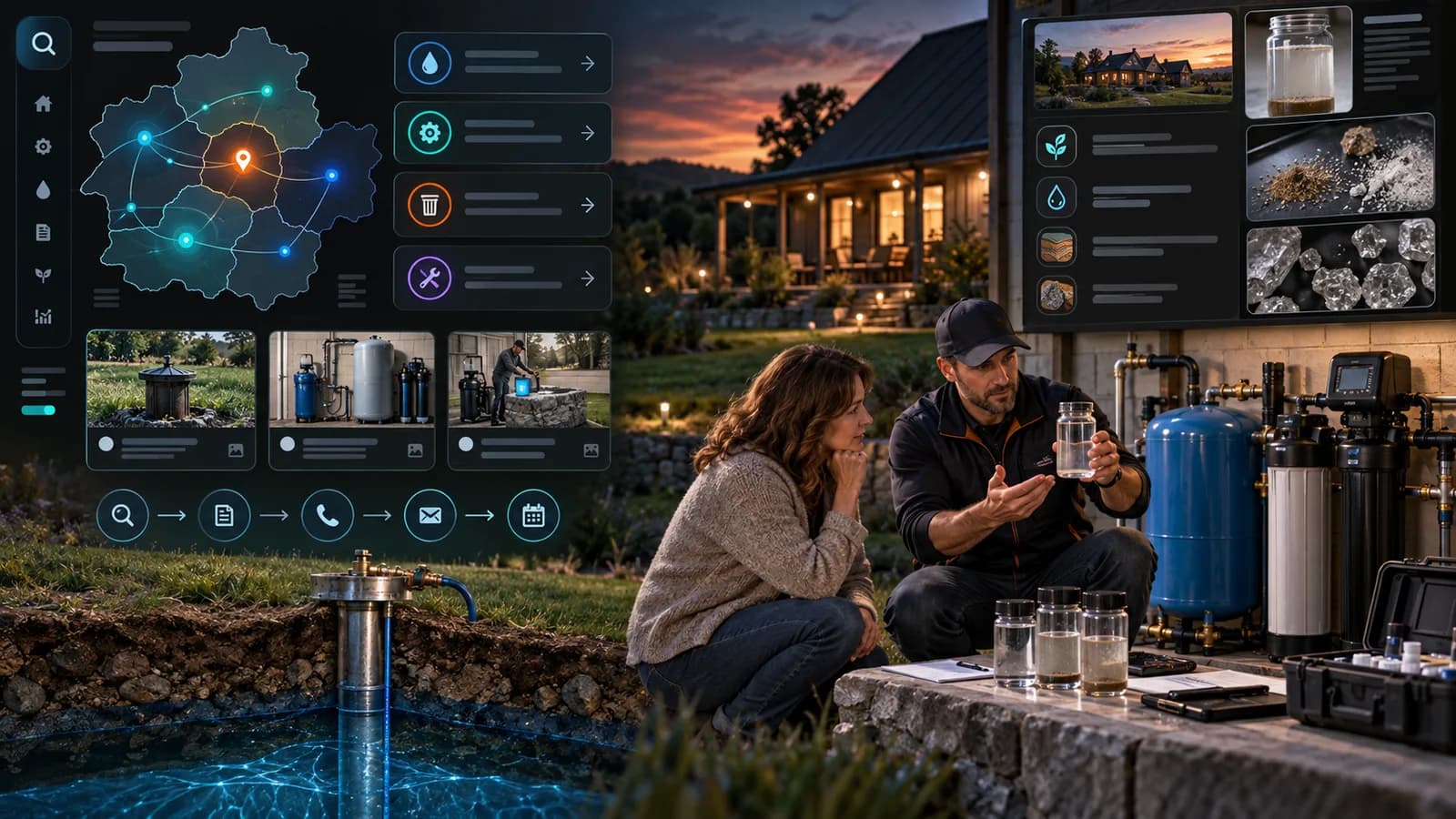
A homeowner two townships over just noticed rust-colored rings around every sink in the house. Their coffee tastes like a penny, the white towels are turning orange, and the dishwasher that was fine last spring now leaves grit on the glasses. They pull out their phone and type 'why is my water staining everything.' They do not type 'water softener company.' They have no idea that is what they need yet. Whoever owns the answer to that first panicked search owns the sale.
Well-water customers may describe a concern before knowing what service is appropriate. Explain the assessment process and route health or water-safety questions to authoritative testing guidance. Symptom language can help navigation, but cannot establish contamination or prescribe treatment.
Confirm where the actual customers and service routes are before choosing a content structure. Wells can serve different property settings; do not assume every prospect lives outside a city or that near-me search follows a separate ranking system.
Choose geography from actual coverage and customer records
Public water comes from a municipal utility. Private wells do not. That single fact reshapes your whole geography. Around 13 million US households get their water from private wells (USGS private well data), and those households are not clustered downtown. They sit on acreage, along rural routes, in exurban subdivisions and farm townships spread across whole counties.
Use customer addresses, service routes and inquiry records to understand the operating area. Explain counties, townships or ZIP codes only when they match real coverage. Search engines do not use a separate ranking system for rural businesses, and a county structure is not automatically better than a clear service-area overview.
Well-water businesses may need content and qualification paths that reflect water source, testing, treatment scope, geography, and serviceability. Use current customer and operating evidence to decide which opportunities deserve priority.
Build a service-area architecture organized by county
Explain genuine coverage clearly. A county or township page should provide distinct service or project information. Use a service-area overview where separate pages would only repeat names, and leave water-safety conclusions to appropriate testing.
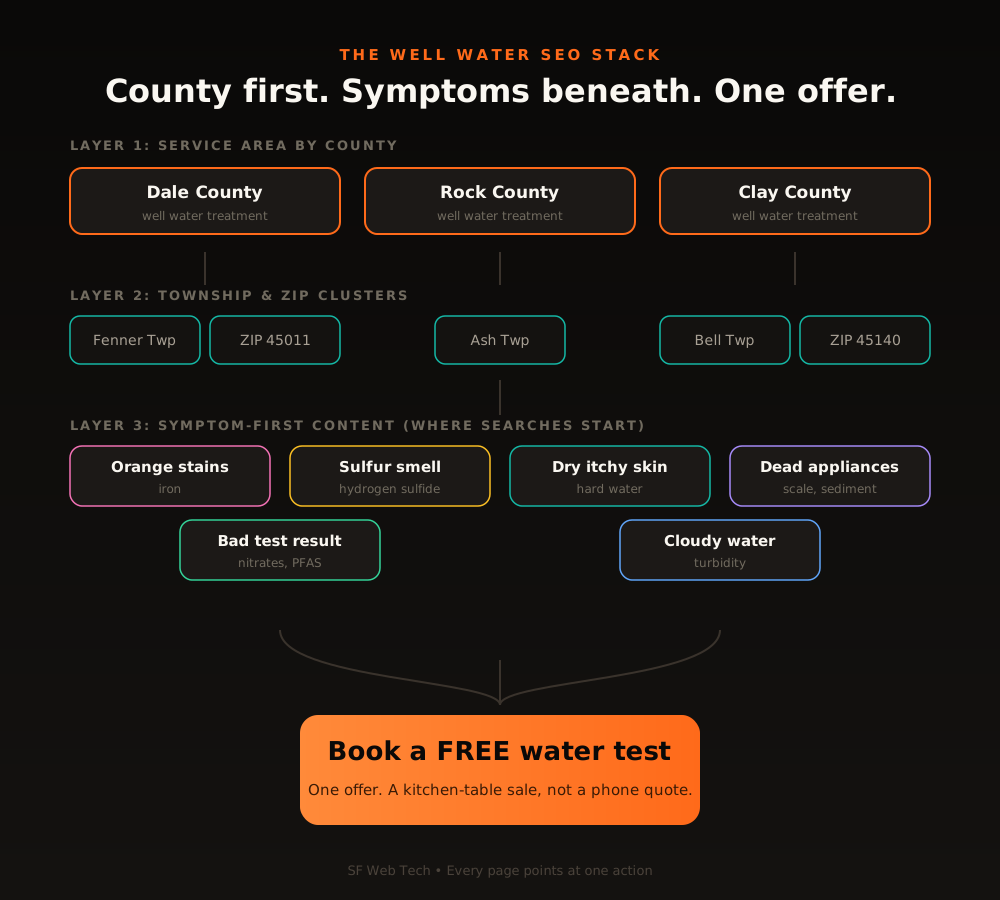
- List every county you actually service, then the townships and ZIP clusters inside each one. This is your map, not a guess.
- Give each county its own page with unique content: the water problems common to that county's geology (iron, sulfur, hardness, nitrates), the towns you cover, and local proof.
- Nest township and ZIP-cluster pages under the county they belong to, so your URL structure reads like your service map.
- Name pages by the term a well owner would search: 'well water treatment in [County]', not 'Service Area 7'.
- Put a real address and service radius on your Google Business Profile, then let the county pages carry the places you cover but do not have a storefront in.
The closest trade to yours is septic service: same rural buyer, same county-shaped market, same 'no downtown' geography. If you want to see this county-first architecture applied end to end, the septic playbook maps almost one to one onto water treatment.
The closest analog to well water: rural, county-shaped, low-competition
Read the septic county-geography playbookBuild a symptom-aware education layer with safety boundaries
Customers may describe staining, odor, taste or equipment problems before they know which service applies. Explain the assessment process, cite authoritative testing guidance and avoid diagnosing contamination from a symptom. The useful content is the page that helps the customer choose a safe next step.
Each symptom page does the same job: name the problem in the homeowner's language, explain the likely cause, and route them to a free water test rather than a hard sell. The service pages ('water softeners', 'reverse osmosis', 'iron filtration') still exist, but they sit above the symptom layer and catch the buyer once they know what to ask for.
Combine clear service pages with responsible answers to common testing and assessment questions. Explain what requires a qualified test and what the business actually offers. Avoid fear-based copy, unsupported low-competition claims or advertising a free test unless that is the real offer.
Coverage, customer questions, assessment paths, and local profile accuracy within the agreed scope.
See how we structure Local SEO for home-service tradesKeep Google Maps information accurate across a broad service area
Use the correct Business Profile configuration for the operating model and describe real service areas honestly. Keep services, hours, photos and contact details current. Reviews and county pages may help customers evaluate the business but do not do geographic heavy lifting or guarantee visibility.
Use an accurate service-area profile configuration for the business model. Publish genuine job photos with permission and invite honest reviews without selecting only happy customers or prescribing place names. State contact and appointment options that are currently supported.
Invite eligible customers to leave honest feedback in their own words. Do not prescribe place names, symptoms or a preferred rating. Google does not publish a formula in which recent geographically specific reviews guarantee that one business outranks another.
Maintain accurate profile information and a neutral customer-review process.
Optimize your Google Business Profile the right wayEvaluate an in-home water assessment offer
An in-home water test can be a useful assessment step when the company actually offers it, the technician is qualified for the represented work, and the page explains the test’s scope and limitations. State any fee, follow-up, laboratory requirement, and sales relationship clearly; a test request is not automatically a qualified sale.
“A no-cost or paid water assessment can be an offer when the business actually provides it and explains the terms, testing scope and limitations. Measure how many requests become qualified appointments and paid work. Do not claim that one offer produces most industry leads without current evidence.”
Use the action that matches the real operating process, such as requesting an assessment or scheduling a water test. State price, eligibility and limitations clearly. An in-home visit should inform the customer; it does not make a product sale automatic.
Your 30-day well water SEO playbook
- Document the real service area using the Business Profile fields and formats Google currently provides.
- Create a county or town page only when real coverage, distinct water conditions, supported evidence, and useful customer guidance justify it.
- Keep profile services, hours, contact details, and service areas aligned with current operations.
- Build symptom guidance only for conditions the company can assess accurately, and explain when laboratory or third-party evaluation is required.
- Use a relevant next step, such as requesting a documented test or consultation, without implying that every visitor needs the same action.
- Add no township or ZIP page until genuine coverage and distinct information support it; consolidate pages that would repeat the same content.
We build the county architecture and symptom layer for home-service trades
Book a call and map your county-first SEO planHelp a customer move from a question to authoritative testing and an appropriate assessment. Build coverage and service information from real operations, then measure accepted inquiries, qualification, booked appointments and paid outcomes separately.
Sources and further reading
- Google Search: SEO Starter Guide
Crawlable links, descriptive page information and content organization. Practical trade examples are SF Web Tech recommendations.
Source checked .
- Google Business Profile: local ranking guidance
Google’s broad relevance, distance and prominence guidance. No exact ranking weights or guaranteed service-area coverage are stated.
Source checked .
- Google Maps: prohibited and restricted content
Rules against fake engagement, incentives and selectively soliciting positive reviews.
Source checked .
- EPA: protect your home’s water
Private-well testing and water-quality guidance; symptoms alone do not establish safety or a treatment prescription.
Source checked .