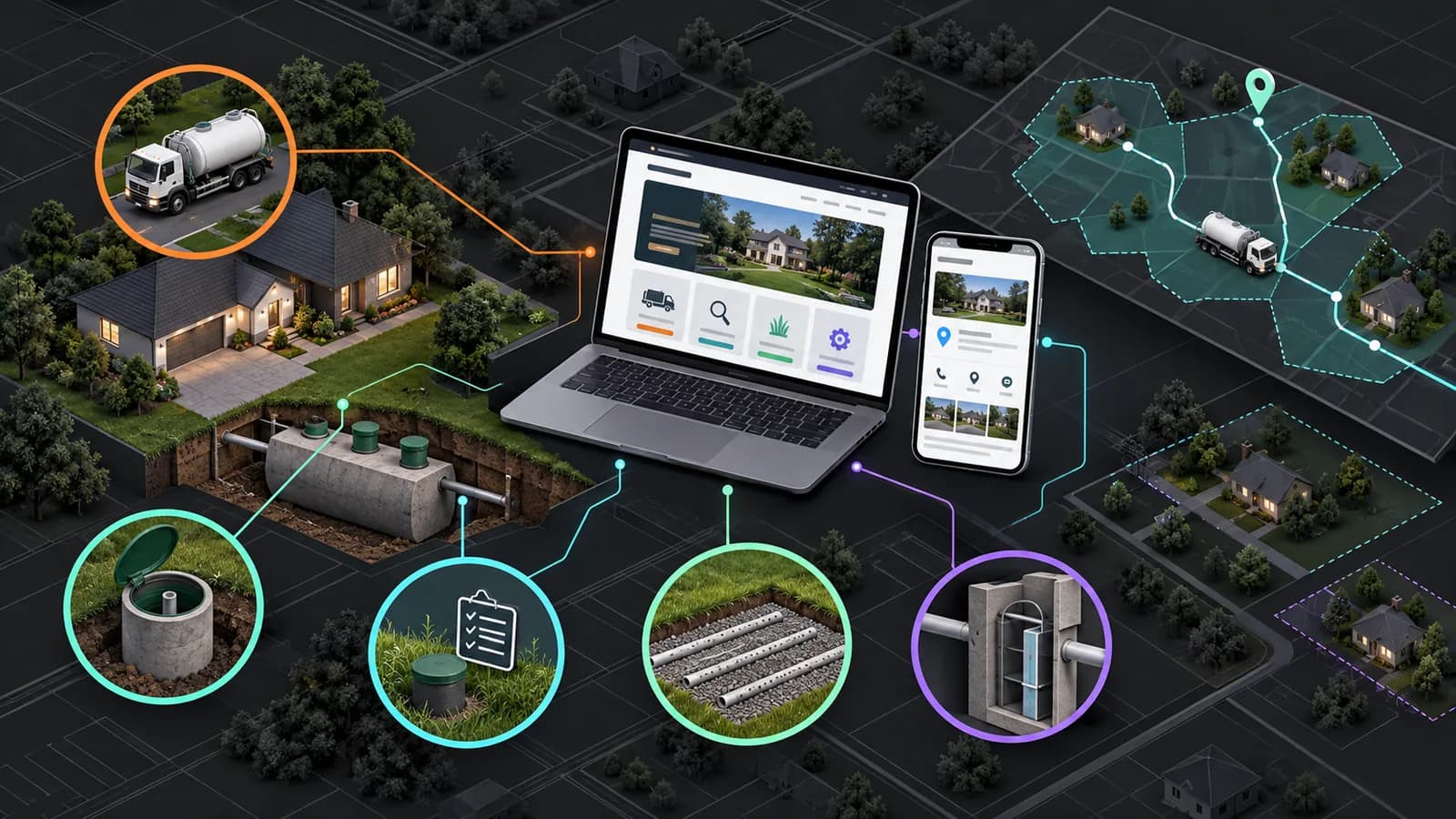
A homeowner in a rural county wakes up to sewage backing into the basement shower. She grabs her phone and types emergency septic near me. Ninety minutes away, a different homeowner sits with coffee and searches how often to pump a septic tank cost. Same trade. Same truck. Two completely different searches, and two completely different tickets.
Pumping, inspection and emergency service can involve different needs. Help the visitor find the service actually offered and understand availability. Separate pages when they contain distinct scope and useful information; a longer services page does not automatically fail to rank.
One Services page loses every emergency query
Emergency and planned septic work can require different information, availability, qualification, and next steps. Separate them when the business genuinely supports both and can provide useful distinct content. Publish only staffed hours and verified maintenance terms, then compare qualified visibility and inquiries rather than assuming a page split will win a query.
For each substantial service page, explain assessment, estimate factors and the next step. Advertise after-hours response only when staffed. Maintenance intervals should follow the actual system and authoritative guidance, rather than a universal schedule.
Use a service hub to connect pumping, inspection and other work actually offered. Give emergency visitors accurate availability and a clear phone path. A separate URL or schema block does not guarantee a search position.
Build three pages, not one
Break the single Services page into three intent-specific pages. Each one targets a different searcher, a different urgency, and a different ticket size. Here is the split that does the heavy lifting.
Septic is a county game, not a city game
Septic service areas can include cities, townships, rural routes, and unincorporated communities. Document how customers describe their locations, where crews operate, and which services are available before choosing the geographic structure for the site.
Create a county or rural-area page when it represents genuine coverage and contains distinct information such as served communities, relevant service details, local requirements, permissioned projects, and an accurate next step. Consolidate pages that would repeat the same content, and measure qualified leads without promising rankings.
- Name the county in the H1, the URL, the intro, and the page title
- List the real towns, townships, and unincorporated areas you cover inside it
- Reference local specifics: county permit rules, common soil or drain field conditions
- Add reviews and job photos from that county, not generic stock
- Link each county page to your emergency and pumping pages so intent and geography reinforce each other
County pages, GBP tuning, and review systems built for rural service businesses.
See how our Local SEO service maps your service areaReview another rural service path where coverage, testing questions and treatment scope need clear explanations.
Compare local SEO for well water treatment servicesWire your Google Business Profile to match
Keep the website and Business Profile consistent about actual services and coverage. Choose categories that accurately describe the business, and add secondary categories only when those services are genuinely offered. Consistency helps customers evaluate fit but does not guarantee a ranking change.
Then use the service entries inside the profile the same way you split your pages. Add distinct services for emergency septic service, septic tank pumping, and drain field repair, each with its own short description. Set your service areas to the counties and towns you cover, not a random radius, so the where in your profile mirrors the county pages on your site.
Urgent service and routine maintenance need accurate scope and availability information. Make it easy to reach the office for assessment without promising that a particular page structure always wins the job.
The county page playbook, in five steps
You do not need fifty pages on day one. Start with your top revenue counties and build out. Follow these five steps for each one.
- Pick the county: rank your service counties by lead volume and ticket size, and start at the top
- Write the page for a real person: county name in the H1, towns listed, local detail included
- Add proof from that county: reviews, before-and-after photos, and named job locations
- Cross-link the intent pages: point the county page at your emergency, pumping, and drain field pages
- Mirror it in your profile: add that county to your GBP service areas so the signals agree
We build intent-split pages, county geography, and GBP tuning for home-service contractors.
Want this built without hiring in-house? See contractor SEOReviews and emergency proof close the loop
Reviews can help a customer evaluate recent service experience. Invite eligible customers to leave honest feedback in their own words, without incentives, positive-only screening or prescribed emergency and repair phrases. Keep review activity separate from visibility, calls, qualification and booked work.
On the emergency page especially, prove the promise. If you answer after hours, say the hours. If you can be on the road within a set window, say the window honestly. Vague speed claims read as filler. A concrete, defensible promise reads as the company that actually shows up.
Request eligible feedback without rating filters, scripted keywords, or promised ranking outcomes.
Use a neutral customer-review processHelp visitors choose between emergency and routine service, understand genuine coverage and reach the current contact path. Add separate pages or county information only when they contain distinct useful details. Measure accepted inquiries and bookings rather than assuming a page structure wins a search or job.
We will map your counties, audit your profile, and show you where the emergency leads are leaking.
Book a free septic SEO strategy callSources and further reading
- Google Search: SEO Starter Guide
Crawlable links, descriptive page information and content organization. Practical trade examples are SF Web Tech recommendations.
Source checked .
- Google Business Profile: local ranking guidance
Google’s broad relevance, distance and prominence guidance. No exact ranking weights or guaranteed service-area coverage are stated.
Source checked .
- Google Maps: prohibited and restricted content
Rules against fake engagement, incentives and selectively soliciting positive reviews.
Source checked .