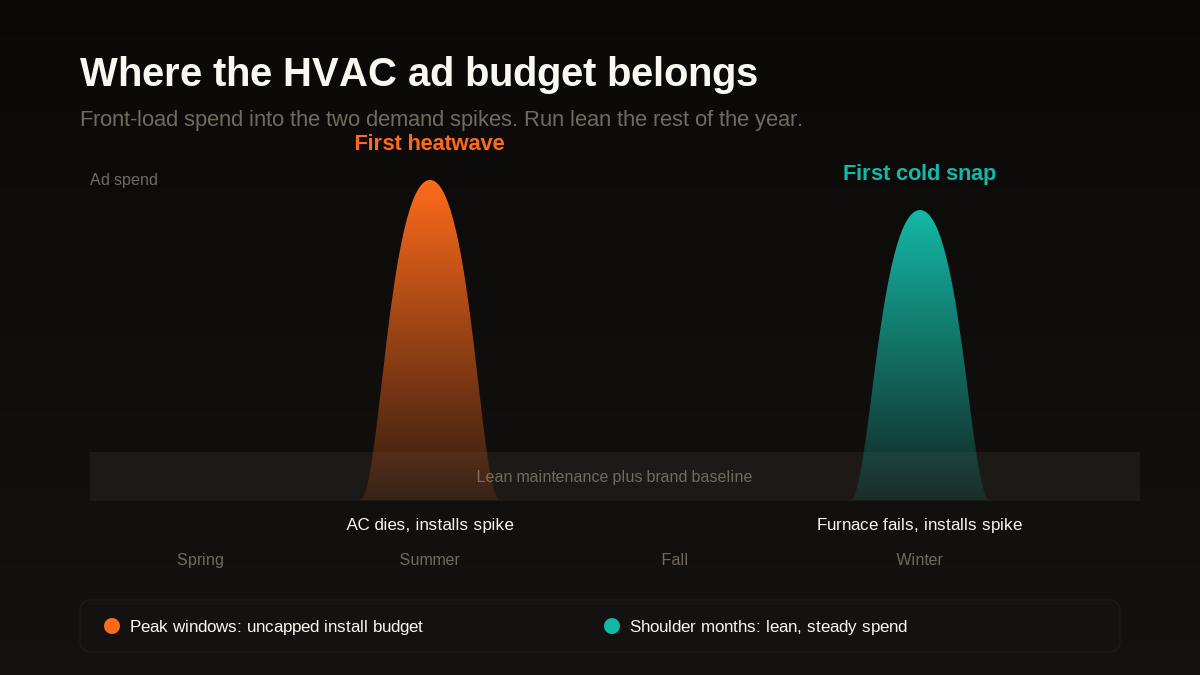
HVAC demand moves with the weather, and it moves faster than search does. When the first heat wave or the first cold snap lands, a homeowner with a dead system searches for whoever shows up, serves their area, and looks trustworthy right now. If your Business Profile, service pages and reviews are not already in order, you are trying to fix them during the exact week you have no time to spare.
That window is already too tight to build from scratch. Search systems need time to crawl and process changes, while customer demand and crew capacity shift on their own schedule. Prepare accurate local information in the quiet months before each season, without promising yourself a universal 60-to-90-day ranking clock.
HVAC local visibility is a seasonal game
HVAC is one of the most schedule-driven trades in home services. A plumber gets emergencies year round. You get two corridors where demand climbs quickly, capacity tightens, and the phone decides your month. Local search visibility, the kind that shows your company in the map results and the organic listings, builds gradually from accurate information and useful evidence. It does not appear the moment you need it.
Google describes local results through relevance, distance and prominence. You can influence relevance and prominence by keeping your profile and pages accurate and earning honest reviews. You cannot control how far a searcher sits from you, how the platform processes a change, or the final ranking. The work that moves is the preparation, and preparation has a lead time.
Map your two prep windows: cooling and heating
Most HVAC marketing advice treats the business as one season. It is two. Air conditioning demand climbs toward the first sustained heat, and heating demand climbs toward the first hard freeze. Each peak has its own shoulder window where the schedule is calmer and the local groundwork can actually be done.
Timing varies by climate, system mix and local habits, so do not borrow a national calendar. Use the company's own dated calls, estimates, installs and maintenance visits to find when demand actually rises in each market, then count back far enough to publish, verify and correct before the rush. Work both prep windows in sequence across the year.
Audit the Google Business Profile before demand spikes
The profile is the first thing a local searcher sees and the fastest thing to fix in the quiet months. Confirm the primary category, the services you genuinely offer, the real area you cover, accurate hours, and current contact routes. Replace stale photos with authorized images of real work. A profile that lists only air conditioning repair hides the heating, indoor air and ductwork a homeowner may be searching for. Our Google Business Profile playbook walks through the fields contractors leave empty.
Category selection, service entries, posting cadence, and the profile fields contractors leave empty.
Read the full GBP optimization playbookList cooling, heating, indoor air and venting as distinct services
Homeowners do not search for HVAC. They search for the specific thing that is wrong or the specific upgrade they want. Split your service entries so each one maps to a distinct job with its own urgency and its own price point, and keep every entry accurate to what the company actually delivers:
- Air conditioning repair and replacement, with scope and scheduling information
- Heating repair and furnace or heat pump replacement, with equipment context explained
- Maintenance and tune-ups, with what a visit covers and when to book it
- Indoor air quality services, such as filtration and humidity control, described plainly
- Ductwork and venting work, with inspection, sealing and airflow context
- Thermostat and controls, with compatibility and installation notes

Update the profile and supporting pages when seasonal services, availability or customer questions materially change. Keep the wording accurate for the current operating period, and judge engagement and qualified inquiries rather than treating a posting interval as a ranking factor.
Build one service page per problem, not one page for everything
A single page titled HVAC Services competes for nothing in particular. Homeowners search for the problem in front of them, and each of these deserves its own page with accurate scope, real project evidence, and a clear next step.
Publish these as a connected set rather than one by one in isolation. When several pages are ready, link them so customers and crawlers can move between related services. Record dates and confirm indexing, but do not assign each page a universal maturity clock.
Name the towns you actually serve
An HVAC company usually serves a mix of a core city, surrounding suburbs and some outlying towns. Use real call, route and completed-job data to understand where demand and crew capacity genuinely overlap. A stated service radius does not guarantee local visibility across that radius.
Distance affects local results, so record observations from agreed locations and never present a remote town as another office. Layer coverage into the build by naming the actual towns and counties you serve inside your service-area description, your service page copy, and your profile. Name the places. That is the language your customers type, and the signal a crawler can read.
Turn maintenance agreements into a year-round engine
Maintenance agreements are not just a sales product. They are a local-SEO asset. They fill the shoulder months with scheduled work, give you a steady and honest reason to ask for reviews, and keep your company the first call when a system finally fails. The off-season visit you complete in spring is the five-star review you will want in the heat of summer. For the economics of that first call, see how we think about the cost per booked HVAC replacement.
“Quieter periods can be used to document services, projects, credentials and customer questions before operating demand increases.”
Earn reviews on a seasonal cadence, within Google's rules
Ask eligible customers for honest feedback after real service, without incentives and without selecting only the happy ones. Keep reminders reasonable and let customers choose whether to respond. There is no confirmed formula that makes one review schedule universally superior, and offering anything in exchange for a review violates Google's policy.
Your slow season is the ideal harvest window precisely because it is slow. Every tune-up, every filter change, every small duct repair between the peaks is a review you actually have time to request properly. Ask on site while the technician is there and the homeowner is relieved, then send one follow-up the same day with a direct link. That beats an automated sequence that fires days later into a full inbox.
Neutral invitations, reasonable reminders and professional responses, without a promised review or ranking cadence.
Build an honest contractor review processRelevance, distance and prominence: what you can and cannot control
Google states that local ranking comes from relevance, distance and prominence, and that there is no way to pay for a better local position. More and better reviews can help prominence, but the weighting is not published and the result is not guaranteed. Keep your profile and pages accurate, earn honest reviews, and accept that distance and platform processing are outside your control. Then compare paid support against organic work using real auction, capacity and sales evidence rather than an assumption that one always beats the other.
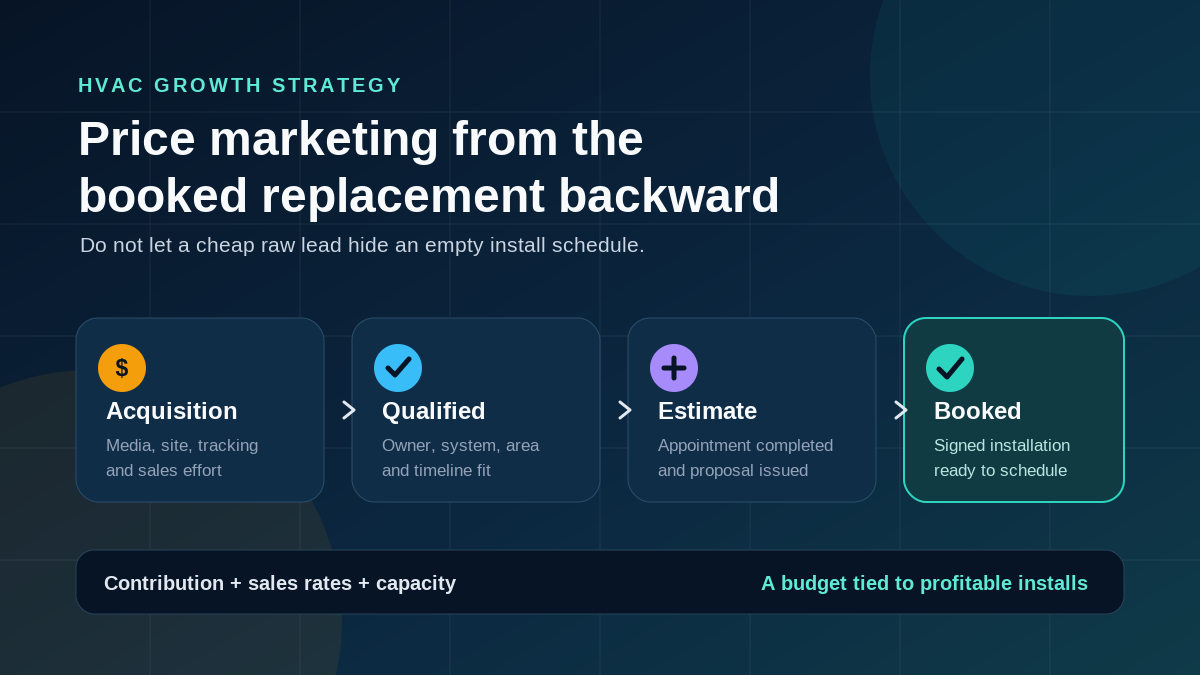
Paid media can create visibility while organic work develops, subject to competition, budget, capacity and campaign quality. A late start still narrows the time available before demand, so weigh the paid-search option for HVAC companies against the actual calendar and economics rather than a reflex.
Build the runway from your own calendar
Use historical calls, estimates, installs and weather context to identify each busy period, then work backward far enough to publish, test, correct and measure the customer journey before capacity tightens. If a peak is already close, set realistic expectations for new organic work and protect current demand with the channels you can support. Durable pages still serve future customers, but no page earns a guaranteed ranking date.
- Publish supported pages and confirm indexing separately
- Keep eligible profile services, hours and contact details accurate
- Invite honest feedback consistently after eligible work
- Compare dated visibility and qualified inquiries against the demand curve
- Record observed local visibility without promising a market-wide position
- Adjust paid support only after reconciled qualified and sold outcomes
- Publish material before the business can verify or support it
- Change profile information without recording the reason or the outcome
- Request reviews in bursts or with rating, sentiment or keyword bias
- Assign a fixed maturity date to new pages or profile work
- Infer market-wide map visibility from one query and location
- Increase media spend without current auction, capacity and sales evidence
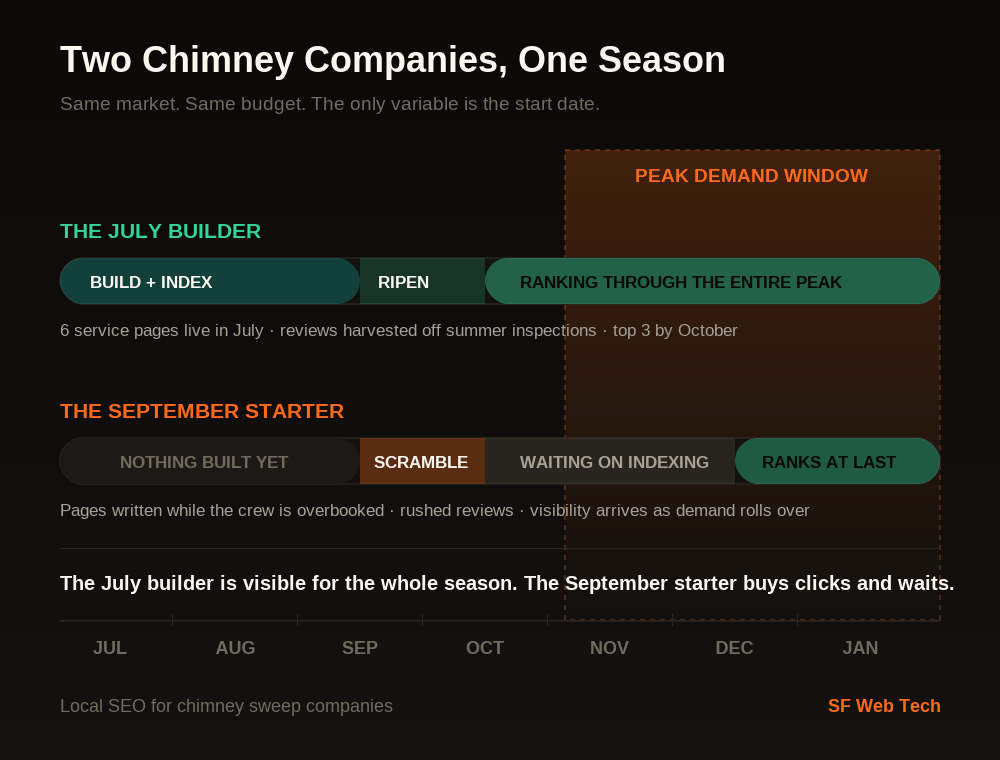
Earlier preparation buys more time to publish, verify, observe and correct before the peak. Compare that against current paid support, referral demand, staffing and economics. Timing alone does not determine market leadership, but a late scramble rarely wins the season:
- Identify each actual peak period from dated business records
- Confirm profile eligibility, identity, hours, services and contact routing
- Publish useful service information in a connected customer path
- Verify accessibility and indexing instead of assuming publication is enough
- Use a neutral review invitation process through the year
- Compare dated visibility with accepted and qualified inquiries during each season
Profiles, pages, reviews and citations maintained around accurate seasonal information, customer needs and measured outcomes.
See how our local SEO builds workReview the company's dated demand, capacity, current visibility and realistic runway, without a fixed 90-day promise.
Book a seasonal planning callSources and further reading
- Google Business Profile: improve your local ranking
Google's relevance, distance and prominence guidance, that reviews can help prominence, and that local ranking cannot be paid for. Practical HVAC examples are SF Web Tech recommendations.
Source checked .
- Google Search: SEO Starter Guide
Crawlable links, descriptive page information and content organization. Practical trade examples are SF Web Tech recommendations.
Source checked .
- Google Maps: prohibited and restricted content
Rules against fake engagement, incentives and selectively soliciting positive reviews.
Source checked .