Local search is how many homeowners shortlist a contractor before they ever call. Maps results, organic pages, reviews and your website have to tell the same story: what you do, where you work, and how to book.
This page used to speak mainly to carpet cleaning. The URL stays. The useful content is now a contractor local SEO checklist with examples from the trades SF Web Tech serves: roofing, decks, remodeling and pools. For hands-on local SEO delivery, see local SEO and contractor SEO agency.
Why a checklist beats a one-time optimization pass
Local rankings move with relevance, distance and prominence signals that Google describes at a high level. Your job is not to chase a secret shortcut. Your job is to keep the public facts accurate, publish useful service proof, collect honest reviews and measure qualified inquiries.
A franchise competitor may have more locations and links. An independent roofer, deck builder, remodeler or pool builder can still win trust with clearer coverage, real project photos and a responsive phone path.
1. Google Business Profile accuracy
Start with the profile homeowners see in Maps:
- Primary category that matches the core trade (for example roofing contractor, deck builder, general contractor or swimming pool contractor when those categories fit)
- Secondary categories only when you truly offer the work
- Hours, phone and website that match the site footer
- Service area that matches where crews actually go
- Description written in plain language, not keyword stuffing
- Photos of real crews, trucks, job sites and finished work
Post updates when you finish notable jobs or seasonal offers you can honor. Respond to questions in the profile. For GBP tactics that apply across trades, see GBP optimization for contractors.
2. Service pages that match how owners search
A thin homepage is not enough. Publish distinct pages for the jobs you want:
Roofing examples
- Roof replacement
- Roof repair and leak response
- Storm damage inspections you actually perform
Deck examples
- New deck construction
- Composite vs wood options you install
- Deck repair when you offer it
Remodel examples
- Kitchen remodel
- Bath remodel
- Additions if that is real scope
Pool examples
- New pool construction
- Remodel or renovation packages you sell
Each page needs unique copy, photos from your jobs, a coverage note, and a clear call or consult CTA. Tie roofing pages into roofing SEO and deck pages into deck builder SEO.
3. Real operating areas, not fake city spam
Create location content only for areas you serve with proof. Name cities and neighborhoods where you have completed work or can respond within your normal schedule. Avoid doorway pages that swap a city name and nothing else.
On the GBP side, set service areas honestly. Presence-based targeting in ads (when you run them) should match the same map.
4. Reviews without manufacturing them
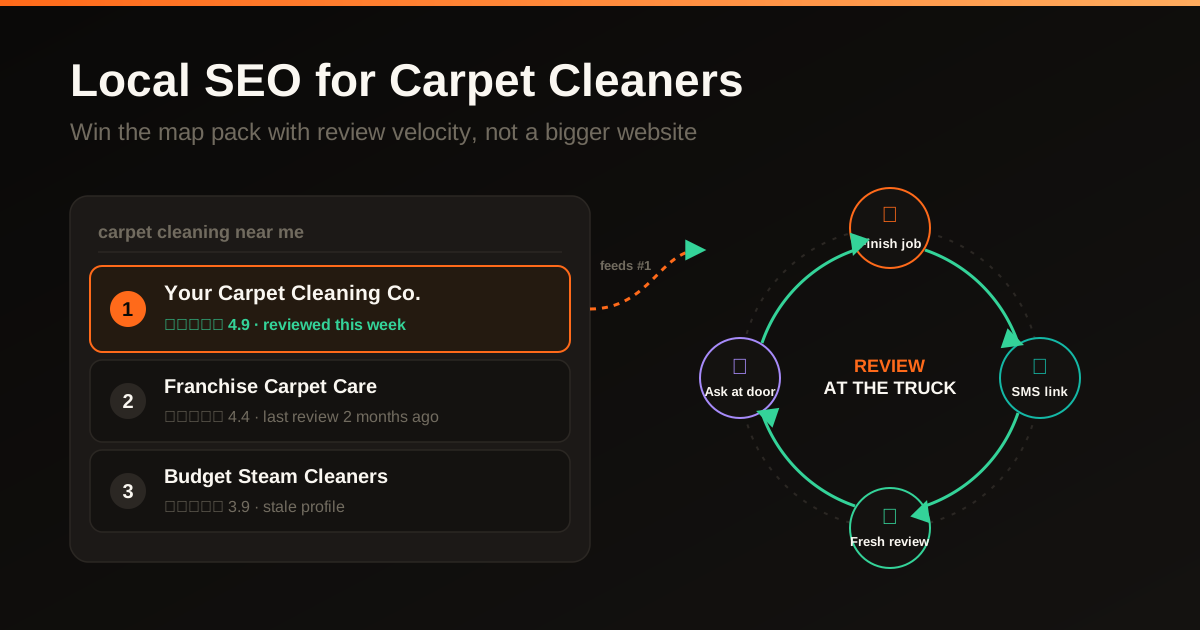
Build a consistent invitation into the completed-job process for eligible customers. Do not filter by how happy someone seemed. Keep reminders reasonable. Let customers write in their own words.
Respond to every review you can. Praise specifics. For criticism, stick to facts and next steps. More detail sits in how contractors get more Google reviews.
Photo reviews help visual trades. A deck photo or roof before-and-after inside a review is often stronger than a star rating alone.
5. Track qualified inquiries, not just rankings
Local SEO without lead tracking becomes a vanity project. Use call tracking or UTM-tagged forms where appropriate. Record source, service requested, zip or city, and whether the job booked.
Report Map Pack impressions and website calls in the same monthly review. A ranking jump that does not change booked work still needs diagnosis: wrong service pages, weak offers, slow response or capacity limits.
Weekly and monthly operating rhythm
Weekly:
- Reply to new reviews and GBP questions
- Add fresh project photos when jobs finish
- Check NAP consistency if anything changed
- Spot-check top service queries in an incognito or rank tool you trust
Monthly:
- Review call and form outcomes by service and city
- Update thin service pages with new proof
- Fix broken CTAs and outdated hours
- Decide which city or service page deserves the next content investment
Common mistakes to avoid
- Stuffing every trade keyword into one GBP category list
- Publishing city pages for markets you cannot staff
- Buying fake reviews or offering incentives that violate Google’s rules
- Ignoring mobile page speed on the pages Maps sends traffic to
- Measuring success only by average position instead of booked jobs
How this connects to broader contractor SEO
Local SEO is one layer. Technical health, internal links, and service hub content still matter. If you need a full program rather than a DIY checklist, start with contractor SEO agency or local SEO. Roofing teams can go deeper on roofing SEO.
Citations and consistency without directory obsession
Major platforms should show the same business name, address and phone as your site. Fix mismatches when you find them. Do not spend months chasing every obscure directory while the GBP photos are stale and the roof replacement page still uses stock images.
Prioritize:
- Website NAP
- Google Business Profile
- Apple Business Connect when relevant
- A short list of high trust industry or local listings you already use
Then return to service pages and reviews. Consistency supports local SEO. It is not a substitute for proof.
Examples of ICP-framed local proof
- A roofer publishes a storm repair page with three recent jobs in named suburbs and a tracked storm line
- A deck builder keeps the GBP gallery current each month with finished composites and rail details
- A remodeler separates kitchen and bath pages so ads and organic clicks land on matching proof
- A pool builder lists construction phases and a consult form that asks for a yard photo
Those patterns beat generic "best contractor near me" copy that could belong to anyone.
Ready for a contractor local SEO review?
SF Web Tech works with high ticket trades: roofers, pool builders, deck builders, remodelers and custom home builders. If you found this URL from an older carpet cleaning search, the practical next step is the contractor checklist above, applied to the trade you actually run.
Sources and further reading
- Google Business Profile help
Profile accuracy, categories, services, photos and review responses.
Source checked .
- Google Search: SEO Starter Guide
Crawlable links, descriptive page information and content organization. Trade examples are SF Web Tech recommendations.
Source checked .
- Google: How local ranking works (relevance, distance, prominence)
High-level local ranking factors. Not a shortcut for outranking a competitor.
Source checked .