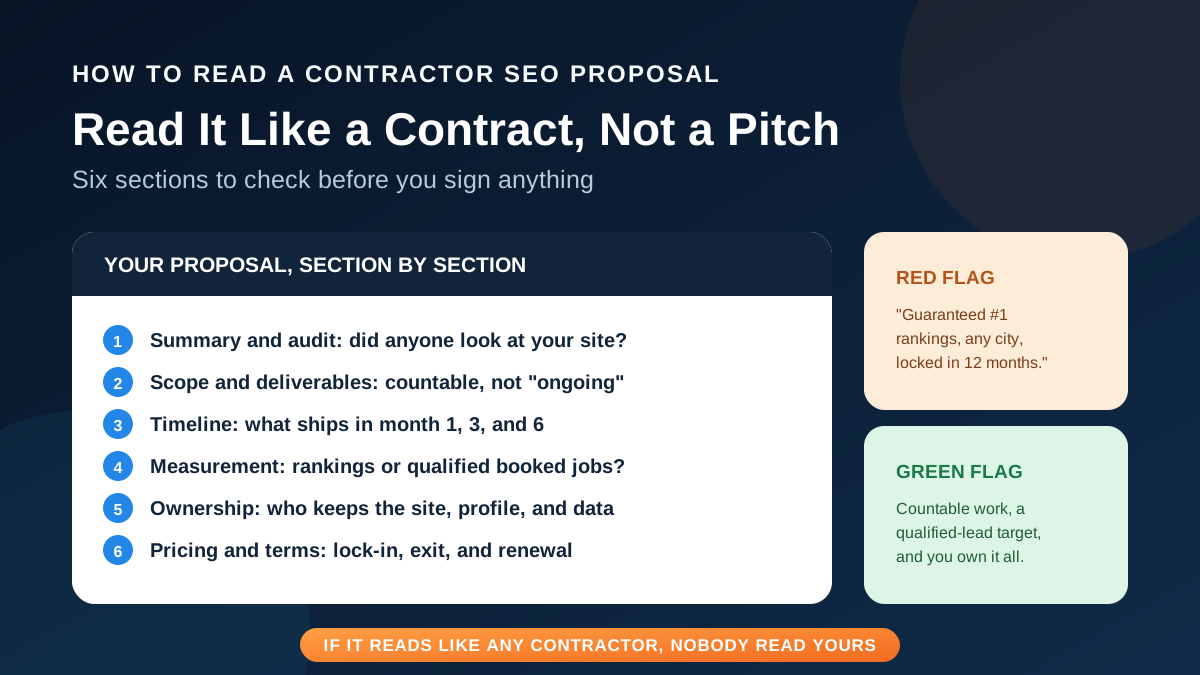
A contractor SEO proposal is not a pitch you have to take on faith. It is a document, and you can read it like a subcontractor's bid: section by section, asking what is promised, who does it, how you will know it worked, and what you own when it is over. You do not need to be an SEO expert. You need to know what each part should say and which phrases should make you slow down.
This guide walks a roofer, remodeler, pool builder, deck builder, or custom home builder through a proposal in the order it is usually written, then lists the red flags and the green flags. It is a companion to how to choose a contractor SEO agency, which covers the questions to ask on the call. Here we stay on the page in front of you.
Start by reading it as a document, not a pitch
A good proposal makes the work comparable. Ask three agencies the same questions and their written answers should line up side by side, so you can see the difference in scope, evidence, and terms. A deck of logos or a polished presentation does not tell you what gets delivered. The written scope does. Open it beside this checklist and mark the parts that are specific and the parts that are vague.
Section 1: The summary and audit
The opening should prove someone looked at your business. Expect a short diagnosis of what is weak: thin service pages, a Google Business Profile with the wrong categories, slow pages, missing reviews, or competitors who outrank you for your money keywords. The quickest test is the substitution test. Swap your company name for a competitor down the road. If the summary still reads as true, it is a template, and nobody crawled your site or checked what your market searches for.
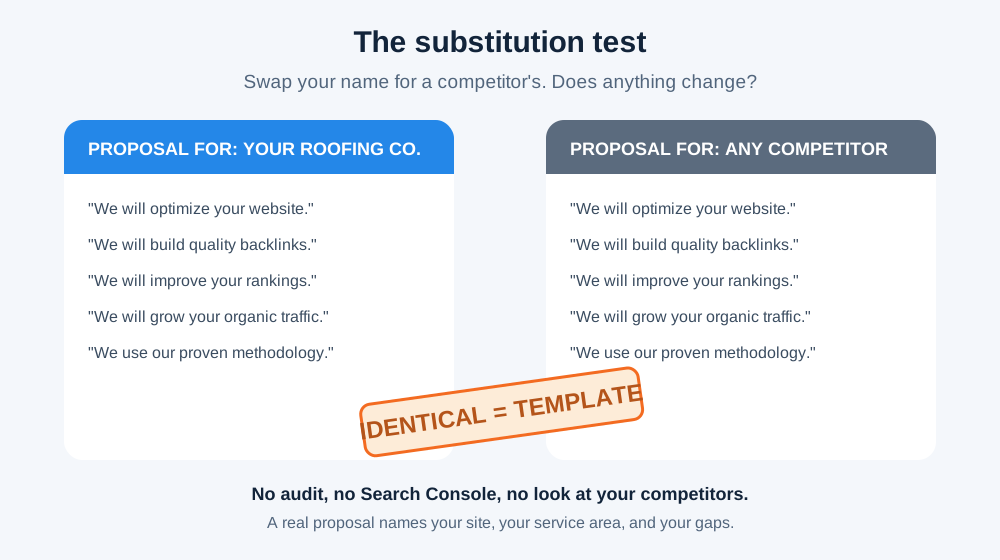
A real audit names your pages, your service area, and your gaps: a missing city page, a category to claim on your profile, a page that loads slowly on a phone. That specificity is the first green flag. A strong proposal for a general contractor looks different from one for a roofing company, because the keywords, seasonality, and competitors differ. Sameness is the tell.
Section 2: Scope and deliverables
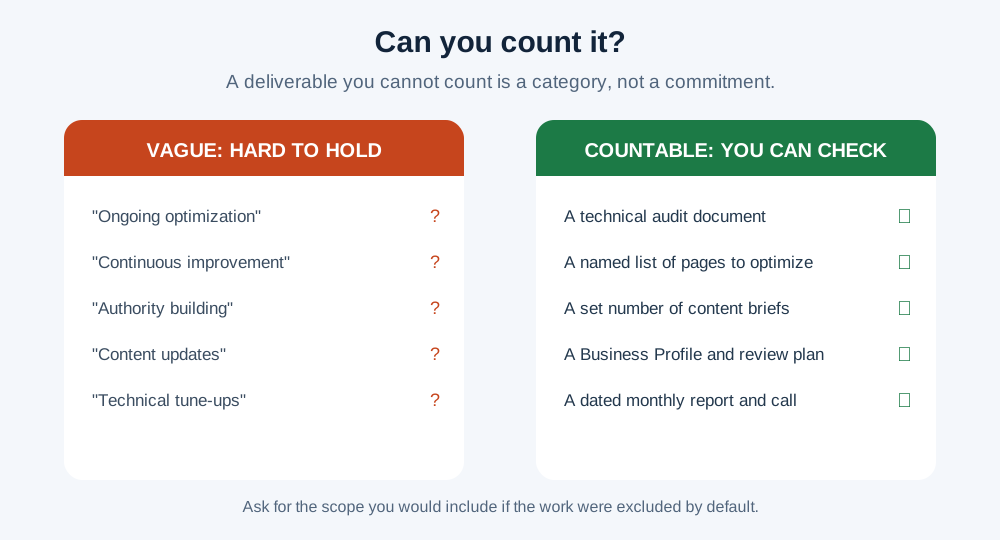
This is where proposals get vague on purpose. Phrases like ongoing optimization, continuous improvement, and authority building are categories, not commitments, and you cannot check them at month end. Look instead for deliverables you can count: a technical audit document, a named list of pages to optimize, a set number of content briefs, a Google Business Profile and review plan, and a dated monthly report. Ask what you would list if every task had to be written in to be included.
Watch two scope habits in particular. First, link building sold by the number, where a higher tier simply buys more backlinks, treats links as a quota rather than an outcome of useful pages. Second, a secret or proprietary method is usually cover for a thin process. The fundamentals of search are published by Google in its own SEO starter guide; a capable agency can describe its approach in plain English without hiding behind a trademark.
Section 3: The timeline
A proposal should sequence the work, not just price it. Early months usually cover measurement setup, technical fixes, Business Profile corrections, and priority service pages. Later months move to content and local coverage. You want to see what gets delivered in month 1, month 3, and month 6, each with named work and a review point.
What you do not want is a universal ranking schedule. Organic timelines vary with crawl timing, competition, distance, and demand, so be wary of both a confident three-month ranking promise and a vague twelve-month one offered as proof. Google warns against anyone who guarantees rankings in its spam policies. Accountability should start with the agreed delivery and measurement, not with a position on a results page.
Section 4: How success is measured
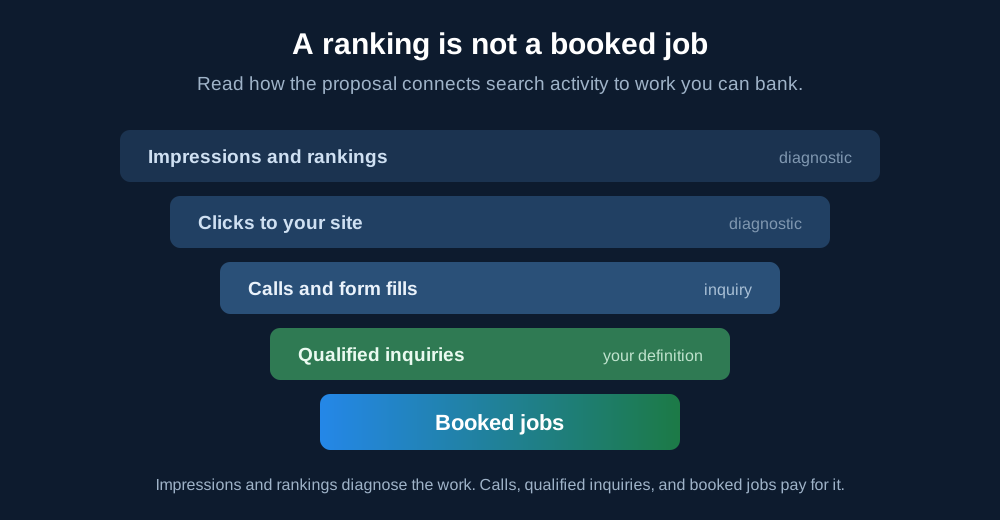
Read the metrics section carefully, because this is where a proposal either connects to your business or floats away from it. Impressions, clicks, and rankings help diagnose the work, but they are not revenue. The proposal should report qualified calls and form fills separately, keep the source data in your own Search Console, and agree on what counts as a qualified inquiry before work starts.
Section 5: Who owns what
The quietest section is often the most important. If the agency leaves, four things should stay with you: the website and domain, the Google Business Profile, the analytics and Search Console, and the content produced. Profiles should sit on your Google account with the agency added as a manager, which Google explains in its guidelines for representing your business. Build your profile on an account the agency controls and you can lose it the day you part ways.
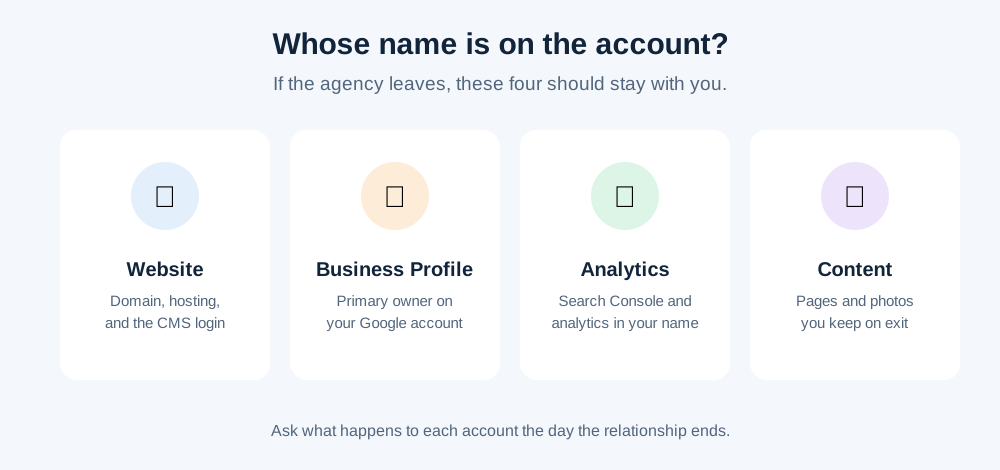
- Website and domain: you hold the domain registration, the hosting, and the CMS login.
- Google Business Profile: your Google account is the primary owner, not the agency's.
- Analytics and Search Console: measurement lives in accounts you can still open after the contract ends.
- Content and photos: the pages, project photos, and copy remain yours to keep or move.
Section 6: Pricing and contract terms
Only now, with scope, measurement, and ownership understood, does price mean anything. A fixed price quoted before anyone looked at your site is a price for a package, not for your problem. Read the terms for the fee, what is included, whether ad budget is separate, the notice period, and what happens to your accounts on exit.
- A defined initial period with a clear notice period after it.
- Advertising spend itemized separately from the management fee.
- Your accounts and content stay yours on exit.
- Any discount or lead target written down, not implied.
- A long lock-in with automatic renewal and no exit clause.
- Ad spend folded invisibly into one blended number.
- Accounts or content held by the agency after you leave.
- A headline price set before any discovery or audit.
For reference, our own fees are published and consistent across the site and every proposal: Lead Launch at $1,500/month, Lead and Local Growth at $2,000/month, and Local Authority at $3,500/month, with advertising paid separately to Google starting at $50/day and all packages month to month. A $299/month offer is not automatically spam, but ask what it includes and who reviews the work. For how scope drives price, see how much contractor SEO costs.
The red flags, at a glance
Use the signals below the way you used the sections above: as reasons to ask for evidence and clarify scope, not as an automatic pass or fail. One red flag is a question. Several together are a reason to walk away.
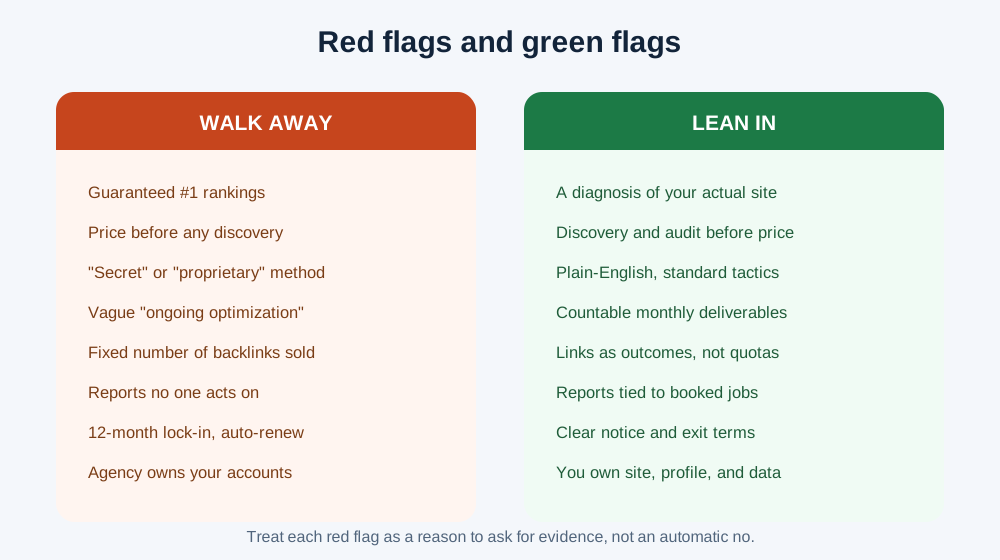
Green flags: what a good contractor proposal reads like
- A diagnosis of your site, profile, and competitors, specific enough that it could not describe anyone else.
- Countable monthly deliverables with a named owner and review points in months 1, 3, and 6.
- Measurement that separates diagnostic rankings from qualified inquiries and reconciles them with booked jobs.
- Plain-English tactics from published Google guidance, not a secret method or a backlink quota.
- Clear ownership and exit terms, so the website, profile, analytics, and content stay yours.
- Content built with human research and editorial review, not published at scale with no check.
The AI question is worth its own line. Ask how the agency researches, reviews, and fact-checks content, including anything drafted with AI tools. Useful pages need accurate services, real local or project detail, and editorial review; publishing at volume does not replace that. The standard is the same whether you are a deck builder or a custom home builder: the page has to help the customer who lands on it.
How to use this on us
Point every test in this guide at SF Web Tech too. Run the substitution test on anything we send. Ask who runs the account, what evidence we can show with a client's permission, how we define a qualified lead, and what you own on exit. We agree a qualified minimum before you enroll and waive subsequent management fees if that minimum is not met in the first 90 days, with advertising always separate. The proposal you get should name your work, not describe any contractor.
Review the scope, evidence standards, local page approach, and reporting before you compare proposals.
See the full contractor SEO systemThe seven questions to ask on the call, the companion to reading the document.
How to choose a contractor SEO agencyBring a proposal you received and we will read it with you, section by section.
Book a free strategy callFAQ
What should a contractor SEO proposal include?
Is a guaranteed ranking ever legitimate?
Is a cheap SEO proposal always a bad sign?
Next step: read the next proposal that lands in your inbox section by section, mark the vague parts, and if you want a second read, book a free strategy call and bring it along.
Sources and further reading
- Google Search: SEO Starter Guide
Search fundamentals are published by Google, supporting the point that a capable agency can describe its approach in plain English rather than a secret method, as used in the scope section.
Source checked .
- Google Search spam policies: no guaranteed rankings
Google warns against guaranteed rankings and link schemes, supporting the timeline and red-flag sections that treat a guaranteed ranking as a warning sign.
Source checked .
- Google Search: creating helpful content
People-first, human-reviewed content and the absence of a preferred word count, supporting the green-flag point on AI content needing editorial review. Does not substantiate a client result.
Source checked .
- Google Business Profile: guidelines for representing your business
Profile ownership and management roles, supporting the ownership section's point that the contractor's Google account should be the primary owner.
Source checked .
- Google Search Console
First-party reporting of the queries and pages a site ranks for, supporting the measurement and ownership sections on preserving source data in the contractor's own account.
Source checked .