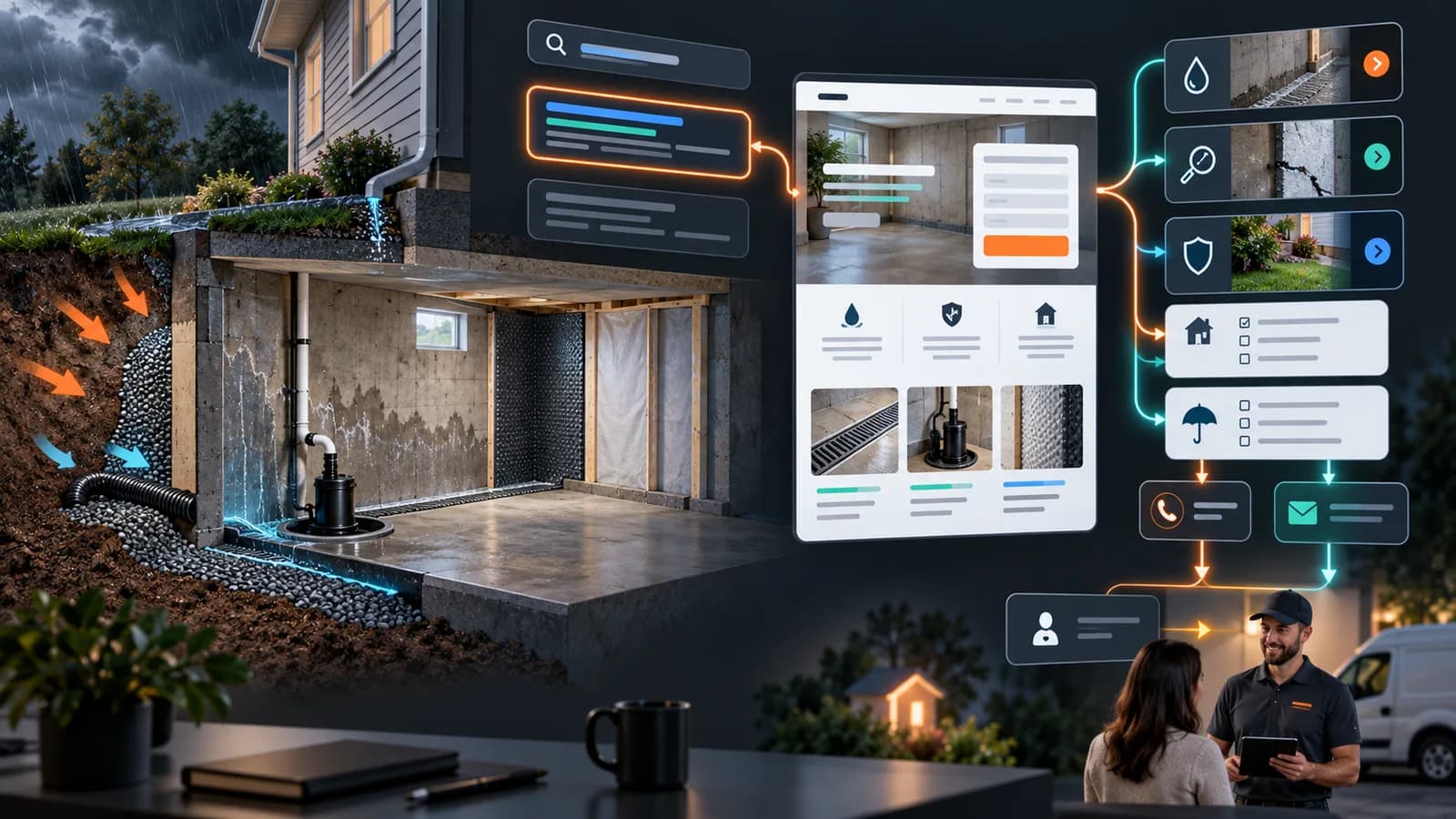
A plumbing inquiry may be urgent or planned. Match the ad to the service and actual availability, then record whether the contact becomes a qualified job. An answered call does not automatically create a future replacement or repeat customer.
Urgent plumbing searches can create a short decision window, while research searches may indicate a later project or no service need. Separate those patterns with search terms, call outcomes, operating hours, and service-area evidence before changing bids or budgets.
Here is the hard truth. Plumbers rarely lose money on Google Ads because the channel does not work. They lose money because the account was built to buy clicks when the business needs booked calls, and nobody ever went back and fixed the gap between those two things.
Use the account’s own cost per qualified lead and acquired customer. Plumbing costs vary by service and market. A national benchmark or audit percentage is not a forecast for this business.
These are LocaliQ home-services benchmarks for 2025. They provide dated directional context for reported click and lead costs, not a forecast for one plumbing account or proof that plumbing has the greatest urgency. Replace them with reconciled account and sales data.
The trend line is worse than the snapshot. Across home services in LocaliQ's 2025 data, cost per lead has been climbing year over year while conversion rates have been falling. Clicks got more expensive and less likely to turn into anything. If your account is coasting on a structure you set up in 2022, it is quietly bleeding out.
Illustrative arithmetic: 100 unsuitable clicks at an assumed $10 each cost $1,000. The useful action is to inspect actual search terms and qualification reasons, not to assume those prices or that amount of waste applies to your account.
The Plumbing PPC Math That Decides Everything
Before you touch a keyword, you need three numbers on a whiteboard where your dispatcher can see them. Average ticket. Close rate on inbound calls. Gross margin. Without those, every conversation about plumbing Google Ads cost is theater.
Illustrative economics should connect qualified-lead cost, verified close rate, collected revenue, labor and material cost, and service capacity. Replace planning assumptions with reconciled account and sales data, and keep unresolved leads visible.
Use actual job contribution, close rates and capacity to choose campaign priorities. A repair may still be commercially useful; do not automatically exclude it because a replacement has higher revenue.
Emergency Intent and Scheduled Intent Are Two Different Businesses
A common structural problem is treating all plumbing searches as one audience. A burst pipe and a bathroom-remodel inquiry can require different economics, copy, destinations, schedules and success definitions. Separate them when account volume, service availability and measurement support the distinction.
Urgent repairs and planned projects may need different availability, scope and contact information. Neither audience has a universal conversion rate or job value. Choose campaign and page structure from actual needs rather than assuming emergencies justify unlimited bids or hours.
Emergency plumbing queries may carry high urgency, but conversion rate, click cost, competition, and job value vary by query, market, device, time, and operating capacity. Separate emergency themes when the company can serve them, use accurate availability and location controls, maintain negatives from real search-term evidence, and track accepted calls through booked, completed, and paid work.
Consider separate campaigns when emergency and scheduled work need different hours, budgets, qualification paths, or landing-page messages. Keep them together when the account lacks enough volume or operational distinction, and decide from qualified-job and contribution data.
We review spend, search terms, measurement, and accepted lead outcomes, then document the highest-priority account questions.
Book a Free Strategy CallSix Ways Plumbers Burn Google Ads Budget
In nearly every plumbing account we audit, the wasted spend is not exotic. It is the same six leaks, in roughly the same proportions, hiding under a dashboard that looks fine because clicks are up and cost per click is down.
Review search terms, match types, geographic settings and staffed hours. Distinguish phone taps and form submissions from qualified inquiries. Call length alone does not establish quality, and cost or insurance questions should not be excluded automatically when legitimate customers ask them.
None of that is clever. It is unglamorous maintenance that agencies skip because it does not screenshot well in a monthly report. It is also the difference between an account that pays for a truck and one that pays for a lesson.
The Anatomy of a Plumbing Account That Books Calls
Structure campaigns by intent, then by margin
Consider separate campaign groups for distinct services when budget and data allow. Use actual contribution, close rates and capacity to prioritize them. Repair services should not be dismissed automatically because replacement work has higher revenue.
Keep plumbing PPC keywords tight and unglamorous
Choose positive match types from current query volume, account history, conversion quality, budget, and bidding controls. If broad match is tested, isolate and monitor it as appropriate, review actual search terms, and reconcile qualified and sold outcomes. No match type is universally more profitable.
- Potential emergency intent: burst pipe repair, water heater leaking, no hot water plumber, sewage backup, emergency plumber near me
- Potential scheduled project intent: tankless water heater installation, whole-house repipe, sewer line replacement, trenchless sewer repair
- Potential commercial intent: commercial plumbing contractor, backflow testing, grease trap service
- Review for exclusion or separate education targeting: employment, training, DIY, parts, and other queries that do not match the documented offer
Track the call, not the click
Where supported and appropriate, connect qualified or completed-job outcomes to advertising measurement. Test the attribution and data handling before using it for bidding. Better signals can inform decisions but do not guarantee that the platform finds more profitable customers.
“Cost per click is a diagnostic metric. Reconcile qualified opportunities, booked work and paid jobs before deciding whether a plumbing campaign is commercially useful.”
Lead Launch is $1,500/month for paid acquisition, campaign-page support and lead tracking. Advertising starts at $50/day separately. Start with a free strategy call and initial audit.
Book a Free Strategy CallSearch Ads, Call Assets and Local Services Ads
These three are not competitors. They are three tools with different jobs, and most plumbers should run at least two of them.
Evaluate eligible LSA alongside Search using current verification and billing rules. Use supported ad formats and call assets with accurate operating hours. Choose the channel mix from the budget and actual qualified outcomes rather than an old badge or call-only-ad playbook.
Choose the initial eligible channel from the budget, service and measurement plan. Use current Search formats and call assets, and evaluate LSA under its current rules. A pay-per-lead model does not cap every business risk.
What Your Plumber Google Ads Budget Should Actually Be
Bidding strategies have different data and eligibility requirements that can change. Check the current strategy documentation and account status. There is no universal rule that every campaign needs 30 conversions before any useful insight is possible.
A limited budget may call for a narrower service and territory. Agree what the test can establish, how long it will run and which outcomes count before spending.
- Choose a service line using contribution, close-rate, demand, and capacity evidence.
- Define a practical geography from actual dispatch coverage and suitable inquiry locations.
- Set a bounded test budget from current auction conditions and the amount the business can evaluate responsibly.
- Run the test long enough to observe search terms and qualified outcomes, with call tracking and documented exclusions where appropriate.
- Expand, repair, hold, or stop according to cost per qualified opportunity, booked work, completed work, and contribution.
Concentration can make a limited test easier to interpret, but a smaller focused campaign does not always outperform a larger one. Compare qualified opportunities and contribution using the actual account data.
Buy a smaller market. Own it.
Not sure what your break even lead cost is? Bring your numbers and we will run the math with you.
Book a Free Strategy CallConnect calls and forms to urgency, job fit, bookings, and later outcomes.
Build the plumbing qualification workflowPaid Search Without Local SEO Is a Rental Agreement
Google Ads is rented attention. The day you stop paying, the phone stops ringing. That is fine, as long as you know what you are buying: speed, control, and presence in tonight's burst pipe search rather than one eight months from now.
Paid and organic work can inform each other when attribution is reliable. Use inquiry quality to choose useful content and budget priorities. Organic search visibility can change and does not automatically replace paid acquisition.
Compare how ads, local results and service pages contribute to qualified plumbing opportunities without promising map-pack ownership.
Review paid and local search togetherStart Where the Money Is
Go open your search terms report right now and sort by cost. Look at what you actually paid for over the last thirty days. If you find plumbing apprenticeship, garbage disposal humming sound, or a town forty minutes outside your service area near the top of that list, you have just found your raise. It was sitting in your account the whole time.
Test the published emergency number during staffed hours using an authorized quality-assurance process. Verify routing, disclosure, voicemail, missed-call recovery, and escalation without creating a false lead. Compare response coverage with qualified bookings rather than assuming a four-ring rule or universal click intent.
We build and manage Google Ads accounts for plumbing contractors who want booked calls, not screenshots of impressions.
Book a Free Strategy CallSources and further reading
- Google Search: SEO Starter Guide
Crawlable links, descriptive page information and content organization. Practical trade examples are SF Web Tech recommendations.
Source checked .
- Google Ads: keyword matching options
How keyword match types relate to search intent; account strategy and examples are editorial recommendations.
Source checked .
- Google Ads: negative keywords
Negative keyword behavior and exclusions. The suggested service exclusions require account-specific review.
Source checked .
- Google Ads: advanced location options
Presence and interest settings and the limits of geographic targeting accuracy.
Source checked .
- Google Ads: average daily budgets
Platform budget and spending mechanics, not a trade-specific CPC or lead-cost forecast.
Source checked .
- Google Maps: prohibited and restricted content
Rules against fake engagement, incentives and selectively soliciting positive reviews.
Source checked .
- Google Local Services Ads: getting started
Eligibility, lead handling and verification. Platform lead-billing criteria differ from a contractor’s sales qualification.
Source checked .
- Google Local Services Ads: Google Verified badge
Current badging and discontinuation of the former Google Money Back Guarantee.
Source checked .