Marketplace directories sell speed. You open an account, set a radius, and inquiries start arriving. For a deck builder that feels useful in a quiet week. The problem shows up later: shared names, race-to-reply dynamics, and a lead flow that stops the day you stop paying.
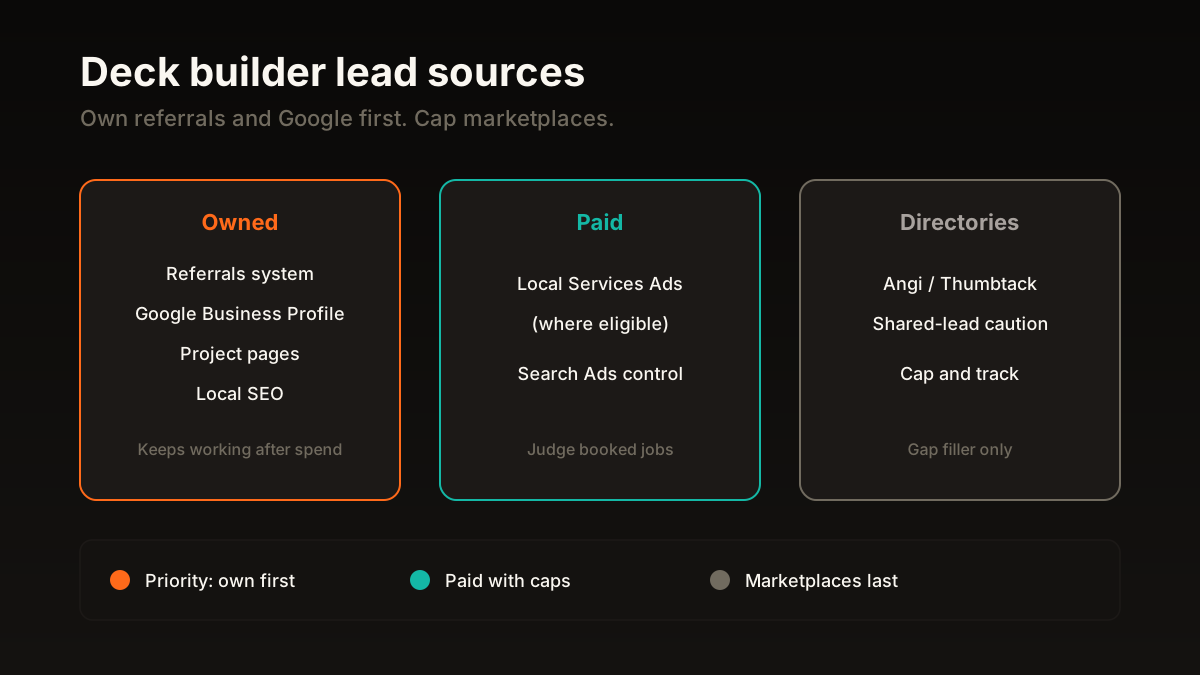
Deck builder lead sources worth owning look different. Referrals, Google Business Profile, local SEO, project pages, and careful paid search keep working after the invoice clears. Marketplaces can still fill gaps. They should not be the whole plan.
SF Web Tech helps deck builders with deck builder SEO and local SEO. This guide is educational: how channels work, where they fit, and what to deprioritize. It does not invent cost-per-lead benchmarks for your market.
Start with the lead you already have: referrals with a system
Most established deck builders already win work from past customers and trade partners. The gap is usually process, not goodwill.
- Ask at a clear moment, such as final walkthrough or first season of use
- Make the ask specific: a review, a photo share, or an introduction to a neighbor with a similar yard
- Track which jobs came from which customers or partners
- Thank people who send work, even when the job does not book
Yard signs, truck branding, and a short leave-behind with a QR to your gallery still matter for visual trades. A homeowner who walks a finished deck often becomes the next inquiry if your name and phone are easy to find.
Partner referrals deserve the same discipline. Remodelers, pool builders, fence crews and landscapers who already trust your build quality can send high intent work. Reciprocate carefully and keep notes so you know which relationships produce booked decks.
Own the search that already exists: Google Business Profile and local SEO
When someone searches 'deck builder near me' or 'composite deck installation' plus a city, Google shows Maps results and organic pages. You do not pay per click for organic placement. You do invest time in accuracy, photos, reviews and useful pages.
For the local SEO playbook aimed at deck builders, see local SEO for deck builders. The short version:
- Claim and complete Google Business Profile with a primary category that matches deck building when available
- Use a real service area that matches where crews actually build
- Upload current project photos, not manufacturer stock alone
- Respond to reviews professionally
- Keep NAP (name, address, phone) consistent across the site and major listings
Local SEO is slow to turn on and hard for a competitor to copy overnight. That is the point. Build it before peak spring demand if you can. Quiet months are when pages and review processes get done.
Reviews are proof for a visual purchase. Ask eligible customers after a successful handoff. Do not filter invitations by how happy someone seemed in the moment. Let them write in their own words, and reply to criticism with facts and next steps.
Project pages beat a generic homepage
Deck buyers compare visuals and scope. A homepage that says 'we build decks' is weaker than pages that show:
- Composite vs wood
- Multi-level or hillside decks
- Covered or screened structures
- Pool decks and outdoor living add-ons
- Repair and refinishing when you offer them
Each page should carry real photos, a clear consult request, coverage notes, and honest next steps. Price ranges, when you publish them, should be framed as ballparks that need a site visit. Link those pages into your deck builder SEO hub and keep them crawlable.
Missed-call text-back and a tracked phone number help close the loop when spring volume spikes. A homeowner comparing two builders often books the first firm that answers with a clear consult path.
Paid search: Local Services Ads vs Google Ads (education only)
Paid channels buy attention. They do not replace owned proof.
Local Services Ads (where eligible)
Local Services Ads can place an eligible business above typical Search ads for some local queries. Billing is usually per lead, with dispute paths for invalid contacts. Availability depends on category and market. Verification, reviews, responsiveness and service area all affect how the profile performs. Check Google's current Local Services help before you print badges on trucks or the site.
Google Search Ads
Search Ads give keyword and landing page control. For deck builders, that can mean separate ad groups for new decks, repairs, materials intent you want, and brand. It also means negative keywords for DIY, jobs hiring, materials only, and services you do not sell.
Search Ads acquisition for SF Web Tech sales conversations is on hold as a product push. This section is still useful education if you already run Ads or compare channels with contractor SEO vs Google Ads and Google Ads management.
Judge either paid channel by qualified consults and booked jobs, not by click price or marketplace lead price alone. Your close rate, ticket size, crew capacity and seasonality decide whether a channel is healthy.
Marketplace directories: visibility with shared-lead caution
Angi, Thumbtack and similar networks can produce opportunities quickly. Treat them as rented attention:
- Many marketplace leads are shared with other contractors, so speed and qualification matter
- Pricing models change by product, market and account terms. Confirm current fees, credits and refund rules in writing before you scale spend
- Cap budgets. Review booked jobs by source monthly
- Keep your own CRM record of every inquiry. Do not rely on the marketplace dashboard as the only history
If you test a marketplace, set a short evaluation window. Decide in advance how many booked consults you need to justify another month. Exit cleanly when the math fails instead of renewing on habit.
What to deprioritize
Not every tactic deserves the same attention this quarter:
- Buying cold lead lists with no local proof or consent trail
- Spreading thin across every network at once without tracking booked work
- Publishing thin city pages with no projects, photos or real service coverage
- Running broad paid search without negatives or staffed phone hours
- Chasing vanity metrics (impressions, raw lead count) instead of consults and signed decks
- Seasonal panic spending that ignores crew capacity and material lead times
If capacity is full, protect crew quality. Pausing a weak channel beats accepting every shared lead and missing the high-intent owners who found you organically.
Seasonal timing without invented forecasts
Deck demand often clusters around warmer planning months, but your own call history beats a national chart. Use last year's inquiries and booked jobs to decide when to raise referral asks, publish new project pages, or open a capped paid test. Do not treat a blog's published average lead cost as your number.
A practical stack for deck builders
Use this as an operating order, not a rigid dogma:
- Referral ask and review process on completed jobs
- Complete Google Business Profile with real photos and responses
- Service and project pages that match how owners search
- Local SEO and citations hygiene for the areas you serve
- Paid layers (LSA if eligible, Search Ads if you run them) with caps and booked-job tracking
- Marketplace directories only as a capped gap filler
Response speed is part of the channel
Owned and paid sources both fail when the phone rings into a full mailbox. Decide who answers consult requests during peak months. Use missed-call text-back if you cannot staff every ring. A homeowner collecting three quotes often books the builder who replies first with a clear next step, not the one with the flashiest marketplace badge.
Track response time by source for a month. If marketplace leads get a five minute reply and organic form fills wait until tomorrow, you are training the wrong channel to win.
Ready to tighten deck builder lead flow?
SF Web Tech works with high ticket outdoor living trades, including deck builders, pool builders, roofers, remodelers and custom home builders. If directories are eating the budget and organic proof is thin, start with the owned stack above, then decide what paid layers still earn a seat.
Sources and further reading
- Google Search: SEO Starter Guide
Crawlable links, descriptive page information and content organization. Practical trade examples are SF Web Tech recommendations.
Source checked .
- Google Business Profile: local ranking guidance
Google's broad relevance, distance and prominence guidance used for the Google Business Profile recommendations in this guide.
Source checked .
- Google Local Services Ads: getting started
Eligibility, per-lead billing and verification referenced in the Local Services Ads section.
Source checked .
- Google Maps: prohibited and restricted content
Rules against fake engagement and selectively soliciting positive reviews, used for the review-honesty guidance in this guide.
Source checked .