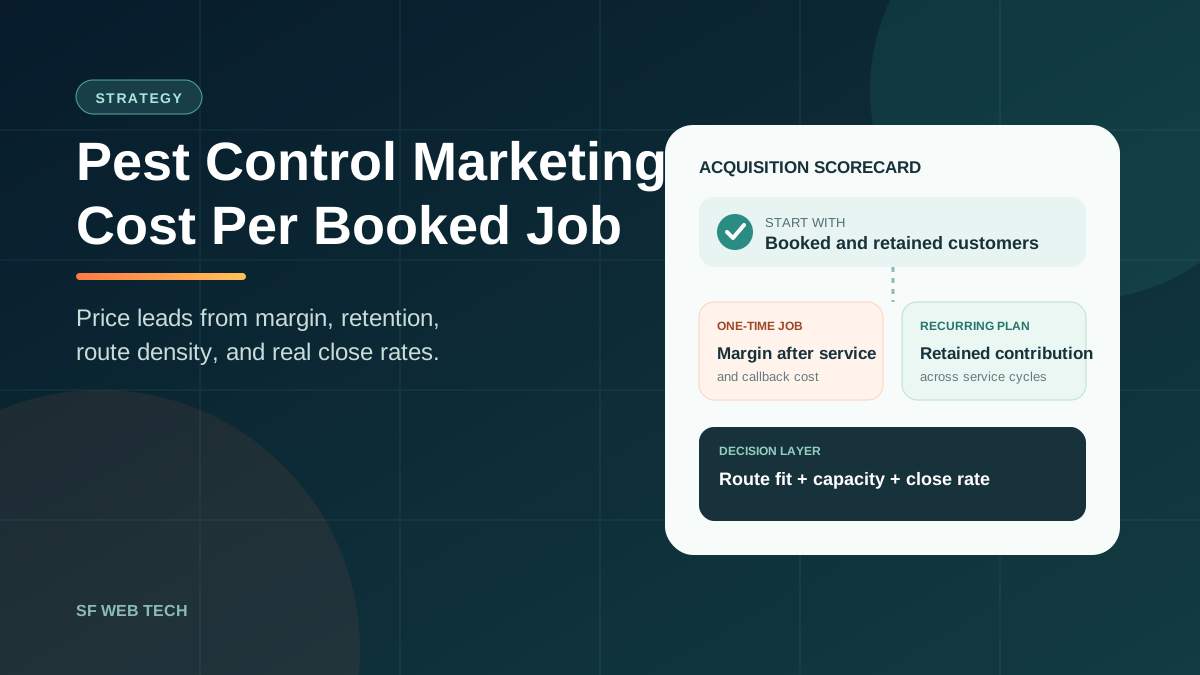
The right marketing cost for a pest control company is not a universal price per lead. It is the amount you can spend to acquire the right kind of customer while preserving contribution margin, filling technician capacity, and strengthening routes. A termite treatment, a one-time wasp removal, and a recurring general pest plan do not create the same value. Putting them under one cost target makes a clean report and a poor business decision.
Start with the booked outcome. Set one acquisition ceiling for one-time work and another for recurring agreements. Build each ceiling from your own service revenue, direct fulfillment cost, retention, sales close rate, callbacks, and travel burden. Then translate those ceilings backward into qualified-lead and raw-lead targets. Marketing becomes easier to judge when every channel has to produce accepted jobs, not just phone calls.
Why one blended cost per lead hides the real answer
A raw inquiry says almost nothing about economic value. One caller may need same-day removal outside your normal territory. Another may own a home inside a dense route and be ready to enroll in ongoing service. A third may be asking for a service you do not offer. If the dashboard counts all three as equal conversions, the cheapest campaign can look like the winner while dispatch and sales know it produced weak work.
Define the stages before calculating anything. Everyone who answers the phone, updates the CRM, or reads the report should use the same definitions. A lead becomes qualified only when it fits your geography, service mix, property type, and commercial requirements. A booked job is an appointment the company accepts, not a call that lasted long enough to trigger an advertising conversion.
- Raw lead: a unique call, form, message, or booking request with usable contact information
- Qualified lead: a prospect inside the service area who needs an offered service and meets the company's basic fit rules
- Booked one-time job: an accepted appointment for a defined treatment without an ongoing agreement
- Booked recurring plan: an accepted customer agreement with a documented service cadence
- Completed job: work delivered and eligible for revenue and margin review
- Retained account: a recurring customer still active at the review point your company uses
Connect search visibility, paid campaigns, landing pages, call handling, and attribution to booked work.
See the full contractor marketing systemBuild separate ceilings for one-time and recurring work
For one-time treatments, begin with expected collected revenue and subtract the direct costs required to fulfill the visit. Include technician labor under your accounting method, treatment materials, vehicle burden, payment fees, expected callbacks, and any other cost that rises when another job is added. The remaining contribution still has to support overhead and profit, so only part of it is available for customer acquisition.
For a recurring plan, use expected contribution over a conservative customer life, not the headline value of every future invoice. Start with collected service revenue, subtract the direct cost of scheduled visits and expected callbacks, then account for observed retention. A contract that often cancels early cannot be valued as though every customer stays indefinitely. Use completed billing and service records rather than a sales assumption.
- Value comes mainly from the scheduled service
- Fulfillment cost is concentrated near acquisition
- Urgency may improve booking speed
- Callbacks can erase a thin margin
- Target is cost per accepted one-time job
- Value develops across retained service cycles
- Future visits create continuing fulfillment cost
- Cancellation risk must reduce the forecast
- Dense routes can improve service economics
- Target is cost per accepted recurring agreement
Route density changes what a booked job is worth
Pest control is a field-service business, so geography changes margin. An account beside an existing stop can use technician time differently from an isolated account across the metro. That does not mean every company needs a complex routing model before advertising. It means service area and route fit should survive all the way from the campaign to the CRM and monthly review.
Create practical territory groups based on how your operation actually dispatches. A core route may support broader keyword coverage or a more flexible acquisition ceiling. An expansion zone may need a stricter threshold until enough customers create density. An area the team cannot serve reliably should be excluded, no matter how inexpensive its leads appear. Cheap demand becomes expensive when it adds windshield time, late arrivals, overtime, or rescheduling.
Use paid search for demand control and SEO to build durable visibility in priority service areas.
Compare Google Ads and SEO for contractorsTranslate the booked-job ceiling into lead targets
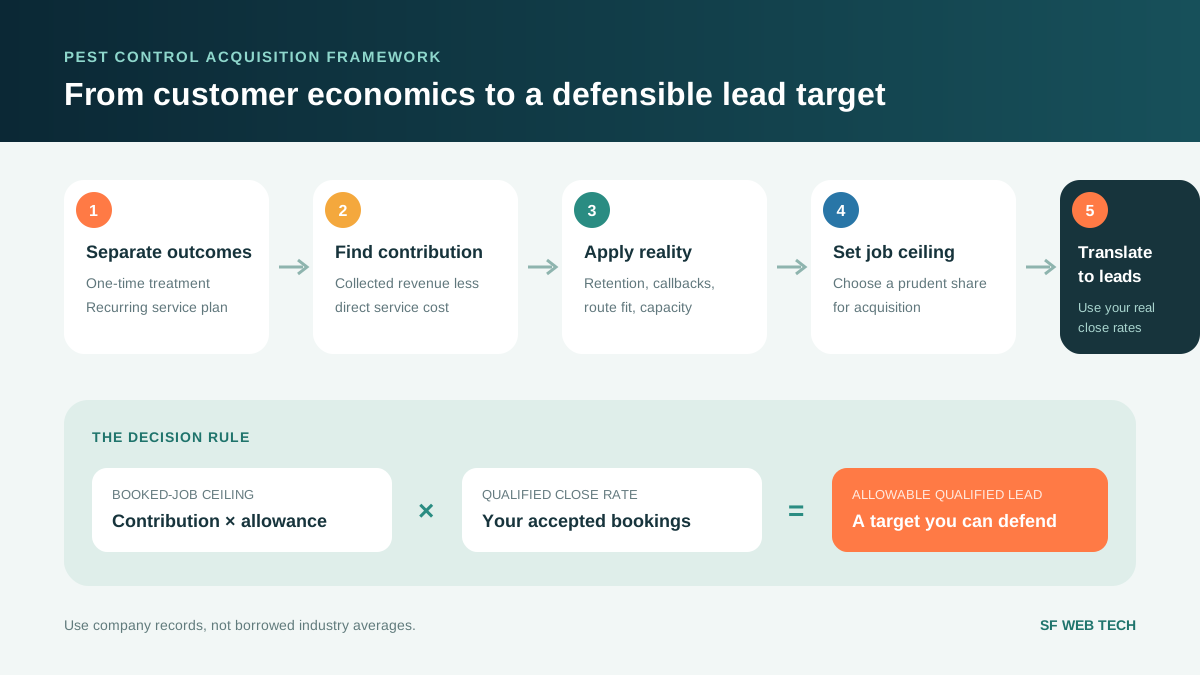
Once each customer type has an acquisition ceiling, work backward through observed sales rates. Multiply the booked-job ceiling by the share of qualified leads that become accepted bookings to estimate an allowable cost per qualified lead. Then multiply again by the share of raw leads that qualify to estimate an allowable raw-lead cost. Use separate rates for recurring plans and one-time services when the sales motion differs.
Do not borrow a close rate from another company. Pull a useful period from your CRM, remove duplicate contacts, and keep disqualified leads visible with a reason. Separate phone, form, message, and direct booking sources if their quality differs. If the office changed scripts, hours, or staffing during the period, annotate the report. Marketing cannot be judged honestly when sales-process changes disappear from the data.
- Calculate contribution for each promoted service or plan using collected revenue and direct fulfillment cost
- Choose the maximum share of that contribution the business can responsibly invest in acquisition
- Measure qualified-lead-to-booking rate by customer type, source, and territory
- Measure raw-lead-to-qualified-lead rate with duplicates and disqualifications retained
- Translate the booked-job ceiling backward into qualified-lead and raw-lead targets
- Compare actual acquisition cost with completed-job margin, retention, and capacity each month
Track the booked and retained outcome in Google Ads
Google Ads documentation says call conversion measurement can count calls based on a minimum duration or, where available, use call-quality analysis. That is useful for understanding engagement, but a call conversion is still not proof of a booked treatment. Reconcile tracked calls with the scheduling or CRM system so the business can distinguish qualified calls, accepted bookings, completed work, and recurring-plan enrollment.
Google's documentation on offline conversion imports explains that advertisers can connect an ad interaction with outcomes that happen later offline. Google also describes enhanced conversions for leads as a way to use hashed first-party, user-provided data with imported offline outcomes to improve attribution. For pest control, the meaningful offline events can include qualified lead, booked one-time treatment, booked recurring plan, completed initial service, and retained account, provided each stage is defined consistently and data use follows applicable consent and privacy requirements.
- Capture original source, campaign, search theme, landing page, and territory
- Store service requested, one-time or recurring outcome, booking status, and disqualification reason
- Deduplicate callers who also submit a form or message
- Import the deepest reliable outcome the team can maintain consistently
- Keep early lead actions separate from booked and completed service actions
- Review platform conversions against CRM, dispatch, and billing records
Separate emergency demand from recurring-plan acquisition, then grade each campaign on the right outcome.
See the pest control Google Ads structureCount the full acquisition cost by channel
Media spend alone is not the full acquisition cost. Include the costs required to create, capture, and convert demand: management, landing pages, call tracking, CRM tools, content, listing work, creative, and sales labor. Allocate long-lived assets consistently rather than loading an entire website cost into one month. The goal is a repeatable decision measure, not an accounting trick that makes one channel look artificially cheap.
Keep channel reporting separate long enough to learn from it. Google Search, Local Services Ads, organic search, referrals, and partnerships can produce different service mixes and sales behavior. Google's Local Services documentation says valid leads can arrive through calls, messages, and bookings, and its dashboard reports spending and leads across those channels. Your internal system still has to show which of those leads became accepted and profitable customers.
- Ad spend divided by all calls
- One target for every pest and plan
- Duplicates counted as extra demand
- No route or capacity context
- Success ends at lead creation
- Full acquisition cost by channel
- Separate one-time and recurring outcomes
- Unique leads with reasons recorded
- Territory, route fit, and capacity retained
- Bookings reconciled with service and billing
Compare fixed SF Web Tech packages before deciding what belongs in your acquisition budget.
Review transparent monthly pricingReview the target as operations change
Cost per booked job is a management rule, not a permanent benchmark. Revisit it when pricing, technician pay, chemical costs, callbacks, retention, route density, seasonality, sales staffing, or capacity changes. Review recent cohorts long enough for recurring customers to reveal early retention, but do not wait so long that weak lead quality runs unchecked.
The final question is not whether marketing produced cheap leads. It is whether the company acquired the right mix of one-time work and recurring customers at a cost the operation can support. Separate the economics, include route fit, work backward through your real close rates, and connect advertising records to booked and retained outcomes. That gives an owner a budget they can defend and a clear reason to scale, improve, or stop a channel.
Book a discovery call to connect customer economics, territory strategy, paid search, SEO, and attribution.
Map your cost per booked pest control jobSources and further reading
- Google Search: SEO Starter Guide
Crawlable links, descriptive page information and content organization. Practical trade examples are SF Web Tech recommendations.
Source checked .
- Google Ads: offline conversion imports
Connecting supported offline outcomes with advertising measurement. Lead qualification and contribution calculations are SF Web Tech operating guidance.
Source checked .
- Google Local Services Ads: getting started
Eligibility, lead handling and verification. Platform lead-billing criteria differ from a contractor’s sales qualification.
Source checked .
- Google Local Services Ads: Google Verified badge
Current badging and discontinuation of the former Google Money Back Guarantee.
Source checked .

