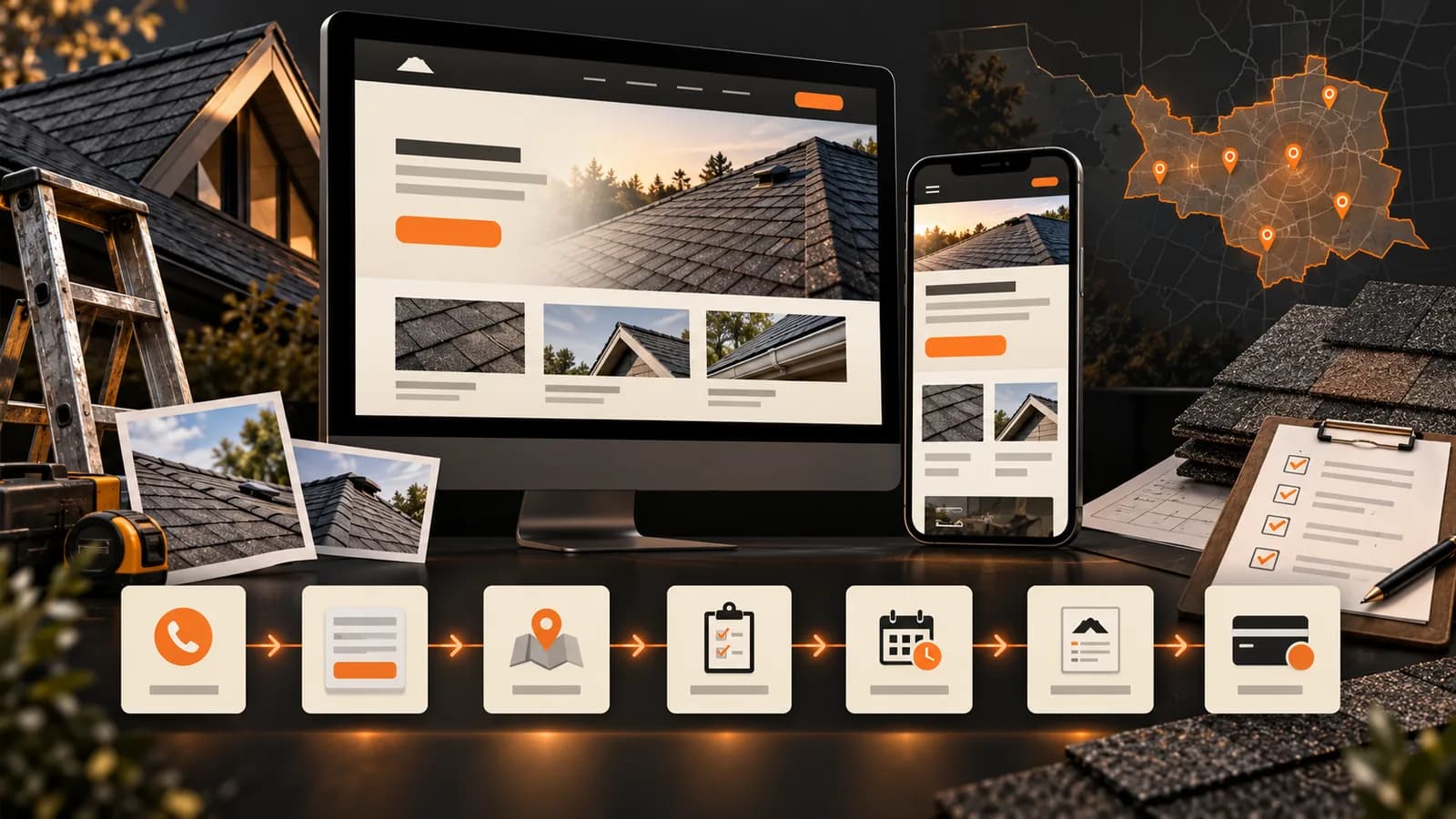
The right marketing cost for a roofing company is not the lowest cost per lead. It is the highest amount the company can responsibly invest to win a suitable, profitable job while protecting margin, cash flow, and production capacity. A cheap repair call outside the service area can be worth less than a more expensive replacement inquiry from the right homeowner, roof type, neighborhood, and timeline.
Set the target backward from an accepted contract. Start with the expected contribution from the roofing work you want to sell. Decide what portion can support customer acquisition. Then use your own qualification, inspection, proposal, and close rates to translate that booked-job ceiling into targets for earlier stages. This turns marketing into a capacity and profitability decision, not a contest to collect the most forms.
Why roofing cost per lead hides the real decision
Roofing demand contains several businesses inside one category. Emergency leak repair, retail replacement, insurance restoration, commercial roofing, coating, inspection, gutter work, employment, and do-it-yourself research can all enter the same reporting view. If every phone call and form is labeled a lead, a campaign can look efficient while filling the office with work the company does not want or cannot serve.
Quality varies within replacement demand too. A prospect may be outside the travel radius, need a roofing system the company does not install, lack decision authority, or expect a schedule the crews cannot meet. Another prospect may fit the scope but still need financing or an insurance decision before an inspection becomes commercially useful. Reporting should preserve these differences instead of compressing them into one average lead price.
- Raw inquiry: a unique call or form before anyone confirms fit
- Qualified opportunity: a property owner and project that meet service area, roof type, scope, timing, and commercial requirements
- Inspection completed: a qualified prospect who completes the next meaningful sales step
- Proposal issued: an inspected opportunity that receives a defined offer
- Booked job: an accepted, signed contract the company is prepared to schedule and fulfill
Separate steady replacement demand from storm response before judging paid lead cost.
Review the roofing Google Ads playbookSeparate roofing job types before setting a target
Build a separate acquisition model for each work category that has meaningfully different economics or sales behavior. Retail replacement, insurance restoration, repair, and commercial work should not share one target by default. They differ in contract value, direct costs, inspection effort, sales cycle, documentation, collection risk, and crew requirements. A blended average can make an expensive but valuable replacement channel look weak, or let low-value repair volume hide poor replacement performance.
Begin with recent jobs that match the campaign you plan to run. Estimate expected contract revenue, then subtract the direct costs your accounting system assigns to delivery. Those may include field labor, materials, disposal, permits, subcontractors, equipment, sales commissions, and job-specific supplements. Confirm classifications with your accountant. The remaining contribution still has to support overhead, warranty obligations, risk, and target profit, so only a deliberate portion should fund acquisition.

- Choose the roofing job type, property profile, roof system, and real service area the campaign will promote.
- Estimate contract revenue and direct delivery costs from recent comparable jobs.
- Protect the contribution required for overhead, risk, warranty work, and target profit.
- Choose the maximum acquisition allowance for one accepted contract.
- Adjust the allowance for backlog, sales availability, crew capacity, season, and cash timing.
- Translate the booked-job allowance into earlier-stage targets using observed sales rates.
Translate the booked-job ceiling through the pipeline
Once management sets the maximum acquisition cost for one accepted job, work backward using company data. If multiple qualified opportunities are normally needed to win one contract, each opportunity carries only a corresponding share of the booked-job allowance. If only part of the raw inquiry pool becomes qualified, the raw lead target must be lower again. The exact result belongs to your company because service mix, geography, reputation, sales process, and estimator capacity all change the rates.
Use consistent stages and enough time for normal decisions to mature. Keep organic search, paid search, Local Services Ads, referrals, canvassing, and repeat customers separate where the data allows. Record why opportunities are disqualified instead of deleting them. Otherwise the qualification rate improves on paper while marketing loses the evidence needed to stop unwanted searches, tighten geography, or clarify the landing page.
Use one reconciled roofing cohort. Count accepted, signed contracts ready to schedule and fulfill as won customers; keep booked appointments and verified paid customers separate.
Calculate cost by roofing sales stageCount the full acquisition cost
Ad spend is only one part of acquisition. Include campaign management, website and landing-page work, content, photography, call tracking, CRM tools, listing management, and the internal labor required to answer, qualify, inspect, estimate, and follow up. Sales time is especially important in roofing. A source that produces many unqualified inspections can consume estimator capacity even if its media cost looks attractive.
- Advertising spend only
- Every call and form counted equally
- Repairs and replacements blended together
- No value assigned to inspection or estimating time
- Reporting stops at the first contact
- Media, management, creative, tools, and sales effort
- Qualified opportunities tracked separately
- Job type, roof system, and service area retained
- Disqualification reasons recorded consistently
- Accepted contracts tied to the original source
See what belongs in the managed marketing portion of your total acquisition cost.
Compare transparent monthly packagesTrack qualified and converted roofing leads
Google Ads Help currently distinguishes qualified leads from converted leads. Google describes qualified leads as prospects that have been further qualified after the initial Google-generated inquiry. Converted leads represent a later business-defined outcome, such as a closed sale. That structure fits roofing better than treating the first ring or form submission as the final conversion, particularly when inspections, insurance steps, proposals, and follow-up sit between inquiry and contract.
Google also documents enhanced conversions for leads for advertisers that track sales or other outcomes that happen away from the website. The system uses hashed first-party lead information to improve matching between later outcomes and earlier ad interactions. Any implementation must follow Google's customer-data policies, applicable consent requirements, and the roofing company's privacy commitments. Hashing does not create permission to upload data the company was not authorized to use.
- Preserve the original channel, campaign, landing page, call, and form source for each unique prospect.
- Record service area, property type, roofing need, roof system, urgency, and sales status.
- Use consistent definitions for qualified opportunity, completed inspection, proposal, and accepted contract.
- Tie repeat calls and forms to one opportunity instead of inflating inquiry volume.
- Send only approved, policy-compliant outcomes to advertising platforms.
- Reconcile accepted contracts with CRM, production, and accounting records.
Deduplicate calls and forms, keep proposal and sold value separate, and calculate from collected service revenue under one documented method.
Build the roofing cohort before calculating costMatch spend to inspections, crews, and weather
A financially acceptable cost per booked job can still create an operational problem. Roofing companies have finite capacity for phone response, inspections, estimating, material coordination, permitting, production supervision, and warranty service. Before increasing spend, decide how many additional inspections and starts the team can support, which job profiles fit the schedule, and where crews can travel without eroding contribution.
Weather makes the capacity check more important. A storm can create a sudden wave of calls while active jobs still need supervision and existing customers still need communication. Hold separate budgets and operating plans for steady replacement demand and storm response. Increase demand only when the office can answer it, estimators can inspect it, and production can set honest expectations. Marketing that overwhelms response capacity can damage reviews and close rate even while lead volume rises.
Use service-area relevance, reviews, and local proof to support demand beyond paid clicks.
Build the organic roofing foundationReview roofing acquisition by cohort
Review performance on a schedule that fits roofing sales cycles, but do not force an opportunity into the reporting period when spend occurred. Group inquiries by entry cohort, then update inspection, proposal, contract, completion, and contribution outcomes as they mature. Separate storm cohorts from normal replacement demand and give longer commercial opportunities appropriate observation time.
- Total acquisition cost by channel and promoted roofing job type
- Unique inquiries, qualification rate, and documented rejection reasons
- Inspections completed, proposals issued, and contracts accepted
- Expected and realized contribution from the jobs won
- Time from first inquiry to each meaningful sales stage
- Estimator, office, supplier, and crew capacity
- Service areas and roof types producing the strongest operational fit
The final standard is not cheap roofing leads. It is a measured mix of suitable contracts at an acquisition cost the company selected from its own economics. Define the accepted job, protect contribution, translate the allowance through observed sales rates, connect later outcomes to the original source, and keep spend aligned with capacity. That gives the owner a marketing budget tied to company records instead of an industry average that may not fit.
Use the roofing marketing agency to connect those economics to channel choice, the buyer path, intake, and the full commercial journey.
Book a discovery call to connect job economics, channel strategy, landing pages, and lead-quality tracking.
Map your cost per booked roofing jobSources and further reading
- Google Search: SEO Starter Guide
Crawlable links, descriptive page information and content organization. Practical trade examples are SF Web Tech recommendations.
Source checked .
- Google Ads: offline conversion imports
Connecting supported offline outcomes with advertising measurement. Lead qualification and contribution calculations are SF Web Tech operating guidance.
Source checked .
- Google Maps: prohibited and restricted content
Rules against fake engagement, incentives and selectively soliciting positive reviews.
Source checked .
- Google Local Services Ads: getting started
Eligibility, lead handling and verification. Platform lead-billing criteria differ from a contractor’s sales qualification.
Source checked .
- Google Local Services Ads: Google Verified badge
Current badging and discontinuation of the former Google Money Back Guarantee.
Source checked .