A facility manager at a 40,000-square-foot medical building has a nightly cleaning vendor that keeps missing exam-room protocols. She opens Google at 4pm and types 'medical office cleaning' plus her city. She is not looking for a maid service. She wants a contractor who understands bloodborne pathogen handling, after-hours access, and a certificate of insurance she can hand to her compliance officer. If your janitorial company only ranks for 'cleaning services,' you never entered her search.
Here is the hard truth: most commercial cleaners copy the residential local-SEO playbook. They optimize one homepage for 'cleaning services [city],' chase 'house cleaning near me,' and wonder why the leads are one-off move-out jobs instead of recurring five-figure contracts. B2B buyers do not search the way homeowners do. They search by their own building type, and they buy on proof.
Why 'cleaning services [city]' is the wrong target
The residential playbook optimizes for volume: broad terms, a service-area radius, and a race for reviews on a single page. That works when the buyer is a homeowner who wants a quick quote. It fails for commercial work because a facility manager, a property portfolio operator, a medical office administrator, and a warehouse supervisor are four different buyers with four different requirements. Lumping them under one generic phrase means you compete with every residential maid in town and speak to none of the people who sign vendor contracts.
Commercial pages should answer facility-management questions about actual scope, scheduling, insurance and documentation. Separate a building type only when the business serves it and has distinct information to provide. Do not claim certifications or compliance capabilities the operator cannot substantiate.
Commercial and residential contracts may have different frequency, staffing and economics. Use the company’s actual contribution and retention records when choosing priorities; a commercial inquiry is not automatically more profitable than a residential job.
Facility managers search by building type, not by 'cleaning'
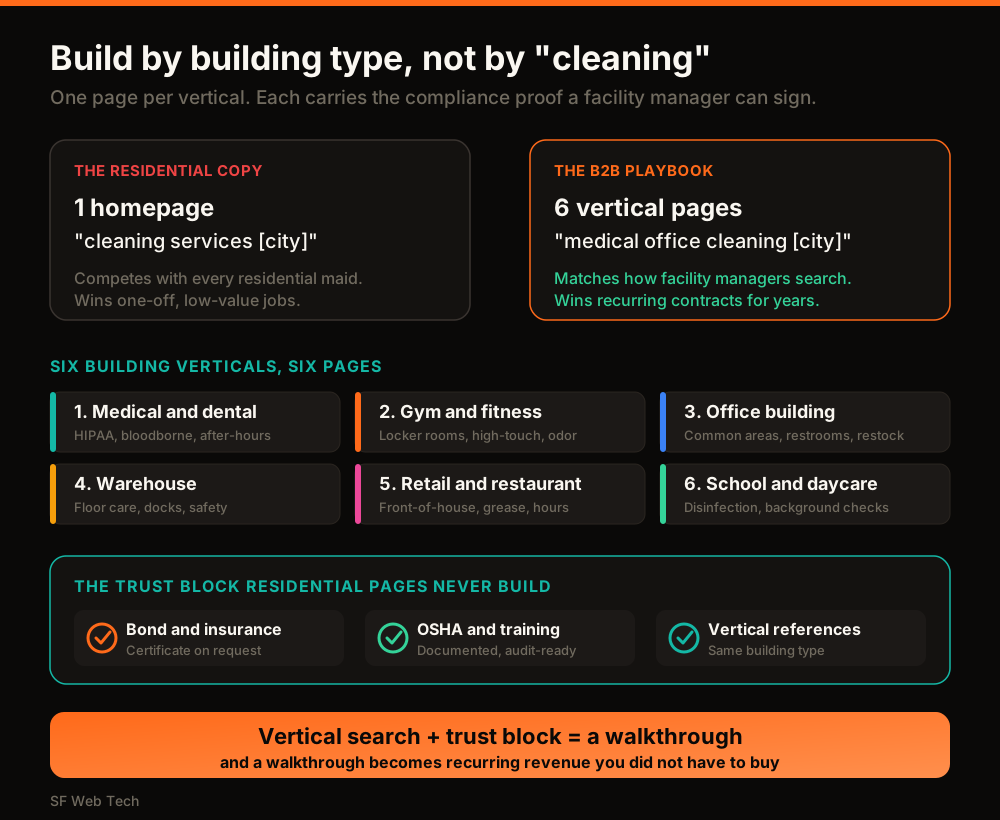
B2B buyers search inside their own vertical language. A gym operator searches 'gym janitorial.' A warehouse supervisor searches 'warehouse cleaning.' A dental practice searches 'medical office cleaning' or 'dental office cleaning.' They lead with the building, because the building defines the job: the floor type, the compliance rules, the access hours, and the insurance the property demands. Your job is to have a page that matches that exact mental model.
That is six building verticals, and each one deserves its own indexed page. Not a paragraph on a shared services page. A full page, titled for the building-type query, written for the person who runs that kind of facility. When she searches, she should land on a page that reads like it was built for her building and nobody else's.
The trust block a residential page never builds
A homeowner wants a friendly face and a fair price. A facility manager wants a vendor she can defend to her boss and her insurer. That is the real reason building-type pages win: each one carries a compliance and trust block that a residential cleaning page has no reason to build. This block is not decoration. It is the proof that lets a decision-maker move you from a search result to a signed contract.
- General liability and janitorial bond coverage, with the ability to issue a certificate of insurance on request
- Workers' compensation coverage for every crew member on site
- OSHA-aligned safety practices and, for medical work, bloodborne pathogen training
- Background-checked, uniformed, and badged staff for schools, medical, and secure facilities
- Documented cleaning protocols and checklists the client can audit
- References from the same building type the buyer operates
One page per building type, each engineered to rank and win the bid.
See how our Local SEO builds vertical pages that convertHow to build one page per vertical
Every vertical page follows the same skeleton, tuned to the building type. Do not spin thin doorway pages. Each one has to genuinely answer the buyer's questions about their kind of facility, or Google and the facility manager both dismiss it.
- Title and H1 built on the building-type query, for example 'Medical Office Cleaning in [City]'
- An opening that names the buyer's real pain: compliance risk, after-hours access, or audit-ready documentation
- The scope of work specific to that building, not a generic checklist
- The compliance and trust block: bond, insurance, OSHA, and training relevant to that vertical
- Proof: references, before-and-after context, and testimonials from the same building type
- A clear next step, a walkthrough or quote request, aimed at the decision-maker
“The vendor who shows up already speaking your building's language, and hands over a certificate of insurance without being asked, has won the meeting before the walkthrough starts.”
The same page architecture, applied to commercial cleaning verticals.
Read the service-page structure that ranks and convertsYour Google Business Profile still carries the map
Vertical pages win the organic and the specific-search game. Your Google Business Profile wins the map pack, and it feeds directly off the same strategy. When a facility manager searches 'office cleaning [city],' the top three map listings get most of the direct calls. Your profile is often the first impression you never get to explain in person.
The profile playbook that lands you in the top three map listings.
Optimize your Google Business Profile the right wayThis is a bid-based sale, so measure lifetime value
Commercial cleaning is a longer sale than residential. It usually runs through a walkthrough, a written bid, and a decision-maker who compares vendors on trust as much as price. That changes how you judge your SEO. A single vertical page that wins one recurring contract can pay for a year of marketing on its own, because the contract renews. Stop counting leads and start counting the monthly revenue each ranking page can hold.
When a walkthrough-quality lead can convert at that rate and a contract renews for years, your best move is to own the search that produces those leads for free. That is what a vertical page plus a strong profile does: it turns a high-intent building-type search into a walkthrough, and a walkthrough into recurring revenue you did not have to buy.
Your next 30 days
- List the building verticals you already service and can prove with references
- Pick your two highest-value verticals to build first, usually medical and office
- Write one full page per vertical, titled on the building-type query
- Add the compliance and trust block: bond, insurance, OSHA, and vertical-specific training
- Optimize your Google Business Profile categories, reviews, and real commercial photos
- Ask three current B2B clients for reviews that name their building type
Start with the services for which you have the clearest evidence and operating capacity. Expand when another substantial page answers a different customer question. Page count is not a ranking guarantee.
We will pick your two best building verticals and build the pages that win the contracts.
Book a call to map your vertical pagesSources and further reading
- Google Search: SEO Starter Guide
Crawlable links, descriptive page information and content organization. Practical trade examples are SF Web Tech recommendations.
Source checked .
- Google Business Profile: local ranking guidance
Google’s broad relevance, distance and prominence guidance. No exact ranking weights or guaranteed service-area coverage are stated.
Source checked .
- Google Maps: prohibited and restricted content
Rules against fake engagement, incentives and selectively soliciting positive reviews.
Source checked .